How can teacher educators (TEs) prepare teachers to teach using justice-oriented technology pedagogy? TEs who prepare teachers to use and integrate technology in their instructional practice, and the field of teacher education at large, have begun to incorporate justice-oriented lines of inquiry to interrogate technologies and their integration in K-12 schools (e.g., Heath et al., 2022; Heath & Segal, 2021; Krutka et al., 2020; Pleasants & Radloff, 2024; Tshuma & Kruass, 2017; Yadav & Lachney, 2022).
We commend these developments and are excited by the possibilities of the emergence and intersection of scholarship from the fields of science and technology studies (STS; e.g., Benjamin, 2019; Noble, 2018), and teacher education (Croom, 2018; Rodriguez et al., 2020; Schroeder & Curcio, 2022). While there is emerging work that connects justice-oriented technology theory to pedagogy for TEs to incorporate in their coursework, it has not been widely adopted by the field of teacher education overall (Heath et al., 2022; Heath et al., 2023).
Our previous work applied theory to investigate justice-oriented approaches to technology in teacher education (Heath et al., 2022); however, we have found only a few examples of work around the application of these approaches (Weisberg & Dawson, 2023). In this article, we draw on conceptual frameworks of justice-oriented technology and inquiry pedagogy to describe an exemplar for practice in teacher education using the Learning Cycle (Bybee, 2014). We close by discussing the implications of justice-oriented tech inquiry on policy, practice, and research, as well as offering resources in the appendix.
Acknowledging the Context
The answer to the question, “How can TEs teach and best prepare their own students to teach about justice-oriented technology?” is quite complex, and even more so when conceptualizing what this means in practice amidst a variety of contextual and situational challenges. Teachers, including TEs, operate within complex micro- and macrolevel systems involving policymakers, school leaders, technology companies, and the institution of schooling itself (Heath et al., 2022). Preservice and in-service teachers are likely to ask TEs about these real tensions that they face within their classrooms and schools, including what to do when their philosophies and knowledge clash with what they are required to do or not to do.
For example, teachers are often restricted to — and may be mandated to use — specific technology products purchased by their districts (Heath et al., 2022). Even if particular products are inadequate for their students or they may be impacted if their states legislate (and in some cases, do not allow) teaching of race or gender or are otherwise intent on limiting speech associated with social issues (Alfonseca, 2022; Schwartz, 2021).
It is important for TEs to acknowledge these and other on-the-ground realities of teachers while empowering them to work toward more just futures. However, teachers are not powerless (Parker, 2015), nor are TEs. It is imperative to make education more just. The development of a justice-oriented culture and practices in teacher technology education will require systemic change. We view the inquiry approach detailed in this article as one practical step toward achieving this goal.
Conceptual Foundations for Justice-Oriented Technology Inquiry
Informed by our past work on topics of justice and technology (Heath et al., 2022), we apply a pedagogical orientation (i.e., justice-oriented technology pedagogy) to inquiry to offer an entry point to teaching about technology and justice in teacher education. Following, we explore the conceptual foundations for this work. First, we explore inquiry as a pedagogy through the Learning Cycle (Bybee, 2014). Next, we detail scholarship grounding justice-oriented technology. Finally, we intersect inquiry with justice-oriented technology, providing a foundation for connecting theory to practice through justice-oriented technology pedagogy.
Inquiry Models
In a recent literature review investigating the preparation of preservice teachers about inquiry methods, Bacak and Byker (2021) identified a need for future research examining how preservice teachers are prepared to teach inquiry methods in their courses and programs. Numerous inquiry models (e.g., Suchman Inquiry Model) exist that may be used for these purposes (Kilbane & Milman, 2014). Each has different affordances and are products of the communities that developed them.
The BSCS 5E Instructional Model (Bybee et al., 2006), also referred to as the Learning Cycle (Burke, 2014; Bybee, 2014) — the term we use in this article — originated in the science education community. The Learning Cycle provides a practical framework for TEs to engage preservice and in-service teachers in dialogue to examine critically the role and use of technology in the teaching-learning process.
The Learning Cycle
An integral part of the Learning Cycle (Bybee, 2014) is that individuals engage in hands-on, minds-on experiences. Although the Learning Cycle does not have to be implemented in a linear fashion, as illustrated in Figures 1 and 2, preservice teachers tend to understand it best when introduced in a simplified way (Brand, 2020). As they gain fluency in the model, they value that in practice it is usually recursive and iterative, as Figure 3 illustrates.
Figure 1
Linear Learning Cycle Phases

Figure 2
Cyclical Learning Cycle Phases

Figure 3
Recursive Linear Learning Cycle Phases
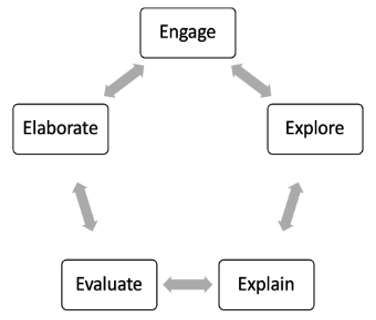
The first step is the Engage phase, or the hook to the lesson, whose purpose is to activate prior knowledge. The next step is the Explore phase, where learners engage in hands-on experiments, data collection, and analysis, which is followed by the Explain phase, where the instructor connects the activity to academic content. The Evaluate phase assesses their understanding, and the Elaborate phase calls on learners to make connections between the learning activities and their real-world contexts. We added the Extend phase for learners to determine how they might expand their learning, where applicable, by creating change- and justice-oriented action plans. Following, we model one possibility for using the Learning Cycle to inquire into justice and educational technology.
Inquiry in the Content Areas
Teacher educators have incorporated inquiry methods as a teaching approach with the goal of preparing teachers to use these methods with their own P12 students to examine, understand, and address complex issues in multiple content areas and grade levels (Prayogi et al., 2018). Inquiry methods provide teachers with a structured approach to teaching inquiry-based lessons. Yet, like so many concepts, methods, and approaches, a variety of definitions exist depending on the context and communities in which they originate. For example, inquiry teaching has long been a pillar of science education, as evidenced by the National Science Teachers Association’s (NSTA, 2004) position statement about scientific inquiry. In its statement, the authors included a definition of scientific inquiry:
The diverse ways in which scientists study the natural world and propose explanations based on the evidence derived from their work. Scientific inquiry also refers to the activities through which students develop knowledge and understanding of scientific ideas, as well as an understanding of how scientists study the natural world. (National Science Education Standards, as cited in NSTA, 2004, para. 1)
Similarly, teacher education standards for nearly every content area incorporate inquiry in some shape or form, whether it is implicitly or explicitly, as is the case with the National Council for the Social Studies’ (NCSS, 2013) C3 framework. In social studies, inquiry centers on compelling questions, inviting learners to probe into complicated historical and social issues, and facilitating active and engaged citizenship through informed, planned actions for democracy (NCSS, 2013, 2016).
Justice-Oriented Technology
A number of scholars across fields, including sociology, African American studies, computer science education, and STS (science and technology studies), have engaged in an interrogation of the injustices of technology on already marginalized groups in society. For instance, Benjamin (2019; 2022) identified the encoded racism in technological code. She illuminated the ways that technology reinforces and recodes systemic oppression in technologies.
Noble (2018) highlighted the perils to Black girls and women when searching algorithms that intersect with racism and technology companies to prioritize profits over humans. She researched the tendency of Google to disproportionately return sexualized images of Black girls by its ostensibly neutral search algorithm.
O’Neil (2017) has similarly exposed the nonneutrality of mathematical algorithms, which she has termed “weapons of math destruction” (p. 3), that prey on the economically and emotionally vulnerable, the racially and linguistically marginalized, and other disenfranchised populations. Buolamwini (2023) extensively researched the human and machine-coded racism in the artificial intelligence of facial recognition software, pointing out the ways that darker-skinned faces are both invisible and hypervisible to surveillance software.
Research in education technology has recently emerged that similarly considers the impacts of bias and oppression in technologies used in schools and educational settings. For instance, Atenas et al. (2022) have explored and critiqued implications of technology in schools through a feminist lens. Zembylas (2023) took a decolonial approach to technology in education, and others have explored critical and justice-oriented approaches to new imaginaries of education technology (e.g., Heath et al., 2022; Holbert et al., 2020; Macgilchrist, 2021).
Tanksley (2024) identified compelling ways that Black students can remake and reimagine algorithms to recode technologies for more just and joyful schooling experiences. However, despite emergent inroads into justice-oriented technology, the field as a whole tends to prioritize techno-solutionism (Morozov, 2013) and techno-optimism (Heath et al., 2022; Heath et al., 2023; Selwyn, 2011; Watters, 2015). Techno-solutionism refers to the notion that complex social or educational problems can be solved by technology. Confronting techno-solutionism critiques the narrative that technology can save humans from climate change, school shootings, education gaps, or any other multifaceted and nuanced problem. These narratives are often developed and propagated by the very technology companies that will most financially benefit from implementing tech-centered solutions to humans’ collective and complex problems.
Techno-optimism is another powerful narrative in technology circles, namely that technology is an unencumbered good that will change the world for the better. In an example of techno-optimism, education technology scholars speak to the necessity of innovation, the techniques school leaders should employ to encourage technological adoption or the possibilities of any new technology without critical and nuanced reflection on whether and why technology will de facto lead to a better future. This preference is especially clear upon examination of the standards, publications, and priorities for funding from education technology organizations, like the International Society for Technology in Education (ISTE), the U.S. Department of Education, the Society for Information Technology and Teacher Education (SITE), and the American Educational Research Association (AERA).
Justice-oriented technology integration centers on liberation and equity for all students and offers a counter to the pervasive techno-solutionism and techno-optimism in education technology. In earlier work, we synthesized and explored justice-oriented tech and suggested that it should “lead to full liberation and the promise of a multiracial democracy for all learners” through “a critical interrogation of the technologies themselves, while also scrutinizing their history, context, and intersections with systems of oppression, to ensure that institutions do not compromise the flourishing of people” (Heath et al., 2022, p. 765). This framing prioritizes inquiry, as well as taking informed action.
Justice-Oriented Technology Inquiry
Conceptually, justice-oriented technology pedagogy overlays critical pedagogy (Freire, 2021; Ladson-Billings & Tate, 1995; Paris, 2012) with technoskeptical approaches (Heath et al., 2022). Figure 4 illustrates the ideas underlying our conceptualization of justice-oriented technology inquiry. This approach advocates for teacher education to develop educators that will mutually engage in understanding the field’s tensions, possibilities, and potential implications.
Figure 4
Elements of Justice-Oriented Pedagogy

Justice-oriented technology inquiry incorporates a critical pedagogy lens to further social justice for all by asking questions, reflecting, and collectively discussing ways to approach issues to build a better world. Across the dimensions of the conceptual framework, there is a sense of imagination and urgency to prompt productive conversations with the objectives to support educators’ development of justice-oriented tech dispositions and practices and build a culture and experience that can positively impact our collective present and future. Educators as change agents strive to delve deeply into relevant content while also avoiding what Muhammad (2020) calls “band-aid equity,” which means not fully addressing systemic issues of inequity.
Our field needs a transformation that aims to explicitly and meaningfully incorporate social justice in a democratic society (Ortiz et al., 2018). Justice-oriented technology pedagogy operationalizes preparing educators to use a critical lens to engage in necessary questioning to support advocacy for marginalized and minority communities that have been overlooked. By considering questions to scaffold tough conversations and discussing pertinent issues encompassing equity, teacher educators are allowing for coreflection with teacher candidates and the discussion of avenues to combat inequalities. With this conceptual framework of justice-oriented technology pedagogy in mind, we offer an example lesson utilizing justice-oriented technology inquiry with preservice teachers enrolled in an initial licensure program.
Justice-Oriented Technology Inquiry in Practice Using the Learning Cycle
The Learning Cycle promotes discussion and critical thinking, which can also cultivate a conceptual understanding of justice-oriented technology pedagogy. When a TE authentically assesses and investigates technology with their teacher candidates (TCs), they allocate a safe space for dialog that contributes to the TC’s feelings of empowerment. A benefit of this model is that its curricular and pedagogical decisions help current and future teachers recognize that they are not powerless within their own classrooms. There is a definite difference between speaking about barriers and taking action toward addressing challenges. The use of pedagogies of inquiry and justice allows educators to act in the spaces where they have influence and hold power.
As faculty members, we hold power and privilege in the spaces of teacher education and research. We have turned to these spaces, informed by first author Asim’s background in science education, to propose a justice-oriented inquiry process that interrogates the inherent power, privilege, and prejudice of educational technology. Inquiry approaches can counter the postindustrial, behaviorist paradigm of instruction through specific steps that cultivate mindful incorporation of new perspectives about content. This serves to strengthen and illuminate the power and privilege dynamics that run throughout social systems (Mirra et al., 2015). Moreover, critical inquiry provides means for challenging existing hegemony from a variety of perspectives. Ultimately, TCs should connect their new knowledge to change — actions they may take in the world. Inquiry also engages TCs in a process that not only invites them to think deeply about what they are learning but also to be critical consumers who rigorously analyze the implications of what they are learning.
In this section, we provide a practical example for TEs to incorporate justice-oriented technology inquiry in practice using the Learning Cycle. In this example, TEs and TCs engage in powerful conversations about their existing beliefs surrounding technology, education, and the subsequent interactions with justice and democracy. The aim of the activity is to develop a critical and informed understanding through appreciation of diverse views rooted in informed action.
A Justice-Oriented Technology Inquiry Learning Cycle Lesson
Engage
During a technology integration course in their senior year, an initial licensure program for elementary education majors, we ask TCs to engage with their underlying conceptions of technology in education. This activity is designed to understand the imbalance of power and work toward a just world. This activity was designed to take place a few weeks into the semester, after TCs have had some time in clinical placements in partnering schools. This lesson was designed to take place in an onsite classroom but can be replicated online or via blended/hybrid means. One possible technique is to invite TCs to sketch representations of a current P-12 classroom. Probing questions help identify TCs’ conceptions. After sharing the conceptions, the TE should give TCs four sticky notes to transition to the Explore stage.
Explore
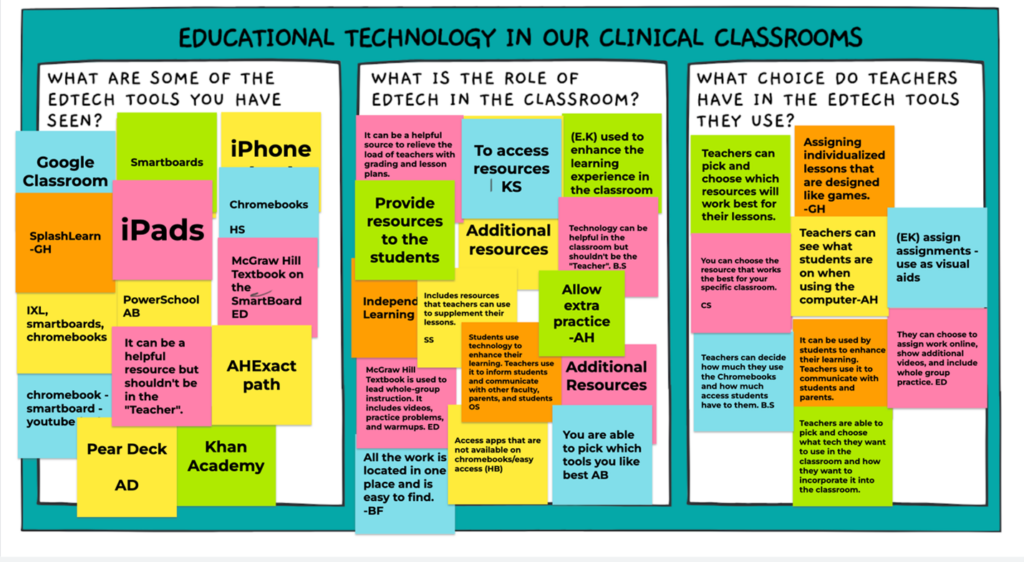
The TE asks TCs to identify and record the roles educational technology plays in education. Once the TCs have identified some of the roles, they work in teams to categorize the sticky notes. Using an anchor chart on chart paper or on a collaborative digital whiteboard, the team of TCs arrange and label the small sticky notes in larger categories. Once the large team-developed categories are labeled, the TE invites the teams to rotate from chart to chart in a gallery walk, make notes of the similarities and differences, and document them on a Venn diagram activity sheet. After completing the gallery walk, the TE may ask teams to review and change their categories. This activity can also be done on a collaborative digital whiteboard to gather the thoughts of all students (see Figure 5).
Figure 5
Responses During Explore
Explain
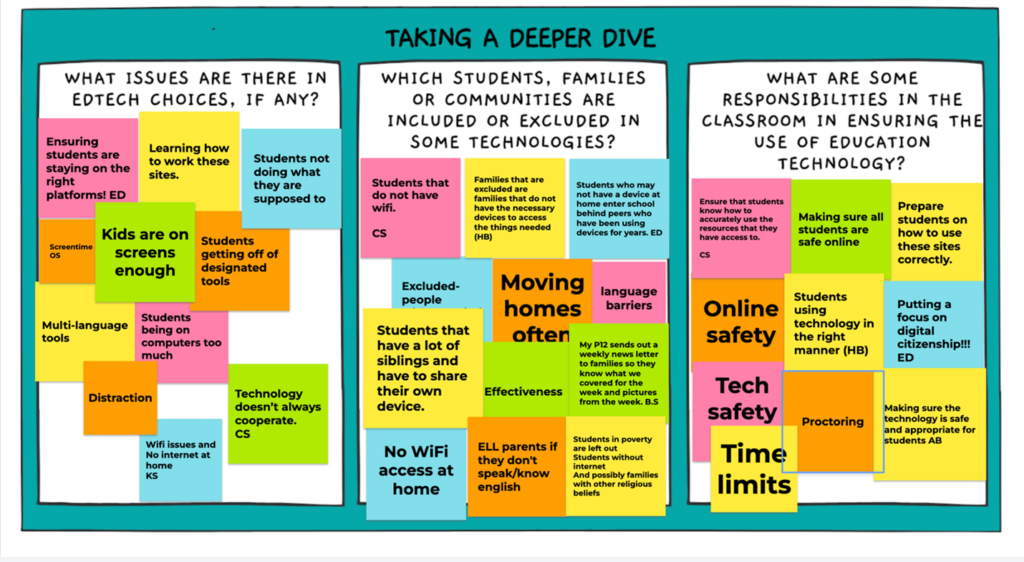
Social interactions in classrooms allow for active participation and knowledge construction (Vygotsky & Cole, 1978). The TE-TC conversation allows productive forms of dialog that can help foreground reasoning and initiate an exploration of new ideas (Iraola et al., 2024; Watkins et al., 2020). Once the gallery walk has been completed in the Explore phase, the TE could pose the following questions to foster discussion:
- What are the specific edtech tools used in the classroom that you drew?
- What major categories did you identify regarding the role edtech plays in teaching and learning in general and for teaching specific content areas?
- What are the choices that teachers have control over and which edtech tools are chosen at the school district level?
- What issues are there in particular edtech tool choices?
- Which students, families, and communities are included and excluded through these technologies?
- What are the responsibilities as teachers in the classroom in ensuring just use of technology?
- Why haven’t we, as a society, found momentum to address justice and technology? These questions will surround the pedagogical action and use of education technology (Asim et al., 2020).
Figure 6
Sample Responses from Teacher Candidates During the Explain
Evaluate
Future educators can play critical roles as change agents by partaking in a variety of dialogs that dig deep into examining technology with critical lenses. Many of these questions and conversations are currently not part of the teacher preparation coursework; this activity allows educators to engage with real challenges and barriers they are likely to encounter in their classrooms. Since the goal of this activity is to foster deep inquiry through discussion and critical analysis, the following guiding questions should deepen the scope and lens of TCs:
- What do we know/not know about justice and technology?
- How can we, ourselves, integrate technology in a just way?
- How can we make ourselves aware of unknowingly integrating technology in ways that are unjust?
- What are just technologies? How do we individually and collectively define them?
- What checks and balances are necessary to ensure just technology use by teachers and students?
- How do we teach our students to think about technology writ large in society and, more specifically, its impact on them individually?
Elaborate
Because of the complexity of the topic, it is important for TEs to slowly introduce and frame the questions for TCs to ensure there is sufficient time for discussion (Table 1).
Table 1
Question Prompts for the Different Inquiry Phases
| Learning Cycle | Teacher Educator Prompts |
|---|---|
| Engage | Ask TC to create a sketch of P12 classrooms, “What edtech tools have you seen?” |
| Explore | Ask TC respond to the question, “What is role of technology in classrooms”? by creating a list |
| Explain | Probing questions: What are the specific edtech tools used in the classroom that you drew?; What major categories did you identify regarding the role edtech plays in teaching and learning in general and for teaching specific content areas?; What are the choices that teachers have control over and which edtech tools are chosen at the school district level?; What issues are there in particular edtech tool choices?; Which students, families, and communities are included and excluded through these technologies? What are some of your responsibilities as a teacher when using edtech? |
| Evaluate | Building on the responses by reflecting collectively on the following questions: What do we know/not know about justice and technology?; How can we, ourselves, integrate technology in a just way?; How can we make ourselves aware of unknowingly integrating technology in ways that are unjust? ; What are just technologies?; How do we individually and collectively define them?; What checks and balances are necessary to ensure just technology use by teachers and students?; How do we teach our students to think about technology writ large in society and more specifically its impact on them individually? |
Meaningful discussions between TCs to consider multiple perspectives cultivate content and pedagogical considerations that should help them better understand the pros and cons of educational technology, its politicized nature, as well as how it can be simultaneously good and bad. The support for constantly revisiting and emphasizing a closer — and deeper — look is needed to refine the decision-making process. Creating safe spaces to promote equitable participation and collective reflection where all voices and points of view are heard and respected will create a space to address challenges in schools and help empower TCs to nurture a culture of continuous learning to achieve meaningful outcomes toward reshaping existing practices in schools. During this activity, the TE can ask the TCs to do a turn-and-talk before coming back together as a group to exchange information discussed.
Extend
While the centrality of the activity is clear, the viewpoints that participants may share will require a dedicated amount of time in class to understand and dialog about the impact of educational technology. The activity is designed so everyone can contribute to stimulate dialog and learn from each other. It is important to note that this activity can serve as a scaffold as the TE helps TCs understand this multilayer topic.
For example, many big tech companies offer cheap or free services to educators; however, they may not truly understand the negative impacts of the use of that particular resource, such as giving up their intellectual property shared via the technology resource. While the offered technology may seem useful in the moment, educators may not consider how it can further divide people or be counterproductive for some individuals or communities. For example, as Nichols and Dixon-Román (2024) noted in their article about educational technology platforms in education,
On one hand, platformization holds promise for helping educational systems meet policy goals. The expansive use of platforms for administration, instruction, and learning produces a vast network of data streams that can be mined for patterns and insights to improve efficiency, efficacy, and equality in schools. The use of educational platforms might seem benign but this platform. … On the hand … they can also reproduce structural inequalities by encoding discriminatory design features (Benjamin, 2019), exploitative data processes (Dixon-Román & Parisi, 2020; Dixon-Román et al., 2020), and racializing surveillance mechanisms (Browne, 2015) into even the most quotidian uses of technology. (p. 309)
This dichotomy is difficult to reconcile but it exists and is a reason why exploring justice-oriented technology pedagogy is so important. However, the critical element of scaffolding is that over time it will diminish as the TCs take ownership of their dispositions, instructional stances, and forethought they bring into their classrooms.
Discussion
In our adaptation of the Learning Cycle, we recognize the ethical implications of knowledge and call teachers and TEs to action based on new understandings using a critical lens that leans into social justice. Catalyzing positive and just action is fundamental to fostering equality and creating a foundation of civic life, public education, and a multiracial democracy (NCSS, 2016). However, rarely do TEs who incorporate/teach about educational technology or challenge their TCs to build knowledge surrounding the drawbacks and downsides of technology (Heath et al., 2022; Tshuma & Krauss, 2017; Yadav & Lachney, 2022), much less act on the knowledge.
One of the ways to encourage justice-oriented approaches to educational technologies is to inquire into the role of technology in a democracy (Heath et al., 2022). We propose possible ways for TEs to support students to act on their new understandings and encourage them to take informed civic actions to make technology integration more just and equitable. Educators can look to where they hold power and influence for cultivating change. While these spaces overlap, we have identified categories to consider as areas for action. We suggest TEs frame taking informed action through the following three domains: personal, pedagogical, and collective. Each domain is described and some of the possibilities and examples of actions representative of the work within those domains are explored in the following section.
Personal
Identity work, consciousness-raising, and individual actions for change all fall within the personal domain. For example, TEs and TCs may choose to review their own technology use through a mindfulness activity (Damico & Krutka, 2018; Jung et al., 2021) or a technological reset. They might also engage in reflective work, considering how their identities intersect with their teaching (Pai, 2019; Picower, 2009). Some TCs might request their Amazon or Google history from these companies to see the scope of the information collected about them as they use these technologies, while others may do an audit of their technology use and decide to change providers to one that does not collect such data or to change their privacy settings to have some control.
Pedagogical
TCs also hold power and can make change in pedagogical spaces. Picower (2012) noted that educators may make significant change for justice within their classrooms through pedagogies informed by culturally responsive education (Ladson-Billings, 1995; Yosso, 2005), antiracist education (Diem & Welton, 2020), abolitionist teaching (Love, 2019), the cultural wealth model (Yosso, 2005), and queer, bilingual, and disability education. Inquiry-based pedagogical strategies are an excellent start to incorporating justice work and might include creative storying to imagine better and worse futures (Krutka et al., 2022).
These strategies might also include a techno-ethical audit (Gleason & Heath, 2021; Krutka et al., 2019), which guides educators through a line of questioning to determine to what degree it is ethical and just to use an educational technology of a technology like Class Dojo, which can uphold norms of whiteness (Manolev et al., 2019). For more lesson plans and examples of technoskeptical and techno-ethical audits, TEs and TCs may consider reviewing resources like the Civics of Technology Project (https://www.civicsoftechnology.org/curriculum), which includes a curriculum for teaching with and about technology in society.
Collective
Personal and pedagogical change is important; however, dismantling systems of oppression requires institutional change, which often only occurs through collective action (Chong, 2014). Teacher preparation programs can work with TCs to encourage them to engage with existing collective spaces that center on technology and justice. An example worth exploring with TCs is union or educational association membership, some of which aim to work toward justice for students.
For example, the BMORE caucus in the Baltimore City schools exemplifies the ways that teachers can push unions to collectively bargain for social justice (Shiller & BMore Caucus, 2019). Other collectives center on technology and justice or technology and democracy. For instance, teachers might wish to join a working group through the Center for Democracy and Technology (https://cdt.org/working-groups/) or a local group like the Detroit Community Technology Project (https://detroitcommunitytech.org/) to support technologies and technology practices that foster justice.
Further, TEs can engage teachers in discussions about the role of social media in social action. For instance, they might pursue questions of whether social media can affect social change (Krutka & Heath, 2019; Schroeder et al., 2020; Tufekci, 2017) and then search for opportunities to connect with others to engage in actions. Finally, after engaging in personal, pedagogical, and collective actions, TEs can engage TCs in reflective practice to consider the impacts and labor involved in acts toward justice.
Conclusion
This article is meant to empower our field of teacher technology education to model meaningful, justice-oriented, and inquiry-based decisions about technology in education for our current teacher candidates, as well as current P12 teachers. P12 educators need to understand the impact and implications of the education technology tools they champion. Participatory culture shifts the focus from individual expression to one of collective involvement and response. Rather than dealing with the issue in isolation, educators can take a sustainable approach to solving the problem at hand.
Teaching to question and examine oppressive structures in the context of teacher preparation can help identify imperative shifts that need to be made, as well as raise awareness that oppressive structures exist and are not only related to educational technology. It also fosters inquiry-based practice, essential to all content areas, the development of critical thinking skills, and the much-needed skills involving listening and learning from other perspectives. When focused on the dialog of learning, representing perceived challenges and opportunities can center the urgency of dealing with the discontinuities that arise when confronting the immediate effects of interaction with certain edtech tools. Teaching with the Learning Cycle allows educators to move across boundaries and to recognize that mechanisms, structures, and patterns of engagement can help combat disparities, especially when so many are unaware that they exist right before their own eyes and under their fingertips.
This approach is a start, not the answer — an answer to the struggle to integrate change for justice in teacher and technology education. We hope that the threads from this new pattern we are starting to weave will be used by others — rewoven and extended into a greater tapestry of justice work focused on justice-oriented technology pedagogy.
Teacher education is the cornerstone of collective action, and educators can learn from one another through dialog and mentoring. The application of justice-oriented lenses into our curricula is a path toward increasing educational equity to gain a more comprehensive perspective. These issues go beyond hardware, internet access, and good instructional practice. Justice-oriented technology pedagogy is an entry point to apply a strategy that can be modified to different contexts and content areas.
References
Alfonseca, K. (2022, March 24). Map: Where anti-critical race theory efforts have reached. https://abcnews.go.com/Politics/map-anti-critical-race-theory-efforts-reached/story?id=83619715
Asim, S., Heath, M. K., Krutka, D. G., Lee, J., Milman, N. B., & Henderson, J. (2020, October 27). How can we advance just technology integration? In D. Schmidt-Crawford (Ed.), Proceedings of the Society for Information Technology and Teacher Education Interactive Online 2020 Conference. Association for the Advancement of Computing in Education. https://www.learntechlib.org/noaccess/219155/
Atenas, J., Beetham, H., Bell, F., Cronin, C., Vu Henry, J., & Walji, S. (2022). Feminisms, technologies and learning: Continuities and contestations. Learning, Media and Technology, 47(1), 1-10. https://doi.org/10.1080/17439884.2022.2041830
Bacak, J., & Byker, E. (2021). Moving from levels of inquiry to the flexible phases of inquiry theory: A literature review of inquiry-based teacher education. Journal of Teacher Education and Educators, 10(2), 255-271. https://dergipark.org.tr/en/pub/jtee/issue/64710/877719
Benjamin, R. (2019). Race after technology: Abolitionist tools for the new Jim Code. Polity.
Benjamin, R. (2022). Viral justice: How we grow the world we want. Princeton University Press.
Brand, B.R. (2020). Integrating science and engineering practices: Outcomes from a collaborative professional development. International Journal of STEM Education, 7(1). https://doi.org/10.1186/s40594-020-00210-x
Buolamwini, J. (2023). Unmasking AI: My mission to protect what is human in a world of machines. Random House.
Burke, B. (2014). The ITEEA 6E learning byDeSIGN(TM) model: Maximizing informed design and inquiry in the integrative STEM classrooms. Technology and Engineering Teacher, 73(6), 14-19.
Bybee, R. W. (2014). The BSCS 5E instructional model: Personal reflections and contemporary implications. Science and Children, 51(8), 10-13.
Bybee, R. W., Taylor, J. A., Gardner, A., Van Scotter, P., Powell, J. C., Westbrook, A., & Lanes, N. (2006). The BSCS SE instructional model: Origins and effectiveness. Office of Science Education National Institutes of Health. https://media.bscs.org/bscsmw/5es/bscs_5e_full_report.pdf
Chong, D. (2014). Collective action and the civil rights movement. University of Chicago Press.
Croom, M. (2018). Meet me at the corner: The intersection of literacy instruction and race for urban education. Urban Education, 55(2), 267-298. https://doi.org/10.1177/0042085918805807
Damico, N., & Krutka, D. G. (2018). Social media diaries and fasts: Educating for digital mindfulness with pre-service teachers. Teaching and Teacher Education, 73, 109-119. https://doi.org/10.1016/j.tate.2018.03.009
Diem, S., & Welton, A.D. (2020). Anti-racist educational leadership and policy: Addressing racism in public education (1st ed.). Routledge. https://doi.org/10.4324/9780429487224
Freire, P. (2021). Education for critical consciousness. Bloomsbury Publishing.
Gleason, B., & Heath, M. K. (2021). Injustice embedded in Google Classroom and Google Meet: A techno-ethical audit of remote educational technologies. Italian Journal of Educational Technology, 29(2), 26-41.
Heath, M., Asim, S., Milman, N., & Henderson, J. (2022). Confronting tools of the oppressor: Framing just technology integration in educational technology and teacher education. Contemporary Issues in Technology and Teacher Education, 22(4), 754-777. https://citejournal.org/volume-22/issue-4-22/current-practice/confronting-tools-of-the-oppressor-framing-just-technology-integration-in-educational-technology-and-teacher-education
Heath, M. K., Gleason, B., Mehta, R., & Hall, T. (2023). More than knowing: Toward collective, critical, and ecological approaches in educational technology research. Educational Technology Research and Development. https://doi.org/10.1007/s11423-023-10242-z
Heath, M. K., & Segal, P. (2021). What pre-service teacher technology integration conceals and reveals: “Colorblind” technology in schools. Computers & Education, 170, 1-9.
Holbert, N., Dando, M., & Correa, I. (2020). Afrofuturism as critical constructionist design: Building futures from the past and present. Learning, Media and Technology, 45(4), 328–344. https://doi.org/10.1080/17439884.2020.1754237
Iraola, E.A., Romero, G.R. & Milera, M.J. (2024). Dialogue among educators: Rethinking and recreating scenarios of cooperative and inclusive learning. International Journal of Educational Research Open, 6. https://doi.org/10.1016/j.ijedro.2024.100322
Jung, I., Omori, S., Dawson, W., Yamaguchi, T., & Lee, S. (2021). Faculty as reflective practitioners in emergency online: An autoethnography. International Journal of Educational Technology in Higher Education, 18(3). https://doi.org/10.1186/s41239-021-00261-2
Kilbane, C. R., & Milman, N. B. (2014). Teaching models: Designing instruction for 21st century learners. Pearson.
Krutka, D. G., Caines, A., Heath, M. K., & Staudt Willet, K. B. (2022). Black Mirror pedagogy: Dystopian stories for technoskeptical imaginations. The Journal of Interactive Technology and Pedagogy, 11(1). https://cuny.manifoldapp.org/read/black-mirror-pedagogy-dystopian-stories-for-technoskeptical-imaginations-5df256c8-ca16-45e1-9d1a-e68593443990/section/962a7c17-50d0-4e7a-aafe-483d077ed4bb
Krutka, D. G., & Heath, M. K. (2019). Has social media made it easier to effect social change?: Inquiring into tactics for change through primary sources. Social Education, 83(5), 269-274.
Krutka, D. G., Heath, M. K., & Willet, K. B. S. (2019). Foregrounding technoethics: Toward critical perspectives in technology and teacher education. Journal of Technology and Teacher Education, 27(4), 555-574.
Krutka, D. G., Seitz, R. Z., & Hadi, A. M. (2020). How do we oppose racist Zoombombs?: A discriminatory design technology audit. In R. E. Fredig, E. Baumgarter, R. Hartshorne, R. Kapalan-Rakowski, & C. Mouza (Eds.), Teaching, technology, and teacher education during the COVID-19 pandemic: Stories from the field (pp. 753-759). Association for the Advancement of Computing Education. https://www.learntechlib.org/p/216903/
Ladson-Billings, G. (1995). But that’s just good teaching! The case for culturally relevant pedagogy. Theory Into Practice, 34(3), 159–165. http://www.jstor.org/stable/1476635
Ladson-Billings, G., & Tate, W. (1995). Toward a critical race theory of education. Teacher College Record, 97(1), 47-68. http:///www.tcrecord.org/content.asp?contentid=1410
Love, B. L. (2019). We want to do more than survive: Abolitionist teaching and the pursuit of educational freedom. Beacon Press.
Macgilchrist, F. (2021). What is ‘critical’ in critical studies of edtech? Three responses. Learning, Media and Technology, 46(3), 243–249.https://doi.org/10.1080/17439884.2021.1958843
Manolev, J., Sullivan, A., & Slee, R. (2019). The datafication of discipline: ClassDojo, surveillance and a performative classroom culture. Learning, Media and Technology, 44(1), 36-51. https://doi.org/10.1080/17439884.2018.1558237
Mirra, N., Filipiak, D., & Garcia, A. (2015). Revolutionizing inquiry in urban English classrooms: Pursuing voice and justice through youth participatory action research. The English Journal, 105(2), 49–57. http://www.jstor.org/stable/26359355
Morozov, E. (2013). To save everything, click here: The folly of technological solutionism. PublicAffairs.
Muhammad, G. (2020). Cultivating genius: An equity framework for culturally and historically responsive literacy. Scholastic Inc.
National Council for the Social Studies. (2013). The college, career, and civic life (C3) framework for social studies state standards: Guidance for enhancing the rigor of K-12 civics, economics, geography, and history. https://www.socialstudies.org/sites/default/files/media/2017/Nov/ncss_teacher_standards_2017-rev9-6-17.pdf
National Council for the Social Studies. (2016). A vision of powerful teaching and learning in the social studies: Building social understanding and civic efficacy. http://www.socialstudies.org
National Science Teachers Association. (2004). NSTA position statement: Scientific inquiry. https://static.nsta.org/pdfs/PositionStatement_ScientificInquiry.pdf
Nichols, T. P., & Dixon-Román, E. (2024). Platform governance and education policy: Power and politics in emerging edtech ecologies. Educational Evaluation and Policy Analysis, 46(2), 309-328. https://doi.org/10.3102/01623737231202469
Noble, S. U. (2018). Algorithms of oppression: How search engines reinforce racism. New York University Press.
O’Neil, C. (2017). Weapons of math destruction: How big data increases inequality and threatens democracy. Crown.
Ortiz, A.P., Tarasawa, B., Al-Musaifry, N., Trimble, A., & Straton, J. (2018). Positionality in teaching: Implications for advancing social justice. The Journal of General Education, 67(1-2), 109-121. https://doi.org/10.5325/jgeneeduc.67.1-2.0109
Pai, M. (2019). Identity work and social justice. Heinemman PD Journal, 72-75. https://www.heinemann.com/pd/journal/2019/pdcj_article_pai_identity_work.pdf
Parker, G. (2015). Teachers’ autonomy. Research in Education, 93(1), 19-33. https://doi.org/10.7227/RIE.0008
Paris, D. (2012). Culturally sustaining pedagogy: A needed change in stance, terminology, and practice. Educational Researcher, 41(3), 93-97. https://doi.org/10.3102/0013189X12441244
Picower, B. (2009). The unexamined whiteness of teaching: How white teachers maintain and enact dominant racial ideologies. Race Ethnicity and Education, 12(2), 197-215. https://doi.org/10.1080/13613320902995475
Picower, B. (2012). Using their words: Six elements of social justice curriculum design for the elementary classroom. International Journal of Multicultural Education, 14(1), 1-16. https://doi.org/10.18251/ijme.v14i1.484
Pleasants, J., & Radloff, J. (2024). Promoting a critical perspective on educational technology in a pre-service teacher education course. Journal of Technology and Teacher Education, 32(2), 187-215.
Prayogi, S., Yuanita, L., WASIS. (2018). Critical inquiry based learning: A model of learning to promote critical thinking among prospective teachers of physics. Journal of Turkish Science Education, 15(1), 43-56.
Rodriguez, N., Brown, M., & Vickery, A. (2020). Pinning for profit? Examining elementary preservice teachers’ critical analysis of online social studies resources about Black history. Contemporary Issues in Technology and Teacher Education, 20(3). https://citejournal.org/volume-20/issue-3-20/social-studies/pinning-for-profit-examining-elementary-preservice-teachers-critical-analysis-of-online-social-studies-resources-about-black-history
Schroeder, S., & Curcio, R. (2022). Critiquing, curating, and adapting: Cultivating 21st-century critical curriculum literacy with teacher candidates. Journal of Teacher Education, 73(2), 129-144. https://doi.org/10.1177/00224871221075279
Schroeder, S., Currin, E., Washington, E., Curcio, R., & Lundgren, L. (2020). “Like, share, comment,” and learn: Transformative learning in online anti-Trump resistance communities. Adult Education Quarterly, 70(2), 119-139. https://doi.org/10.1177/0741713619884270
Schwartz, S. (2021, May 17). Four states have placed legal limits on how teachers can discuss race. More may follow. EducationWeek. https://www.edweek.org/policy-politics/four-states-have-placed-legal-limits-on-how-teachers-can-discuss-race-more-may-follow/2021/05
Selwyn, N. (2011). In praise of pessimism-the need for negativity in educational technology. British Journal of Educational Technology, 42(5), 713-718. https://doi.org/10.1111/j.1467-8535.2011.01215.x
Shiller, J., & BMore Caucus. (2019). Winning in Baltimore: The story of how BMORE put racial equity at the center of teacher union organizing. Berkeley Review of Education, 9(1). http://files.eric.ed.gov/fulltext/EJ1243256.pdf
Tanksley, T. C. (2024). “We’re changing the system with this one”: Black students using critical race algorithmic literacies to subvert and survive AI-mediated racism in school. English Teaching: Practice & Critique, 23(1), 36-56. https://doi.org/10.1108/ETPC-08-2023-0102
Tshuma, N., & Krauss, K. (2017, July). Towards using critical reflection to interrogate the oppressive effects of educational technology use in South African higher education [Paper presentation]. African Conference on Information Systems & Technology (ACIST) Conference 2017, Cape Town, South Africa.
Tufekci, Z. (2017). Twitter and tear gas. Yale University Press.
Vygotsky, L. S., & Cole, M. (1978). Mind in society: Development of higher psychological processes. Harvard University Press.
Watkins, J., Jaber, L.Z., & Dini, V. (2020). Facilitating scientific engagement online: Responsive teaching in a science professional development program, Journal of Science Teacher Education, 31(5), 515-536. https://doi.org/10.1080/1046560X.2020.1727622
Watters, A. (2015). Is it time to give up on computers in schools? Hybrid Pedagogy. https://hackeducation.com/2015/06/29/is-it-time-to-give-up-on-computers
Weisberg, L., & Dawson, K. (2023). The intersection of equity pedagogy and technology integration in preservice teacher education: A scoping review. Journal of Teacher Education, 74(4), 327-342. https://doi.org/10.1177/00224871231182129
Yadav, A., & Lachney, M. (2022). Teaching with, about, and through technology: Visions for the future of teacher education. Journal of Technology and Teacher Education, 30(2), 189-200. https://www.learntechlib.org/p/221072/
Yosso, T.J (2005) Whose culture has capital? A critical race theory discussion of community cultural wealth, Race Ethnicity and Education, 8(1), 69-91. https://doi.org/10.1080/1361332052000341006
Zembylas, M. (2023). A decolonial approach to AI in higher education teaching and learning: Strategies for undoing the ethics of digital neocolonialism. Learning, Media and Technology, 48(1), 25-37. https://doi.org/10.1080/17439884.2021.2010094
Appendix
Resources for Further Learning
This article presented an inquiry framework. We embed justice-oriented pedagogies with fidelity that require teacher educators to simultaneously focus on learning and critical consciousness development. Through the collective commitment to the antiracist and intersectional praxis within our own academic spheres and classrooms, we wish to strategize a solution to manifested oppression within departments, communities, and ourselves. The following list of resources can further your understanding of these intersections.
- This is a test that can be taken in class and discussed. Take the Race, Disability, and Sexuality Harvard Implicit Bias Tests (https://implicit.harvard.edu/implicit/takeatest.html)
- This is a link to a TED talk by Ibram X. Kendi, “The Difference Between Being ‘Not Racist’ and Antiracist”
- This article by Della V. Mosley, Candice N. Hargons, Carolyn Meiller, et al., “Critical Consciousness of Anti-Black Racism: A Practical Model to Prevent and Resist Racial Trauma,” https://pmc.ncbi.nlm.nih.gov/articles/PMC7529650/
- This book, Captivating Technology: Race, Carceral Technoscience, and Liberatory Imagination in Everyday Life. Edited by Ruha Benjamin.
- A few books for further consideration, Rest Is Resistance by Tricia Hersey and Co-teaching in Teacher Education: Centering Equity
- This website, Civics of Technology, shares research and curriculum specific to technoethics. (https://www.civicsoftechnology.org/ )
- The website, Abolitionist Teaching Network, shares on racial justice.(https://abolitionistteachingnetwork.org )
- Here is an anti-racist toolkit developed by Chicago beyond that helps address inequities: https://www.cps.edu/sites/equity/tools/me/toolkit-becoming-anti-racist/
