Artificial intelligence (AI) systems are increasingly embedded in the technologies that shape young people’s everyday experiences, from search engines and recommendation systems to generative tools that support writing, coding, and creative production. In response to this growing presence, AI literacy has emerged as an important educational goal in K–12 education, with increasing consensus that students must develop not only basic familiarity with AI tools, but also the ability to reason about how AI systems function, how outputs are produced, and how these systems affect individuals and society. Recent systematic and scoping reviews highlight that AI literacy is widely framed as a multidimensional construct, encompassing conceptual understanding, practical interaction skills, and ethical awareness (Casal-Otero et al., 2023; Ng et al., 2023; Su et al., 2023).
At the same time, the rapid diffusion of generative AI tools into classrooms has intensified longstanding tensions in educational technology integration. Tools such as AI tutors, chatbots, and writing assistants are often adopted to increase efficiency or productivity, yet these uses do not necessarily support deeper learning. Generative AI systems can produce fluent and persuasive outputs with minimal effort, which may obscure uncertainty, embedded assumptions, or representational bias — particularly for novice learners. Empirical evidence suggests that students’ effective use of generative AI is closely associated with their underlying AI literacy and metacognitive awareness, rather than with access to the technology alone (Jing et al., 2024). These findings show a growing concern: Without intentional pedagogical structures, generative AI may amplify superficial engagement or overreliance rather than foster critical understanding.
Game-based learning has been proposed as one promising approach for introducing complex AI concepts in accessible and engaging ways. Across K–12 contexts, games have been used to motivate learners, support inquiry, and situate abstract ideas within concrete experiences. Systematic reviews of AI education indicate that play- and game-based approaches are among the most frequently used pedagogical strategies for AI literacy, particularly at the primary and secondary levels (Su et al., 2023; Zhan et al., 2022). However, these same reviews caution that many implementations prioritize engagement and affective outcomes, with less consistent evidence of impact on higher order reasoning or ethical understanding.
Educators, therefore, face increasing pressure to integrate generative AI into instruction in ways that are both pedagogically meaningful and ethically responsible. However, reviews of K-12 AI education consistently indicate that teachers often lack concrete pedagogical models to guide this work. While many AI literacy initiatives introduce engaging activities or tools, fewer articulate how teachers can structure learning processes that support inquiry, iteration, and reflection over time — especially in contexts where student work is open ended and outcomes are difficult to predict (Casal-Otero et al., 2023; Ng et al., 2023). This challenge is particularly salient in classrooms experimenting with creative or design-oriented uses of AI, where students’ outputs may vary widely in quality, intent, and ethical complexity.
Importantly, existing research has focused more heavily on student-facing tools and activities than on how teachers learn to design, facilitate, and adapt AI literacy instruction over time. Reviews of K–12 AI education repeatedly note the lack of pedagogical models that support teachers in orchestrating learning processes, especially when instruction involves open-ended creation, variability in student outputs, or ethical ambiguity (Casal-Otero et al., 2023; Ng et al., 2023). This gap is particularly salient for game-based and generative AI–supported learning, where student work may be creative, iterative, and difficult to assess using traditional instructional structures.
Within this landscape, game-based learning has been identified as a promising approach for supporting AI literacy in K–12 settings. Systematic reviews show that play- and game-based approaches are among the most frequently used pedagogical strategies in AI education, particularly at the primary and secondary levels (Su et al., 2023; Zhan et al., 2022). Games can lower barriers to entry, sustain motivation, and provide concrete contexts for exploring abstract concepts. However, the same reviews also caution that much of the existing evidence emphasizes affective outcomes such as engagement and interest, with less consistent attention to higher-order reasoning, ethical judgment, or sustained learning progression (Zhan et al., 2022). In other words, while games can create conditions for learning, they do not, on their own, guarantee that students will develop the forms of reasoning central to AI literacy.
These limitations point to the importance of pedagogy, specifically, how teachers design, facilitate, and scaffold learning experiences within game-based environments. Yet, teacher learning remains underexamined in the AI literacy literature. Reviews repeatedly note that most studies foreground student-facing tools and outcomes, offering limited insight into how teachers learn to orchestrate AI literacy instruction, adapt to emergent student work, or navigate ethical ambiguity in classroom discussions (Casal-Otero et al., 2023; Ng et al., 2023). As a result, there is a gap between the promise of game-based AI literacy and the practical realities teachers face when implementing these approaches in classrooms shaped by curricular constraints, accountability pressures, and diverse learner needs.
The research described in this article responds to this gap by examining a game-based AI literacy framework grounded in the Design–Create–Reflect (DCR) process and its implementation within a 6-week mixed-methods professional development study. Rather than positioning generative AI or game-based learning as inherently transformative, the study took a more modest and exploratory stance, focusing on ways teachers engaged with a structured pedagogical cycle. The DCR framework conceptualizes AI literacy as an iterative process, in which teachers support students in designing meaningful problems and prompts, creating interactive artifacts with generative AI and computational tools, and reflecting critically on both human and AI contributions.
By centering teacher professional learning, this study shifted attention from isolated activities to pedagogical discussion: how teachers framed generative AI for students, how they balanced open-ended creativity with learning goals, and how they supported reflection on bias, fairness, and intent as part of the design process. In doing so, the study contributes empirical insight into how game-based learning environments, when paired with an explicit pedagogical structure, may help teachers extend engagement toward deeper student reasoning and ethical awareness in the context of generative AI.
Literature Review
Conceptualizing AI Literacy in K–12 Contexts
The concept of AI literacy in K–12 education has been defined and framed in various ways, but common themes have emerged in recent literature. Early initiatives like the AI4K12 project articulated “Five Big Ideas in AI” (e.g., perception, representation & reasoning, learning, natural interaction, and societal impact) as core concepts every child should know. Around the same time, researchers began proposing competency frameworks for AI literacy. For example, Long and Magerko (2020) synthesized interdisciplinary literature to identify key competencies of AI-literate individuals, ranging from understanding how AI algorithms work to recognizing ethical implications (17 competencies in total). Similarly, Ng et al. (2021) outlined cognitive domains of AI literacy (knowledge, skills, and attitudes) and suggested pedagogical approaches for teaching and assessment.
Despite differing details, most frameworks have converged on a broad definition: AI literacy entails an individual’s capability and confidence to explain how AI technologies function and affect society, to use AI technologies ethically and responsibly, and to communicate and collaborate effectively with AI (Chiu et al., 2024; Ng et al., 2021; Yi, 2021). In essence, students should ideally become more than passive consumers of AI; they should understand AI enough to be critical users or even cocreators of technology.
Crucially, conceptualizations of K–12 AI literacy extend beyond technical knowledge. They include understanding AI’s societal role and ethical dimensions. UNESCO’s recent efforts emphasize that AI literacy has become “a basic grammar of our century,” encompassing knowledge, skills, and values so that all citizens (including school children) can understand what AI is, how it works, when it is useful, and when its use should be questioned. This holistic vision aligns with scholars who argue AI-literate students need not only to grasp concepts like machine learning or neural networks, but also to appreciate issues of bias, fairness, and the impact of AI on daily life (e.g., how recommender systems influence what they see online; UNESCO, 2022).
In the K–12 context, age-appropriate framing of AI literacy is key. Educational researchers note that younger students might focus on recognizing AI in their world and basic principles (e.g. understanding that AI can learn from data), whereas older students can delve into technical implementation and ethical analysis (Johnson & Verdín, 2021). Progression guidelines have been proposed. For example, the AI4K12 initiative offers grade-band progressions for introducing concepts gradually from elementary to high school (AI4K12 Initiative, 2020).
Internationally, several countries have begun adopting these ideas. China’s Ministry of Education integrated AI topics into the secondary curriculum in the late 2010s, even piloting textbooks on machine learning and pattern recognition for high school students (Ministry of Education of the People’s Republic of China, 2024). Other regions (e.g., parts of Europe, Australia) have published strategic plans highlighting the need for AI knowledge and computational thinking skills in compulsory education (European Commission, Directorate-General for Education, Youth, Sport and Culture, 2025). These moves reflect a recognition that AI literacy is increasingly seen as a critical 21st-century competency on par with general digital literacy.
Prevalence and Roles of Game-Based Learning in AI Education
Given the challenges of teaching abstract AI concepts, game-based learning (GBL) has been increasingly explored as a pedagogical strategy in AI education. While formal K–12 AI curricula are still relatively rare worldwide (as of 2022, only 11 countries had officially endorsed K–12 AI curricula, according to a UNESCO survey), many educators and researchers have turned to games as accessible entry points for AI topics (UNESCO, 2022). In these early implementations, games function as interactive sandboxes where students can experiment with AI principles in a tangible and engaging manner.
One role games play is in contextualizing complex concepts. AI involves invisible processes — algorithms adjusting numerical weights or models making probabilistic decisions — which can be hard for students to grasp from lectures alone. Games can metaphorically represent these processes. For instance, a simple board game or digital puzzle can illustrate how a machine learning algorithm improves through trial and error. An early example is MIT’s “PopBots” project, where preschool and early elementary children taught a social robot in a game-like setting; this tangible play helped young kids understand basic ideas like training an AI with examples (instead of abstract definitions). Another example, by Guei et al. (2018), used a digital game patterned on 2048 to demonstrate reinforcement learning. Students had to develop strategies (akin to an AI learning to play 2048), and studies reported improved motivation and even gains in understanding after playing the game.
For older students, games often take on narrative or strategic roles. Researchers in China and the US have created immersive games for teaching AI. PrimaryAI, a platform described by Gupta et al. (2024), engages middle school students in a story-driven inquiry adventure involving AI technologies; for example, navigating a scenario with image recognition and semi-autonomous navigation challenges. Such narrative games present AI concepts within a mission or problem to solve, thereby situating learning in a meaningful context.
At the high school level, a notable project is ARIN-561, a 3D role-playing game recently developed to teach fundamental AI concepts alongside math and coding skills. In ARIN-561, students assume the role of agents in a futuristic world and encounter puzzles that require understanding AI (like training a simple model or recognizing patterns) to progress. Early design papers argue that this game-based approach aligns well with AI education because “problem solving in games and AI have commonalities” [NEED A PAGE OR PARA. NUMBER FOR THIS QUOTATION] and the immersive world can motivate learners to tackle difficult concepts (Leitner et al., 2023).
Indeed, selecting suitable game genres for different age groups and learning goals was a recommendation from a 2019–2024 systematic review by Li and Liu (2025). Globally, the prevalence of game-based AI learning remains in an exploratory stage. Many documented cases come from research pilots or extracurricular programs rather than standard school curricula. Nonetheless, they span several countries. In the United States, aside from research projects at universities (MIT, Carnegie Mellon, North Carolina State, etc.), initiatives like Microsoft’s Minecraft “AI for Good” tutorial (an Hour of Code activity) have introduced thousands of middle schoolers to AI through game-style coding challenges (Microsoft, 2019). In Europe, a team in Belgium created a role-playing game for secondary students to critically examine the question, “What is intelligence?” by playing characters in a futuristic scenario (Henry et al., 2021). In Asia, Taiwan’s outreach programs have used gamified unplugged activities and board games to teach concepts like computational thinking and perception in AI (Lin & Hsu, 2025). These examples illustrate a growing interest in GBL for AI, even if not yet mainstream in classrooms.
The literature also discusses why game-based learning is appealing for AI education. First, games can increase student motivation. Complex, dry topics (e.g., algorithms or data bias) become more palatable when wrapped in a game challenge or story. Studies in general computing education have long shown that educational games can sustain attention and encourage persistence in ways traditional exercises do not (Steinkuehler & Squire, 2014). Second, games provide immediate feedback and a low-stakes environment for failure. In a game, if your AI character fails to classify an object correctly, you get another try. This iterative feedback loop mirrors how AI itself learns, reinforcing the content message. Third, games often naturally integrate problem-solving and collaboration. AI literacy can benefit from such integration; for example, a multiplayer game where one student tunes an AI model and another interprets the results could mirror real-world teamwork between developers and domain experts.
However, researchers also caution that simply adding games is not a silver bullet. Alignment with learning objectives is critical. Li and Liu (2025) found that poorly designed games (ones that were fun but not educationally grounded) can even distract from learning, ultimately “failing to achieve instructional goals.” [NEED P. OR PARA. NUMBER FOR QUOTATION] They highlight challenges such as a shortage of quality AI-specific game resources for teachers and difficulties integrating games with standard curriculum requirements. In many cases, implementing a game in class means fitting it into a tight schedule and ensuring it meets curriculum standards, which might be why there was more GBL in AI happening in enrichment contexts or short programs.
Additionally, the technical complexity of AI poses design challenges for games: representing something like a neural network in a game requires simplification, and there’s a risk of oversimplifying to the point of misconception. For instance, a game might analogize a neural network to a series of yes/no questions — a helpful entry point, but not a fully accurate model. This balance between simplicity and fidelity is a known tension. Moving forward, as AI literacy frameworks solidify, there may be more structured integration of game-based learning into curricula, provided that challenges of resource availability and alignment can be addressed. As one review concluded, GBL offers a transformative potential for K–12 AI education, but realizing it broadly will require careful design and support (Li & Liu, 2025)
Empirical Evidence from Game-Based AI Literacy Interventions
A growing number of empirical studies have examined the outcomes of game-based AI literacy interventions in K–12, yielding insights into what works and where difficulties remain. Collectively, these studies suggest that well-designed games can produce measurable gains in students’ understanding of AI concepts, engagement, and even attitudes toward AI, though outcomes vary with context and implementation.
One of the most ambitious studies to date involved the ARIN-561 high school AI game mentioned earlier. Wang et al. (2023) conducted an implementation study with nearly 1,000 high school students across multiple schools using ARIN-561. The game, as a reminder, is a 3D role-playing environment where students learn AI concepts (like search algorithms or neural nets) implicitly through gameplay and explicit challenges. The study collected gameplay data, pre/post knowledge tests, and surveys of student attitudes. The findings demonstrated significant gains in AI knowledge after ~5 hours of gameplay and debriefing. Students showed improved understanding of key concepts and were better able to explain AI applications postintervention.
Interestingly, the researchers reported that prior background factors influenced outcomes: For instance, students with stronger math proficiency tended to progress further in the game’s AI puzzles (unsurprising, given some puzzles involved math reasoning), and those with gaming experience navigated the challenges more readily. However, even students without these advantages showed learning gains, suggesting the game had broad accessibility. This large-scale evidence supports the efficacy of game-based AI learning when carefully scaffolded. It also yielded design insights, for example, the importance of optional “side-quests” to accommodate advanced learners without leaving others behind (Leitner et al., 2023).
For upper elementary and middle school students, several smaller scale studies provide evidence on both cognitive and affective outcomes. Gupta et al. (2024) described a quasi-experiment with a story-driven game for upper elementary students. In this game, aligned with an AAAI [DEFINE ACRONYM] curriculum module, students helped a narrative character solve problems using AI tools (e.g., training a virtual helper robot to sort recycling). The intervention group (game-based) outperformed a comparison group (who learned similar content via readings and quizzes) on a posttest of AI concept knowledge. Moreover, classroom observations noted that the game group asked more “why” and “how” questions about AI, indicating deeper curiosity.
Similarly, Lee et al. (2021) integrated an AI-infused collaborative inquiry game into an upper-elementary science unit. Students in groups used an AI system within the game to conduct investigations (e.g., diagnosing a virtual patient with an AI diagnostic tool). The approach led to significant improvements in students’ understanding of AI’s capabilities and limitations and fostered collaboration skills. Teachers in that study noted that students began personifying the AI (e.g., saying “our AI helper thinks X”), which opened opportunities to discuss the differences between AI “thinking” and human thinking — an important AI literacy insight.
Even at the early childhood or primary level, where one might assume AI is too advanced, there is intriguing evidence. Williams et al. (2019) evaluated the PopBots curriculum (for ages 4–7), in which children engaged with a mix of unplugged games and a tangible robot to learn simple AI concepts (like training by examples). Through interviews and analysis of children’s play, the researchers found that children could grasp simplified notions of concepts like classification (sorting objects by features) and even made nascent attempts to infer rules from examples. For instance, kids trained a robot to like certain foods and not others; afterwards, some could articulate “The robot likes things that are sweet.” While their understanding was far from formal machine learning, these are foundational reasoning skills. The game-like, story-based approach (feeding a robot cupcake vs. broccoli) was key in maintaining engagement for this age group. The empirical takeaway is that AI education can start early if done playfully and with concrete analogies, though long-term retention at that age is unknown.
A particularly active area of empirical work is teaching machine learning (ML) concepts through games or gamified tools. Shamir and Levin (2022) conducted an intervention in an Israeli elementary school where students learned basic machine learning using a gamified platform. Over several sessions, students trained simple ML models (for example, a system to recognize geometric shapes) with a game-like training interface and received feedback as a score or game outcome. They reported that students as young as fifth grade developed a functional understanding of the concept that more data can improve an AI’s accuracy, and they learned to critically test their models (e.g., trying edge cases to see if the AI would be fooled). Pre-post evaluations showed significant improvement in students’ ability to reason about how an AI makes decisions. However, the study also noted challenges: Some students initially had misconceptions (e.g., thinking the computer was cheating when it made mistakes), which required teacher facilitation to correct. This highlights that games alone may not dispel all misunderstandings. Guided discussion is often needed.
Another study by Priya et al. (2024) introduced ML-Quest, a digital game intended to teach middle schoolers about ML concepts (like training, testing, and bias). In a pilot with ~30 students, they found notable gains in students’ conceptual vocabulary. Students were better able to use terms like “dataset” or “algorithm” correctly after playing ML-Quest. They also found that the game improved students’ attitudes toward AI: Many students reported feeling less intimidated by AI and more interested in learning further (measured by pre/post surveys on interest in computer science). However, one finding was that lower performing students in the class benefited less from the purely game-based approach. The authors suggested incorporating more scaffolds or blended learning (game plus direct instruction) for those who struggle. This nuanced result aligns with general educational research: games can engage and teach but typically need to be part of a larger instructional design to support all learners.
Across these empirical studies, a few patterns emerge. First, engagement is consistently high in game-based AI interventions. Teachers frequently report that students are on task and excited, sometimes to the point that the classroom is noisier (in a productive way) than usual (Liu et al., 2021). This motivation boost is a clear advantage. Second, conceptual understanding can improve, as evidenced by test scores and qualitative responses, especially for concepts that are experiential in the game (e.g., students who play with a training algorithm understand training data better than those who only read about it). Third, many interventions also aim to influence broader outcomes like self-efficacy (students’ confidence that they can learn or do AI) and ethical awareness. Some evidence suggests positive movement on these fronts; for example, in the ARIN-561 study, students’ self-reported confidence in explaining AI to others increased after the gameplay unit. In an ethics-focused game (discussed in the next section), students demonstrated greater awareness of bias in AI after playing a scenario involving an algorithmic decision, according to Ali et al. (2023).
Researchers have also pointed out that in some cases games did not show significant learning gains — usually when the comparison group had an equally engaging nongame activity or when the game’s educational content was too shallow. For instance, a recent review noted that a few studies found no difference between game-based and nongame interventions for AI when the nongame method was hands-on and inquiry-based (Miao et al., 2022). This suggests that engagement alone is insufficient; the pedagogical substance of the experience matters greatly.
Games as Sites for Ethical Reflection in AI Literacy
Beyond technical knowledge, ethical literacy is increasingly seen as an integral part of AI literacy for K–12. Games, with their ability to simulate scenarios and immerse players in decision-making, provide a unique opportunity to engage students in ethical reflection about AI. Recent literature explores how games can be intentionally designed to surface the social and ethical dimensions of AI — areas like fairness, privacy, bias, and the impact of AI on human lives — in a developmentally appropriate way.
In the AI4K12 framework, one of the Five Big Ideas is Societal Impact of AI, which implicitly includes ethics (AI4K12 Initiative, 2020). Traditional teaching of AI ethics might involve case studies or debates, but games offer a experiential approach. Siau and Wang (2020) argued that the interaction of multiple variables and stakeholders in games makes them well-suited to model the “intricate socio-cultural phenomena” of AI ethics beyond simplistic good/bad binaries. In other words, a game can put students in the shoes of different characters who are affected differently by an AI system, prompting discussion and empathy that a lecture might not invoke.
One concrete example is the use of card games to teach AI ethics. Researchers at MIT and Harvard developed a game called AI Audit (Ali et al., 2023) specifically for middle and high school students. In AI Audit, players act as startup founders deploying AI in domains like healthcare or social media. They draw “event cards” that present ethical challenges, for example, discovering their facial recognition system has higher error rates for certain demographics (a bias issue) or facing a privacy dilemma with user data. To succeed in the game, players must discuss and choose mitigation strategies, and the game rewards teams that make more ethical choices (like investing in bias reduction, even if it has a cost).
Initial trials of AI Audit in classrooms found that students became animated and deeply engaged in these scenarios. Importantly, they started to use terminology like “bias,” “transparency,” and “accountability” in their deliberations (terms introduced in the game’s materials). Postgame reflections showed many students had gained a more nuanced understanding of AI ethics, for example, realizing that “accuracy isn’t the only measure — you have to consider fairness” when evaluating an AI system (as one student put it).
Another innovative approach is through narrative-driven digital games that incorporate ethical decision points. Kumar and Choate (2025) designed Distinguishing Minds, a visual novel-style game for teens that interweaves AI concepts and ethical dilemmas. In the story, students meet AI characters with human-like traits and must make judgments such as whether an AI should have the same rights as a human in a given situation or how to program an AI car when faced with an unavoidable accident (echoing the classic trolley problem but in game form). The narrative format encourages players to empathize with different perspectives: For example, an AI character might express frustration at being treated unfairly, prompting the player to consider issues of AI agency and bias. While the full evaluation of this game is forthcoming (it is a recent project), early feedback suggests it effectively sparks classroom discussion. Students reported that playing the game made them think about AI “as more than just technology, but something that affects people’s feelings and lives,” [ADD P. NUMBER FOR THE LOCATION OF THIS QUOTATION] connecting the narrative to real-world ethical questions.
Digital games can also bring multiple players together to debate ethics. Right Poker, a multiplayer digital card game discussed by Bloomfield et al. (2021), is not about AI per se but about digital ethics. Players are dealt cards with moral statements and must bet and bluff based on how strongly they agree, then justify their reasoning. Bloomfield et al.’s study found that such gameplay “enhances learners’ digital ethical thinking” [ADD P. NUMBER FOR THE LOCATION OF THIS QUOTATION] by forcing them to articulate and negotiate their values.
Adapting this idea to AI, one could imagine a similar game where each card is an AI ethics scenario and students must take a stance, then hear others’ stances. The act of playing can make the exploration of ethics feel less didactic and more personally relevant. The corporate world has also used game approaches for ethics, which educators have noted. Microsoft’s Judgment Call is a role-play card game for its product teams to surface ethical issues in product design. Participants choose scenario cards (like “AI system for hiring employees”) and then take on roles of different stakeholders (an applicant, a hiring manager, a regulator, etc.). They generate fictional product reviews or news headlines about the AI product from those perspectives and discuss potential harms.
Ballard et al. (2019) reported that this game led Microsoft engineers to uncover concerns they had not considered and to appreciate the importance of diverse viewpoints in ethical design. While this is industry, not K–12, it is easy to see parallels: A high school classroom could use a simplified version where students role-play stakeholders for a hypothetical AI (say, an AI tutor in school) and write statements or concerns from each perspective. This kind of activity, essentially a gameful discussion, aligns well with educational goals of teaching ethics and is informed by practices in professional ethics training.
One well-known public example is the Moral Machine (developed at MIT in 2016), an online platform/game that presents users with self-driving car dilemmas (e.g., should the car prioritize passengers or pedestrians in a no-win scenario). Millions of people played it, providing data on societal morals. While Moral Machine itself is more of a data-gathering tool than a classroom lesson, teachers have used its scenarios to engage students with AI ethics. It is often mentioned in literature as a demonstration that gamified platforms can capture nuanced ethical preferences at scale. In K–12 discussions, moral dilemmas from Moral Machine or similar can be presented as a quiz game or a vote, then debriefed to reveal how different people value different outcomes.
A key feature of using games for ethics is the debrief or dialogue that accompanies them. Scholars emphasize that gameplay alone is not enough. It is the reflection and discussion that solidify ethical learning (Kolb’s experiential learning cycle applies here; Morris, 2020). In studies where teachers or facilitators led a postgame discussion, students were able to connect the game scenario to real life and abstract principles. For example, after playing AI Audit, a teacher might ask, “How does this relate to real social media algorithms? What harms can come if they’re not designed ethically?” Students, having just “lived” a scenario in the game, often have insightful answers. This reflective step ensures that the game’s lessons are not lost and helps students generalize from the specific scenario to broader ethical frameworks (like fairness or transparency as guiding principles).
There are challenges in this domain too. One is ensuring that ethical complexity is represented accurately but accessibly. Too much complexity might overwhelm or confuse younger students; too little might trivialize serious issues. Designers have tackled this by focusing on age-appropriate contexts (e.g., framing a dilemma around a school context rather than an abstract corporate one for middle schoolers) and by providing scaffolding — maybe a glossary of terms like “bias” or a guided worksheet to accompany the game (Wang et al., 2022). Another challenge is measuring learning outcomes for ethics, which are inherently qualitative. Studies often rely on written reflections or discussions to gauge whether perspectives shifted, which can be subjective. Nonetheless, repeated findings show games and role-plays can at least get students talking about ethical issues in AI, which is a crucial first step in developing ethical reasoning (Rana et al., 2025).
Generative AI, Metacognition, and GBL
The rise of generative AI (GenAI) — AI that can create text, images, music, and more — has introduced new dimensions to AI literacy and the teaching process. In GBL environments, GenAI is beginning to be leveraged in two main ways: (a) as a tool within games to enrich interaction and personalize learning, and (b) as a topic of learning, where students learn how generative models work and reflect on their use (Li & Liu, 2025). Both aspects have significant implications for developing students’ metacognitive skills (their ability to think about their own thinking and learning processes).
Modern educational games increasingly incorporate AI-driven characters or content generation to create adaptive, immersive experiences. For example, in a project funded by the National Science Foundation called EngageAI, researchers use large language models (LLMs) to enable the conversational nonplayer characters (NPCs) in educational games. In a science learning game about food justice, students work through a narrative with the help of AI mentors and peers — essentially virtual characters that can engage in dialogue (Humburg et al., 2024). These AI agents can answer student questions, provide hints, and ask guiding questions. This is a gamechanger for metacognition: Instead of a fixed script, the AI NPC might ask a student, “Why do you think that solution didn’t work? What will you try next?” — prompting the learner to articulate their reasoning or adjust their strategy. Such interactions cultivate self-monitoring and reflection.
Early reports from EngageAI indicate that students respond well to these AI tutors/teammates, and the system’s ability to interpret student actions and emotional state (via multimodal data like their in-game behavior or even facial cues) allows it to tailor support in the moment (Gallotta et al., 2024). In essence, the GenAI becomes a “coregulator” of learning alongside the teacher, gently nudging the student to be aware of their understanding and knowledge gaps, a role traditionally hard to achieve in one-size-fits-all games.
Additionally, given GenAI’s prominence (e.g., students are now aware of tools like ChatGPT and DALL-E), AI literacy efforts are including content on how these systems work and how to use them critically (Han et al., 2024). One approach is to design games where students themselves use generative AI as part of gameplay. For example, a learning game might involve a challenge where students must prompt an AI image generator to create a piece of art that meets certain criteria, then perhaps identify limitations or biases in the AI’s output. By gamifying the use of GenAI, students remain engaged while also demystifying the technology. Crucially, the game can frame reflective questions: “Did the AI draw what you expected? Why or why not?” or “Try to get the AI to produce a different result. What will you change in your prompt?” This transforms what could be a passive use of AI into an active learning and metacognitive exercise.
Recent research by Lin and Hsu (2025) provides empirical evidence of the power of integrating GenAI with game-based learning for fostering higher order thinking. They conducted an exploratory study in a junior high setting, combining an image-generating AI tool with a computational thinking board game and an argumentation exercise. Students not only learned about GenAI concepts (like how an AI might create an image from text) but also engaged in structured reasoning about the AI’s outputs. The results showed significant gains in metacognitive awareness related to GenAI: Students were better able to reflect on and articulate how the AI worked and how they approached using it after the program.
For instance, some students noted they learned to double-check and refine their inputs to the AI (a metacognitive strategy of planning and monitoring one’s actions when interacting with AI). This study also saw improvements in computational thinking skills, suggesting that the integration of GenAI did not detract from other learning goals but, in fact, enhanced overall engagement and thinking.
Another area where GenAI intersects with metacognition is shared cognitive load. Generative tools can take over some lower-level tasks, for example, composing a draft, suggesting code, or generating a dataset. When used thoughtfully in an educational game, this offloading allows students to focus on higher level decision-making and reflection. An article in British Journal of Educational Technology (Zhang & Tang, 2024) found that when students had an AI helper for routine tasks in a learning environment, they experienced reduced cognitive load and could devote more effort to self-regulated learning strategies (like evaluating solutions and reflecting on mistakes). In practice, a game might have an AI assistant that automatically tracks which objectives the student has met, freeing the student to think about how to tackle the remaining ones. The student can then check in with the AI assistant (metacognitive monitoring) to see what is done and what is left to do. This design echoes how, in professional settings, AI can serve as a cognitive aid.
However, there are cautions and open questions. A big concern is that GenAI, if uncritically accepted, might hamper the development of critical thinking (Van den Berg & Du Plessis, 2023). For example, if a student uses a chatbot integrated in a game to get answers too easily, they might not engage deeply with the problem. Educational game designers are aware of this and experiment with mechanisms to encourage appropriate use. One idea is to implement a kind of “strategic delay” or cost: The game’s AI helper might only give hints after the student has made a certain number of attempts or if the student asks a thoughtful question. This mirrors tutoring systems where help seeking is scaffolded to prevent gaming the system. Another idea is to turn the tables and ask students to evaluate AI outputs(LaFlamme, 2025). For instance, a game could present two answers or creative solutions — one generated by an AI and one by a human — and ask the student to decide which is better or whether either is flawed. This playful approach has been suggested to train students in identifying AI-generated content and its issues, thus directly addressing AI literacy about generative media (e.g., deepfakes and AI-written essays).
Furthermore, GenAI introduces ethical and epistemological questions that are themselves teachable moments. In a game context, students might confront scenarios like an AI character that disseminates misinformation. Handling this can foster metacognitive skills of skepticism and verification. Educators are starting to ask how games can incorporate the idea of “not trusting everything the AI says” as part of the narrative, prompting students to cross-verify using their own knowledge or external resources. This aligns with real-world digital literacy: In the era of ChatGPT, students need the habit of reflecting, “Does this information make sense? Should I double-check it?” As researchers Liao et al. (2025) put it, GenAI in K–12 is creating “a multi-agent system in which goals, activities, and roles co-evolve” [NEED P. NUMBER LOCATION OF QUOTATION] (teachers, students, and AI all interacting), and understanding how this shapes metacognition and learning is a frontier for both research and practice. The challenge will be ensuring that AI serves as a scaffold that empowers student thinking, rather than a crutch that replaces it. Early indications are optimistic that with careful design, game-based learning with GenAI can produce more self-aware, adaptable, and AI-savvy learners.
Teacher Pedagogy and Professional Learning Gaps
Amid the excitement of new curricula and educational games for AI literacy, researchers consistently underscore a critical reality: Teachers are the linchpin of implementing AI education, and many teachers feel unprepared for this role. The past 5 years have revealed substantial gaps in teacher pedagogy and professional learning when it comes to AI literacy, particularly in game-based or innovative pedagogies. Addressing these gaps is essential for scaling up any AI learning initiative in K–12.
Several studies and reports point out that the majority of K–12 teachers have little background in computer science, let alone artificial intelligence (Yadav et al., 2021; Zhang & Lu, 2022). This lack of content knowledge leads to understandable anxiety. In an expert review by SRI International (2025), interviewees noted that “most teachers do not have a computer science background” [NEED P. NUMBER OF QUOTATION] and, thus, need to build a basic understanding of AI themselves before they can teach it. Teachers are often unsure about fundamental questions: What exactly should I teach about AI at my grade level? How do I answer students’ questions about complex or even philosophical aspects of AI?” Without clear guidelines or training, introducing AI can feel “like being expected to teach a foreign language with just a phrasebook,” as one teacher in a pilot project quipped.
Professional development (PD) opportunities for AI literacy remain scarce. All experts in the SRI (2025) study agreed that teacher PD is the key support needed for navigating AI integration. Yet, they also observed that current demand far outstrips supply: “the current demand for AI literacy PD is too high to be met,” [NEED P. NUMBER OF QUOTATION] with a scarcity of quality programs and resources for in-service teachers.
A 2023 nationwide survey in the U.S. similarly found that over 60% of K–12 teachers had heard of AI applications (like classroom assistive tools) but less than 10% had any training on how to use or teach AI (Touretzky et al., 2023). This gap suggests many teachers are interested or at least aware of AI’s relevance but have nowhere to turn for skill development. Some are piecing it together on their own, for example, by using free online courses or experimenting with tools like Teachable Machine. This ad hoc approach can lead to inconsistent outcomes and does not reach those teachers who are less tech-savvy or lack time.
There is also a pedagogical shift required that some teachers find challenging: moving from the role of knowledge provider to facilitator. Because AI as a field is evolving so rapidly, no teacher can truly master all AI knowledge (even AI experts are continuously learning). Thus, teachers may need to adopt a stance of colearning with students, focusing on guiding inquiry rather than delivering facts. SRI’s expert interviews highlighted this, noting that a reimagined teacher role is as a designer of learning experiences and facilitator. One expert said teachers must become “comfortable not knowing everything” [NEED P. NUMBER OF QUOTATION] and instead model how to find answers with students. This is easier said than done. Traditional teacher training and culture often expect teachers to be the authority in the room. Admitting “I don’t know, let’s figure it out together,” about an AI question is a new norm to cultivate. PD programs that do exist (e.g., AI4K12’s workshops) are encouraging this mindset, often by giving teachers hands-on experience with AI projects so they feel what it is like to learn through exploration.
Another gap is specific pedagogical content knowledge (PCK) for AI — knowing not just AI content, but how to teach it effectively (Yue et al., 2024). For instance, game-based learning is promising, but many teachers have never used serious games in their classroom and might be unsure how to facilitate them. A teacher could face practical issues like managing a class playing a game (classroom management for potentially noisy, active learning) or aligning the game to learning objectives and assessment. Without PD or exemplar materials, a teacher might underutilize the game (e.g., let students play but skip the all-important reflection/debrief due to time or uncertainty). In one case study, a teacher who piloted an AI ethics card game reported feeling uncertain how to guide the discussion, worrying that “there’s no single right answer” in ethics and thus fearing the discussion could go off-track. This indicates a need for teacher support – possibly detailed teacher guides, discussion prompts, and even training videos demonstrating how to run these activities [CITE THE STUDY HERE AND ADD TO REFERENCE LIST; ALSO ADD PAGE NUMBER OF QUOTATION].
To date, some resources have been developed to bridge this gap. The AI4K12 initiative not only defined big ideas but also started creating teacher-friendly resources and online communities. There are also emerging teacher professional learning communities around AI, for example, Facebook groups or forums where educators share experiences. But these are informal. On the formal side, a few professional development programs have been piloted. One example is a series of workshops by Dr. Deborah Seehorn and colleagues (noted in Touretzky et al., 2019) that introduced high school teachers to the AI4K12 big ideas and had them try out AI tools and curriculum modules. Teachers in those workshops reported increased confidence and that they particularly valued the concrete lesson plans provided. Another example is in China: When the new AI textbook for high school was released, the Ministry organized training sessions for STEM teachers on how to use it and how to incorporate project-based learning around AI (Li et al., 2020). Those sessions often modeled classroom activities, effectively giving teachers a rehearsal of what they would later do with students.
Despite these efforts, challenges persist. Time is a big one. Teachers are exceedingly busy. Adding AI PD means taking time from other work or using personal time. Without incentives or mandates, many teachers will not engage, even if interested. Some experts have suggested building AI topics into existing PD requirements or integrating AI into preservice teacher education so that new teachers enter the field with some background (Ismail et al., 2024). A point raised by experts (e.g., in SRI’s, 2025, report) is the idea of creating AI literacy standards or curriculum guidelines. If states or districts were to adopt standards for AI competencies (as some have for computational thinking or digital citizenship), that could drive development of PD and curriculum support. Aligning AI literacy with existing standards (like science, math, or social studies) is also a strategy so teachers see it not as an extra but part of meeting current goals.
Moreover, teachers need not only technical know-how but also strategies for inclusive AI education. Professional learning should address how to engage girls and students from underrepresented backgrounds in AI, since there is well-documented underrepresentation in computer science fields. Game-based approaches might actually shine here. Some research suggests that narrative and collaborative games can appeal to a broader range of students than traditional coding tasks (Liu et al., 2020). Teachers should learn how to leverage this, ensuring that classroom dynamics during games are equitable (e.g., one student does not dominate the computer) and that examples used in AI ethics discussions are culturally relevant to their students.
The literature identifies encouraging examples of teacher growth. In one case (K–8 teachers in California learning to use an “unplugged AI” activities kit), teachers initially voiced fears that “AI is over my head.” [NEED P. NUMBER OF QUOTATION] But after the PD, they realized that many activities rely on analogies to things they already teach (like sorting, patterns, if-then logic). They reported feeling empowered to start small — maybe by introducing one AI game or demo — and crucially, comfortable telling students when they would defer a question and find out later (McDowell et al., 2022). This kind of mindset shift is a key PD outcome.
Summary and Identified Gap
In summary, the literature on game-based learning and AI literacy in K–12 education over the past 5 years depicts a field of rapid development, rich innovation, but also unresolved challenges. Conceptually, there is increasing clarity about what AI literacy entails for young learners: a blend of understanding AI concepts, being able to use and even create with AI tools, and critically evaluating AI’s societal impacts. This broad consensus has informed curricular developments and pedagogical experiments worldwide. Also, empirical evidence supports the efficacy of these approaches, with numerous interventions showing improved student outcomes in AI knowledge and skills. Notably, even complex ideas like machine learning can be introduced in age-appropriate ways, and students as young as elementary school are capable of engaging with them given the right scaffolds. At the same time, the research highlights tensions. One tension is between engagement and rigor: a highly engaging game might oversimplify content to the point of not conveying deeper understanding, whereas an accurate simulation might be too dry or difficult to be engaging. Striking the balance is an ongoing design challenge. Some studies pointed out that games need to be carefully integrated into curriculum. A game in isolation may not yield learning gains unless there is reflection and connection to broader lessons.
Another tension lies in how to incorporate ethical discussions. The literature is unanimous that ethics should be part of K–12 AI education, and games offer a promising avenue for that. Yet, dealing with nuanced ethical issues with young people raises questions: How can educators ensure students take away the right lessons and not, say, justify unethical behavior because “it was just a game”? The initial research using card games and scenarios is promising, showing students can handle and reason about fairness, bias, and related issues when guided appropriately. But more work is needed to develop age-progressive ethics education. What does an ethics lesson for a third grader look like versus for a12th grader in the context of AI?
This remains a gap in coherent curricular planning. The advent of GenAI has been a disruptive force, injecting both excitement and uncertainty. As our review shows, educators are beginning to experiment with GenAI in the classroom and within games, finding that it can personalize learning and foster metacognitive skills when used well. However, GenAI also raises the issue of ensuring academic integrity and critical thinking. There is a risk that if students rely on AI to create content, they may not engage in the productive struggle that often is needed for deep learning. The field has not yet reached consensus on best practices for integrating GenAI. This is a fresh gap. Open questions include the following: How can student’s learning be assessed when an AI helped produce the work? How can students be trained to use AI as a thinking partner rather than a shortcut? Some scholars suggest focusing on “AI literacy for all” — teaching every student how tools like ChatGPT work, their limitations (e.g., propensity to produce false information), and how to critically evaluate their outputs (Kahn et al., 2024). Game-based learning might play a role here (as with the “ImaginAItion” game example aimed at GenAI literacy), but empirical results are just starting to come in. This GenAI wave essentially ensures that AI literacy is not a static target; curricula will need continual updating, which is a logistical and conceptual challenge.
Therefore, a pressing gap is in policy and curriculum integration: developing standards, frameworks, and supports to help all schools systematically include AI literacy, potentially using engaging methods like games. Some have called for embedding AI topics into existing subjects (e.g., simple AI activities in science class when learning about the brain or in civics class when discussing technology’s impact on society) as a way to ensure coverage without needing standalone courses. By confronting these open questions and challenges, the field can move toward a vision where AI literacy is a normal part of K–12 education, producing a generation that is not just AI-capable, but AI-critical and AI-conscious, ready to participate in an AI-driven world with wisdom and agency.
Game-Based Theoretical Framework and Applications
Game-Based Theoretical Framework
The iterative design approach is substantiated by extensive literature emphasizing the significance of a growth mindset and continuous learning (Dweck, 2006). The research highlights how individuals who embrace challenges and view failures as opportunities for growth tend to excel in their learning endeavors. This mindset aligns with the iterative nature of game-based learning, where students are encouraged to revisit and refine their solutions through multiple iterations, promoting a positive attitude towards learning and overcoming obstacles (Erbil, 2020).
The iterative nature of game-based learning, with its emphasis on revisiting and refining solutions, responses to Vygotsky’s [NEED CITATION AND REFERENCE LIST ENTRY] idea of continuous development through dynamic social engagement. Furthermore, the incorporation of collaboration and peer learning highlights the value of collaborative learning in contributing to the development of critical interpersonal skills. This is particularly relevant in the context of game-based learning, where collaborative problem-solving not only enriches the learning experience but also reflects the interdisciplinary collaboration essential in fields of AI literacy.
Enriching AI knowledge through game-based learning, with its emphasis on modeling a diverse range of competencies, aligns with the Technological Pedagogical Content Knowledge (technology, pedagogy, and content knowledge, or TPACK) framework. The TPACK framework, (Mishra & Koehler, 2009), posits that effective teaching involves the dynamic interplay of technological knowledge (TK), pedagogical knowledge (PK), and content knowledge (CK). In the context of AI education, game-based learning responds to these three components. The technological aspect involves the utilization of interactive game environments, fostering hands-on experience and engagement. Pedagogically, GBL encourages active participation, collaboration, and critical thinking, aligning with effective teaching practices. Finally, AI concepts are embedded within the gameplay, allowing students to explore and apply theoretical concepts in the real world. It is critical for educators to develop an understanding of technology (AI literacy principles), pedagogy (effective teaching methods), and content knowledge (AI applications). Game-based learning becomes a valuable tool for integrating these elements, providing a dynamic platform for students to engage with AI concepts.
The theoretical framework’s emphasis on problem-solving aligns with existing literature that identifies the essential competencies for to develop critical thinking skills, especially emphasizing the use of AI to solve real world problems (Long & Magerko, 2020). Ray et al. (2021) argued that critical thinking is a fundamental skill in navigating the complexities of AI literacy concepts, allowing students to analyze, evaluate, and develop innovative solutions to challenges in the real-world. Furthermore, the hands-on projects that integrate real-world scenarios support project-based learning serve as an effective means for contextualizing and understanding AI concepts (Tissenbaum, 2019).
Wong et al (2020) highlighted that project-based learning not only enhances students’ understanding of complex topics but also provides a practical application of theoretical knowledge. Therefore, the design principle emphases on problem-solving, hands-on projects, aligns with established educational research, emphasizing the pedagogical value of developing critical thinking skills through practical, real-world applications in the context of AI education.
The theoretical framework’s emphasis on reflection and ethical considerations of AI education, emphasizing the responsible use of AI. By encouraging students to reflect on the ethical implications of AI applications, it is critical for students to develop a deeper understanding of the societal impact of technology, fostering a sense of responsibility and ethical awareness. Lee et al.’s (2021) call for a comprehensive ethical framework within AI education finds resonance in the proposed theoretical framework, positioning reflection as a critical mechanism for encouraging critical thought and ethical decision-making. Thus, the incorporation of reflection and ethical considerations in the design principles not only aligns with current literature on AI education but also responds to the ethical imperatives articulated by scholars in the field.
The final component of the theoretical framework, highlighting the importance of accessible and inclusive design, draws support from educational literature on the critical need for equitable educational opportunities (Rose & Meyer, 2002). Educational environments should be intentionally designed to accommodate diverse learning needs, ensuring that every student, regardless of individual differences, has equal access to educational resources.
The concept of accessibility aligns with the principles of Universal Design for Learning (UDL), which posits that educational materials and methods should be designed to be inclusive from the outset (CAST, 2018). By incorporating principles of accessible and inclusive design, the design principles acknowledge the diversity of learners in the context of AI literacy education. It aligns with the call for educational practices that accommodate various learning styles, linguistic backgrounds, and abilities, ensuring that AI literacy education is not only comprehensive but also accessible to a broad spectrum of students. In conclusion, the theoretical framework synthesizes insights from educational psychology, AI literature, and pedagogical practices to offer a comprehensive approach to game-based learning for AI literacy (Table 1).
Table 1
AI Literacy Game-Design Framework
| Framework | |
|---|---|
| Design | |
| Iterative Design | - Design the game with the flexibility to support iterative learning. - Allow students to revisit and refine their solutions, fostering a growth mindset and reinforcing the idea that learning is an ongoing process. |
| Enrich AI Knowledge | - Model a range of competencies, including understanding basic AI functions, applying AI knowledge in diverse scenarios. - Demonstrate higher order thinking skills in AI applications. |
| Problem-Solving Emphasis | - Design the game to emphasize problem-solving skills, allowing students to apply AI concepts in the context of challenges or scenarios. - Encourage critical thinking and decision-making within the game environment. |
| Create | |
| Create hands-on project | - Integrate real-world scenarios and applications of AI to make the game authentic and relevant. - Connect AI concepts to everyday situations to enhance students' understanding of the technology's impact. |
| Align with AI Literacy Goals | - Ensure that the game aligns with specific AI literacy learning objectives and goals. - Address both conceptual understanding and practical application of AI Concepts. |
| Collaboration and peer learning | - Foster collaboration by incorporating multiplayer or group elements within the game. - Encourage students to work together to solve problems, reflecting the collaborative nature of AI development in the real world. |
| Reflect | |
| Integrate feedback and assessment mechanism | - Implement effective feedback mechanisms to provide immediate responses to students' actions. Integrate assessment components that gauge not only the correctness of answers but also the depth of understanding and application of AI concepts. |
| Ethical Considerations: | - Address ethical considerations related to AI within the game. - Encourage discussions about the societal impact, ethical dilemmas, and responsible use of AI technologies. |
| Accessible and Inclusive Design: | - Ensure the game is accessible to a diverse range of learners. - Consider factors such as usability, language, and inclusivity to create a learning experience that is welcoming to all students. |
Applications of Game-based Design Principle Into Curriculum Design
Design
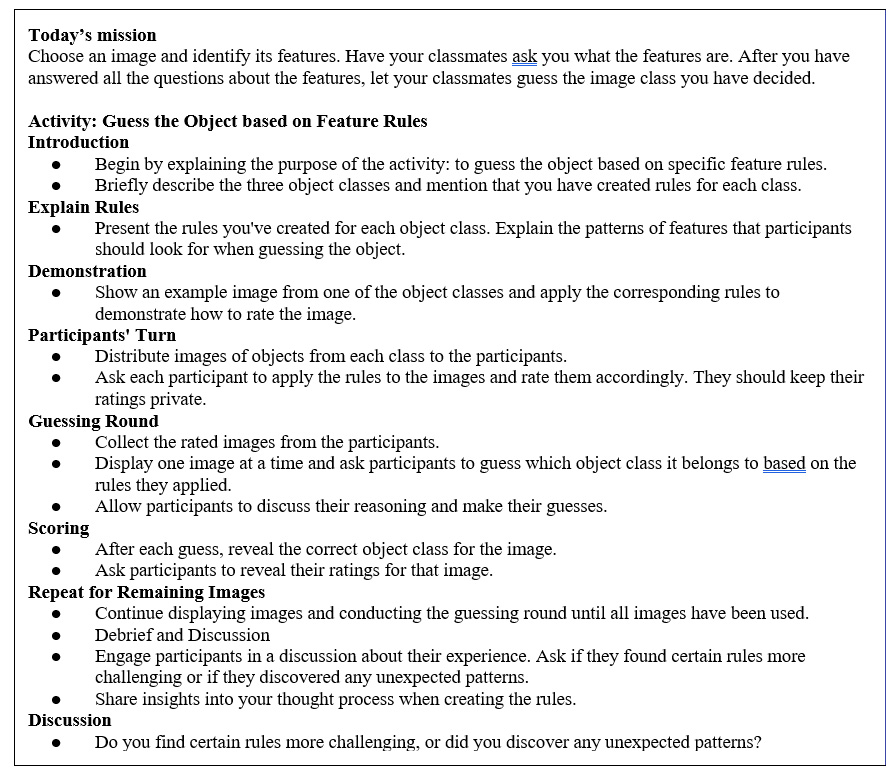
The learning activity Guess the Object Based on Feature Rules epitomizes the iterative game design principle in promoting continuous improvement, adaptability, and active engagement throughout the learning process. Students are provided opportunities to choose an image and identify its features, then have classmates guess the features. The game mechanics is an example for students to constantly test assumptions and create a community space to share their understanding on feature perceptions with peers. Through this iterative process, educators could conduct the formative assessment to capture students’ understanding on the core AI concepts. Additionally, this iterative design ensures that students can refine their comprehension of feature patterns and adjust their rule-making approach. Also, the debrief and discussion phase fosters ethical considerations, prompting students to reflect on their experiences and uncover potential biases in their rule creation.
The inclusivity of the design is reflected in the discussion phase, where students share insights and challenges, accommodating diverse perspectives and learning styles. The iterative nature of the activity encourages continuous improvement, as students progressively apply rules to different images, refining their understanding and adjusting rules based on new examples. The discussions about challenging rules and unexpected patterns contribute to a deeper understanding of feature patterns, aligning with the reflective principle (see Figure 1)
Figure 1
Sample AI Literacy Curriculum 1
Create
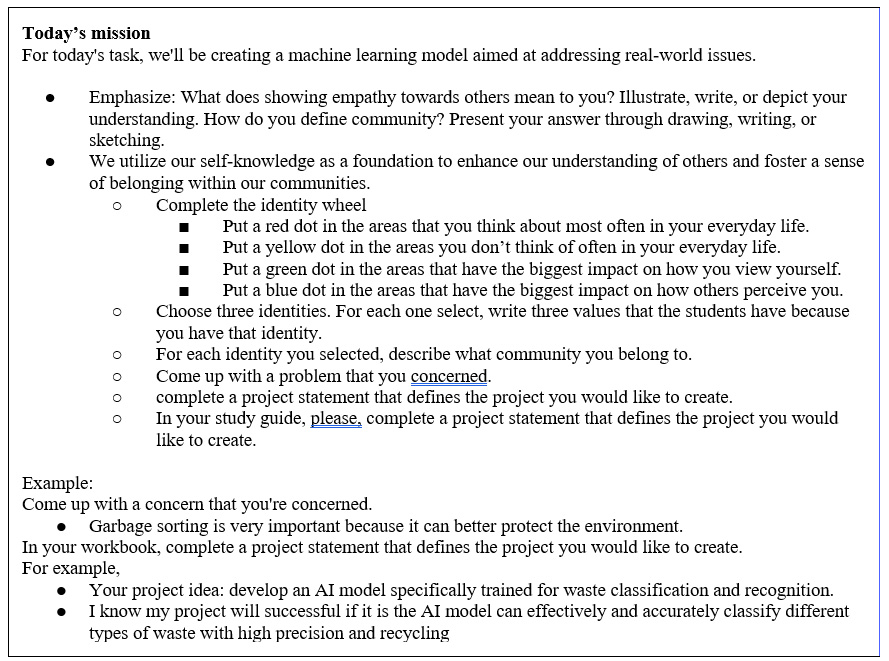
In the curriculum, the instructional choices are anchored in the Create component, fostering a hands-on and personalized approach to learning. The mission begins by encouraging students to illustrate their understanding of empathy and define community through drawing, writing, or sketching, aligning with the engagement seen in game creation. The subsequent activity, completing an identity wheel with red, yellow, green, and blue dots, mirrors game design principles by allowing participants to visually represent internal and external factors that shape their self-perception. By prompting students to choose three identities and articulate values for each, the curriculum encourages creativity and personalization, essential elements in both game design and machine learning project development. The emphasis on describing community affiliations and identifying concerns reflects the collaborative aspects of game design and connects the curriculum to tangible, impactful scenarios, aligning with the real-world focus. Last, completing a project statement for the machine learning project echoes the meticulous planning and envisioning inherent in game development, providing students the agency and opportunities for meaningful contributions to the field of machine learning (see Figure 2).
Figure 2
Sample AI literacy Curriculum 2
Reflect
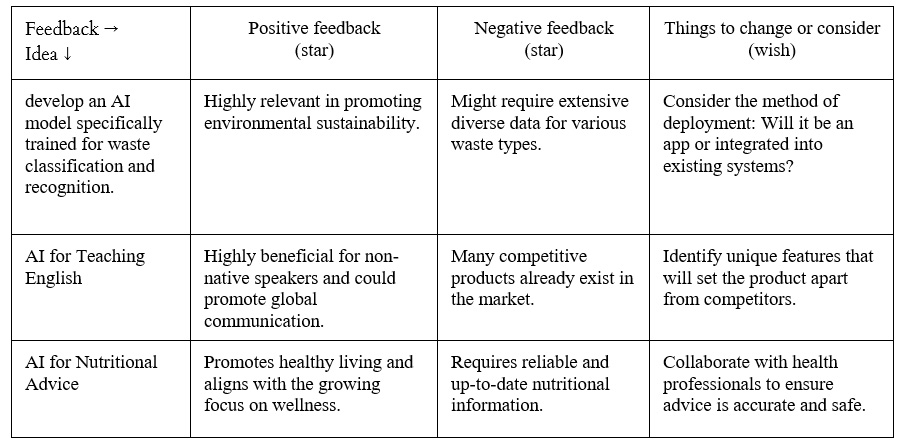
The scenario-based lesson on designing solutions to minimize real-world algorithmic bias problems is structured to the development of AI classifiers. In Scenario 1, where the aim is to develop an AI system for waste categorization, the lesson encourages stakeholders to reflect on the classes they would create, the features characterizing each class, and the potential sources of bias in the dataset. Feedback mechanisms are emphasized, enabling immediate responses to user actions, fostering continuous improvement, and reducing biases over time (see Figure 3). Ethical considerations are woven into the lesson, prompting discussions about the societal impact of biased waste categorization and responsible AI use.
Figure 3
Feedback
In Scenario 2, where the task is to create an AI for authenticating products, the reflective component is implemented through guiding questions about the classes, features, and data sources. Assessment components are designed not only to evaluate correctness but also to gauge the depth of understanding, encouraging reflective thinking. Ethical considerations are explicitly addressed, prompting stakeholders to reflect on the consequences of biased product authentication, potentially impacting consumers, businesses, and markets.
Scenario 3, involving the development of an AI tool for wildlife species identification, reflects through guiding questions about data diversity, algorithmic biases, and testing mechanisms. The lesson emphasizes the importance of continuous reflection and testing to ensure that the AI classifier remains unbiased over time. Ethical considerations come to the forefront, urging stakeholders to reflect on the potential negative consequences of biased wildlife classification on biodiversity assessments and urban planning (see Appendix A).
Methods
Research Design
This study employed a 6-week mixed-methods PD design to examine how teachers developed pedagogical capacity to integrate GenAI through a game-based AI literacy framework grounded in the DCR process. The study was exploratory and design-oriented, aiming to understand how teachers’ instructional practices shifted over time rather than to test causal effects. A convergent mixed-methods approach was used to triangulate survey data, interview narratives, and classroom artifacts, allowing for a more nuanced understanding of teacher learning and instructional decision-making.
Participants and Recruitment
Participants were in-service K–12 teachers recruited through district and professional learning networks focused on computational thinking, digital literacy, and emerging technology integration. Participation was voluntary. Teachers represented diverse grade bands, subject areas, and levels of prior experience with AI-related instruction. This diversity was intentional, reflecting the inclusive design principle of the framework and allowing examination of how the DCR process functioned across heterogeneous instructional contexts (Table 2).
Table 2
Participants Demographics
| Category | Subcategory | n (%) |
|---|---|---|
| Total Participants | — | 24 (100%) |
| Grade Band Taught | Elementary (K–5) | 9 (37.5%) |
| Middle School (6–8) | 8 (33.3%) | |
| High School (9–12) | 7 (29.2%) | |
| Primary Subject Area | Computer Science / STEM | 7 (29.2%) |
| Science | 6 (25.0%) | |
| Mathematics | 5 (20.8%) | |
| Humanities / Social Studies / ELA | 6 (25.0%) | |
| Years of Teaching Experience | 1–5 years | 6 (25.0%) |
| 6–10 years | 8 (33.3%) | |
| 11–15 years | 5 (20.8%) | |
| 16+ years | 5 (20.8%) | |
| Prior Experience with AI Instruction | None | 10 (41.7%) |
| Introductory exposure (tools or workshops) | 9 (37.5%) | |
| Prior AI/ML teaching experience | 5 (20.8%) | |
| Prior Experience with Game-Based Learning | Minimal / none | 7 (29.2%) |
| Occasional use | 11 (45.8%) | |
| Regular use | 6 (25.0%) | |
| School Context | Urban | 11 (45.8%) |
| Suburban | 8 (33.3%) | |
| Rural | 5 (20.8%) |
Professional Development Structure
The PD consisted of weekly sessions combining synchronous workshops and asynchronous design work. Each week aligned with one or more phases of the DCR cycle. Teachers completed at least two full DCR cycles during the intervention, allowing iterative refinement of instructional choices.
Instruments
Construct validity was established through theoretical alignment, internal structure, and triangulation across data sources. The three constructs — pedagogical confidence, pedagogical readiness, and pedagogical capacity — were defined a priori based on the DCR framework and prior research on teacher learning for emerging technologies. Each construct was operationalized using multiple items designed to capture distinct but related dimensions of AI literacy instruction, with confidence reflecting teachers’ self-efficacy in facilitating reasoning and ethical discourse, readiness reflecting perceived preparedness to design and implement AI-integrated activities, and pedagogical capacity reflecting the ability to enact, align, and assess AI-supported learning in practice (Table 3).
Table 3
Survey Constructs and Item-Level Indicators
| Item Code | Survey Item |
|---|---|
| Pedagogical Confidence | |
| C1 | Guiding students to interpret and reason about AI-generated outputs |
| C2 | Prompting students to critique AI responses rather than accept them at face value |
| C3 | Facilitating discussion about AI limitations and uncertainty |
| C4 | Leading discussions about representational bias and fairness in AI systems |
| C5 | Supporting students in articulating ethical implications of AI use |
| C6 | Responding productively to unexpected or problematic AI outputs |
| Pedagogical Readiness | |
| R1 | Designing AI learning activities aligned with instructional goals |
| R2 | Structuring iterative cycles of experimentation, feedback, and revision |
| R3 | Scaffolding student AI use without over-directing outcomes |
| R4 | Managing pacing during open-ended, AI-supported activities |
| R5 | Integrating ethical reflection into AI lessons |
| R6 | Supporting productive student collaboration during AI projects |
| Pedagogical Capacity | |
| P1 | Assessing open-ended AI artifacts (e.g., prompts, games, rule systems) |
| P2 | Aligning creative AI projects with clearly defined learning objectives |
| P3 | Providing formative feedback that supports iteration and deeper reasoning |
| P4 | Integrating ethical reflection within design and revision processes |
| P5 | Distinguishing conceptual understanding from surface-level tool use |
| P6 | Documenting and communicating student learning in AI-rich contexts |
Evidence of internal structure validity was supported by coherent patterns of pre–post change across constructs. Survey results showed larger gains in confidence and readiness than in pedagogical capacity, a pattern consistent with the theoretical distinction between belief- and preparation-oriented constructs and those associated with enacted instructional practice and assessment. Item-level analyses further indicated that gains clustered meaningfully within constructs, with confidence items related to AI reasoning and ethics showing stronger increases than capacity items related to assessment and alignment, suggesting that the constructs captured substantively different aspects of teachers’ pedagogical development.
Convergent validity was supported through triangulation with qualitative interview data and analysis of student artifacts. Teachers’ reported increases in confidence and readiness aligned with observed instructional shifts toward greater emphasis on student reasoning, iteration, and discussion of AI outputs. In contrast, more modest gains in pedagogical capacity corresponded with greater variability in artifact quality and persistent challenges related to assessment and instructional coherence in open-ended, game-based AI learning environments. This convergence between self-report measures and independent evidence of classroom practice provides additional support for the validity of the constructs as operationalized.
Data Sources
Three primary data sources were collected: (a) Teacher surveys (pre- and postintervention) assessed self-reported confidence, perceived preparedness, and pedagogical intentions related to AI literacy, GenAI, and ethical instruction; (b) semistructured teacher interviews (postintervention) explored teachers’ instructional reasoning, challenges, and reflections on balancing creativity, structure, and ethics, and (c) student artifacts and instructional materials, including game designs, prompts, rule sets, feedback tables, and reflection prompts, provided evidence of enacted pedagogy and classroom-level implementation of the DCR framework.
Data Analysis
Qualitative data (interviews and artifacts) were analyzed using iterative thematic analysis. Initial codes were derived deductively from the DCR framework (e.g., iteration, problem-solving, ethical reflection, and feedback use), then refined inductively to capture emergent themes. Survey data were analyzed descriptively and used to triangulate qualitative findings, focusing on shifts in confidence and pedagogical orientation rather than inferential comparisons.
Results
This study adopted a convergent mixed-methods design, integrating quantitative survey data with qualitative interview data and artifact analysis to examine how teachers’ pedagogical approaches to generative AI evolved during a 6-week game-based professional development intervention grounded in the DCR framework. Quantitative and qualitative data were analyzed separately and then integrated to identify convergent, complementary, and divergent patterns.
Quantitative Findings
Pre- and postintervention survey data were analyzed to examine changes in teachers’ pedagogical confidence, pedagogical readiness, and pedagogical capacity for AI literacy instruction. Paired-samples comparisons indicated statistically significant improvements across all three domains, with the largest effects observed for pedagogical confidence, followed by pedagogical readiness, and more modest gains for pedagogical capacity. Table X [WHAT TABLE DID YOU MEAN TO REFER TO?] summarizes item-level means, standard deviations, effect sizes, and p values.
Pedagogical Confidence
Teachers demonstrated the strongest gains in pedagogical confidence, with large effect sizes across all confidence-related items. Confidence in guiding students to interpret and reason about AI-generated outputs increased from a preintervention mean of 2.4 (SD = 0.7) to a postintervention mean of 3.9 (SD = 0.6), representing a large effect (d = 1.20, p < .001). Similar gains were observed in confidence prompting students to critique AI responses rather than accept them at face value (pre: M = 2.5, SD = 0.8; post: M = 4.0, SD = 0.6; d = 1.18, p < .001).
Teachers also reported substantial increases in confidence facilitating discussion about AI limitations and uncertainty (d = 1.15, p < .001) and leading conversations about representational bias and fairness (d = 1.28, p < .001), the latter representing the largest effect observed across all domains. Confidence supporting students in articulating ethical implications of AI use (d = 1.19, p < .001) and responding productively to unexpected or problematic AI outputs during instruction (d = 1.05, p = .001) likewise increased markedly. Collectively, these results indicate that the PD was highly effective in strengthening teachers’ confidence to facilitate reasoning-focused and ethically grounded discussions about AI systems.
Pedagogical Readiness
Moderate to large gains were observed in pedagogical readiness, reflecting increased preparedness to design and implement AI-integrated learning activities. Teachers’ readiness to structure iterative cycles of experimentation, feedback, and revision increased from a pre-intervention mean of 2.6 (SD = 0.8) to 4.0 (SD = 0.6), yielding a large effect size (d = 0.98, p < .001). Readiness to design AI learning activities aligned with instructional goals also increased substantially (pre: M = 2.8, SD = 0.7; post: M = 3.9, SD = 0.6; d = 0.82, p = .003).
Teachers reported moderate gains in readiness to scaffold student AI use without overdirecting outcomes (d = 0.76, p = .004) and to integrate ethical reflection into AI lessons (d = 0.80, p = .003). Smaller but still statistically significant gains were observed in readiness to manage pacing during open-ended, AI-supported activities (d = 0.62, p = .012) and to support productive student collaboration during AI projects (d = 0.55, p = .018). These patterns suggest that while teachers felt increasingly prepared to plan and launch iterative AI learning experiences, real-time classroom orchestration remained a comparatively greater challenge.
Pedagogical Capacity
In contrast to confidence and readiness, gains in pedagogical capacity were more modest, with medium effect sizes across items. Teachers’ ability to assess open-ended AI artifacts increased from a pre-intervention mean of 2.3 (SD = 0.7) to 3.1 (SD = 0.7) (d = 0.58, p = .015). Similarly, ability to align creative AI projects with clearly defined learning objectives increased from 2.8 (SD = 0.6) to 3.6 (SD = 0.6) (d = 0.56, p = .017).
Teachers reported smaller but significant improvements in providing formative feedback that supports iteration and deeper reasoning (d = 0.52, p = .021) and integrating ethical reflection into design and revision processes (d = 0.57, p = .016). Gains were also limited in distinguishing conceptual understanding from surface-level tool use (d = 0.50, p = .024) and documenting student learning outcomes in AI-rich contexts (d = 0.49, p = .026). These results suggest persistent challenges in translating increased confidence and readiness into consistently assessable and instructionally coherent practice.
Cross-Domain Patterns
Across domains, effect sizes followed a clear gradient: pedagogical confidence exhibited the largest gains (d ≈ 1.05–1.28), pedagogical readiness demonstrated moderate to large gains (d ≈ 0.55–0.98), and pedagogical capacity showed moderate gains (d ≈ 0.49–0.58). This pattern reflects increasing pedagogical complexity, from facilitating discourse and ethical reasoning, to designing learning experiences, to enacting, aligning, and assessing open-ended AI-supported instruction. The consistency of this gradient across items supports the conceptual distinction among domains and helps explain variability observed in classroom artifacts and instructional implementation (Appendix B).
Analysis of student artifacts further contextualized these survey trends. Across 72 artifacts, over two thirds demonstrated evidence of iteration (68%) and explicit justification of AI outputs (61%), while fewer than half included sustained ethical reflection (38%). Teacher ratings of artifact quality revealed substantial variability, with only 14% of artifacts reaching the highest level characterized by integrated reasoning and ethical reflection. This dispersion provides quantitative support for teachers’ reported difficulty managing assessment and pacing in open-ended, game-based learning environments
Qualitative Findings
Qualitative analysis of postintervention teacher interviews and student artifacts revealed how changes in pedagogical confidence, readiness, and capacity were enacted in classroom practice. Three interrelated themes emerged: (a) reframing AI from a tool to an object of inquiry, (b) iteration as a driver of student reasoning, and (c) persistent tensions around assessment and instructional coherence. Teacher quotes are used selectively to illustrate these themes and to triangulate quantitative findings.
Across interviews, teachers described a shift in how AI was positioned instructionally — from a productivity aid to a system students were expected to interrogate. Rather than emphasizing getting the right answer, teachers reported prompting students to interpret, critique, and justify AI outputs. As one teacher explained, “Before, I worried about whether students were using AI ‘correctly.’ Now I’m more interested in what they notice about how it behaves and why it gives the responses it does” (T3). Another teacher emphasized how this reframing reduced pressure on both teachers and students: “I don’t have to be the AI expert. I’m guiding the conversation, not validating the output” (T7).
Teachers consistently noted that ethical discussions became more authentic when grounded in students’ own interactions with AI. “Talking about bias made more sense once students could point to something the AI actually did in their project,” one teacher reflected (T1). These accounts align with the large gains observed in pedagogical confidence related to reasoning and ethical facilitation.
A second theme highlighted iteration as central to student learning and teacher decision-making. Teachers reported that repeated DCR cycles helped them reconceptualize iteration as productive sense-making rather than error correction. One teacher described this shift succinctly: “The first output isn’t wrong — it’s just information. I treat it like data and ask, ‘What should the change next?’” (T5). This perspective was evident in student artifacts that showed successive revisions to prompts, rules, and game mechanics, often accompanied by written justification. Teachers also acknowledged that facilitating iteration required letting go of linear lesson structures. “It felt uncomfortable at first because students were all in different places,” one teacher noted, “but the structure of the cycle helped me stay focused on the process, not the pace” (T9). These reflections help explain moderate gains in pedagogical readiness and persistent concerns about pacing and orchestration.
While teachers expressed increased confidence in facilitating ethical discussions, interviews revealed that ethical reflection was often episodic rather than fully embedded across design cycles. Teachers frequently described ethics as something they “added on” rather than a consistent design criterion. As one teacher admitted, “I can get students talking about fairness, but I’m not always sure how to push that thinking deeper or connect it back to their design choices” (T4). Another noted uncertainty around evaluation: “Ethical reasoning feels important, but it’s hard to grade without being subjective” (T8). These concerns were reflected in artifact analysis, where ethical considerations were more likely to appear in reflection prompts than in iterative design decisions. This qualitative pattern aligns with smaller gains in pedagogical capacity related to assessment and ethical integration.
Assessment emerged as the most consistent challenge across interviews. Teachers described difficulty defining quality, developing rubrics, and aligning open-ended AI projects with learning goals. One teacher explained, “When every student’s project looks different, it’s hard to say what ‘good’ even means” (T6). Another noted relying on informal strategies: “I know what strong reasoning looks like when I see it, but putting that into a rubric is still really hard” (T2). These uncertainties were mirrored in the wide variation observed in student artifact quality and provide qualitative support for the modest quantitative gains observed in pedagogical capacity.
Finally, interviews suggested an emerging shift in teachers’ professional identity. Rather than striving to master AI tools, teachers increasingly described themselves as designers of learning experiences that use AI to provoke inquiry. As one teacher reflected, “I don’t feel like I need to keep up with every new AI tool. My job is to design the experience and help students think” (T10). At the same time, teachers emphasized the need for ongoing support: “This feels sustainable if we keep sharing examples and calibrating together” (T7).
Discussion
This study contributes empirical evidence on how a design-oriented professional development model shapes teachers’ development of AI literacy pedagogy, distinguishing among pedagogical confidence, pedagogical readiness, and pedagogical capacity. The domain-level results reveal a consistent and theoretically meaningful gradient of impact, offering insight into how different dimensions of teacher learning respond to short-term, iterative PD interventions.
The strongest gains observed in pedagogical confidence suggest that teachers’ beliefs about their ability to facilitate AI-related reasoning and ethical discourse are highly responsive to structured, inquiry-based professional learning. By foregrounding interpretation, critique, and ethical reflection rather than technical mastery, the PD appears to have lowered entry barriers to AI literacy instruction. This finding supports theoretical accounts that position discourse and sense-making as accessible leverage points for teacher learning in emerging technological domains, where expertise is distributed and evolving.
Pedagogical readiness showed moderate gains, particularly in teachers’ preparedness to design iterative AI learning activities aligned with the DCR framework. These results indicate that teachers were able to translate conceptual understanding into planning-level decisions, such as structuring cycles of experimentation and feedback. However, comparatively smaller gains related to pacing and collaboration suggest that readiness remains partially decoupled from real-time classroom enactment. This distinction underscores the importance of separating design readiness from enactment fluency when evaluating professional development outcomes.
Pedagogical capacity exhibited the most modest gains, particularly in domains related to assessment, alignment, and documentation of learning. These findings are theoretically consistent with research on teacher expertise development, which suggests that assessment of open-ended, creative work requires sustained practice, shared norms, and robust exemplars. Capacity-related competencies demand integration across planning, facilitation, and evaluation, making them less amenable to rapid change through short-term interventions. The persistence of these challenges highlights assessment and instructional coherence as central bottlenecks in AI literacy pedagogy.
The observed gradient across domains suggests that the DCR framework functioned primarily as a cognitive and pedagogical scaffold rather than a full enactment support. Design and reflection phases appear to have supported teachers’ interpretive framing and ethical reasoning, while repeated creation cycles strengthened readiness to orchestrate iterative learning experiences. In contrast, assessment and alignment were less directly scaffolded within the PD, limiting growth in pedagogical capacity. This pattern suggests that PD models emphasizing design and reflection may require complementary assessment-focused supports to produce balanced growth across pedagogical domains.
These findings have important implications for the design and evaluation of AI literacy PD. First, they suggest that confidence and readiness gains should not be conflated with instructional capacity. Second, they point to the need for intentionally sequenced PD models in which early phases build confidence and readiness, while later phases emphasize assessment practices, alignment of creative work with learning goals, and shared criteria for evaluating AI-supported artifacts. Without such sequencing, teachers may develop strong facilitation skills without corresponding capacity to assess and sustain learning outcomes.
The study’s reliance on self-report measures and a modest sample size necessitates cautious interpretation. However, the alignment between survey results and independent artifact-based indicators strengthens confidence in the observed patterns. Future research should adopt longitudinal designs to examine how pedagogical capacity evolves with extended classroom implementation and investigate how targeted assessment scaffolds influence the translation of confidence and readiness into sustained instructional practice. Further work is also needed to explore whether pedagogical capacity can be accelerated through collaborative calibration, shared rubrics, or co-analysis of student artifacts.
Conclusion
As GenAI becomes more common in K–12 classrooms, educators are challenged to move beyond tool adoption toward instructional approaches that support student reasoning and ethical understanding. This study examined a game-based AI literacy framework grounded in the DCR process and its use within a 6-week PD intervention. Findings suggest that many teachers developed greater confidence and pedagogical clarity in guiding students to reason about AI outputs, examine representational bias, and reflect on the relationship between human intent and machine generation. Game-based artifacts served as concrete anchors for making abstract AI concepts and ethical issues visible in classroom practice. At the same time, growth was uneven. Teachers continued to face challenges in balancing open-ended creativity with structured learning goals, managing variability in student work, and navigating ethically complex discussions. These findings reinforce that engagement alone is insufficient; pedagogical structure is essential for supporting deeper AI literacy. The DCR process offers a practical way to organize learning around inquiry, creation, and reflection, helping teachers focus on learning processes rather than final products. Overall, this study contributes research-informed insights into how teacher development within participatory, game-based environments can support student reasoning, creativity, and ethical awareness in the context of GenAI.
Reference
AI4K12 Initiative. (2020). Grade band progression charts. https://ai4k12.org/gradeband-progression-charts
Ali, S., Kumar, V., & Breazeal, C. (2023). AI audit: A card game to reflect on everyday AI systems. Proceedings of the AAAI Conference on Artificial Intelligence, 37(13), 15981–15989.
Casal-Otero, L., Catalá, A., Fernández-Morante, C., Taboada, M., Cebreiro, B., & Barro, S. (2023). AI literacy in K–12: A systematic literature review. International Journal of STEM Education, 10(1), Article 1.
https://www.semanticscholar.org/paper/4c067037dba2c25ccbaf59ce2b3aea0d4c046521
Ballard et al. (2019)
Bloomfield et al. (2021)
CAST, 2018
Chiu, T. K. (2024). Empowering K–12 education with AI: Preparing for the future of education and work. Taylor & Francis.
Chiu, T. K. F., Ahmad, Z., Ismailov, M., & Sanusi, I. T. (2024). What are artificial intelligence literacy and competency? A comprehensive framework to support them. Computers and Education Open, 6, 100171. https://doi.org/10.1016/j.caeo.2024.100171
Dweck, 2006
Erbil, 2020
European Commission, Directorate-General for Education, youth, sport and culture. (2025, November 18). Digital education action plan: Policy background. https://education.ec.europa.eu/focus-topics/digital-education/plan
Gallotta et al., 2024
Guei et al. (2018)
Gupta, A., Lee, S., Mott, B., Chakraburty, S., Glazewski, K., Ottenbreit-Leftwich, A., . . . [LIST ALL AUTHORS UP TO 19] Lester, J. (2024). Supporting upper elementary students in learning AI concepts with story-driven game-based learning. Proceedings of the AAAI Conference on Artificial Intelligence, 38(21), 23092–23100.
Han, A., Zhou, X., Cai, Z., Han, S., Ko, R., Corrigan, S., & Peppler, K. A. (2024). Teachers, parents, and students’ perspectives on integrating generative AI into elementary literacy education. Proceedings of the 2024 CHI Conference on Human Factors in Computing Systems, 1–17.
Henry et al., 2021
Humburg, M., Dragnić-Cindrić, D., Hmelo-Silver, C. E., Glazewski, K., Lester, J. C., & Danish, J. A. (2024). Integrating youth perspectives into the design of AI-supported collaborative learning environments. Education Sciences, 14(11), 1197.
Johnson & Verdín, 2021
Ismail, A., Aliu, A., Ibrahim, M., & Sulaiman, A. (2024). Preparing teachers of the future in the era of artificial intelligence. Journal of Artificial Intelligence, Machine Learning and Neural Network, 44, 31–41.
Kahn et al., 2024
Kumar, P., & Choate, S. A. (2025). Distinguishing minds: A narrative game for teaching AI literacy and ethics in K–12 education (Preprint). TechRxiv.
Jing, Y., Wang, H., Chen, X., & Wang, C. (2024). What factors will affect the effectiveness of using ChatGPT to solve programming problems? A quasi-experimental study. Humanities and Social Sciences Communications, 11(1), Article 1.
https://www.semanticscholar.org/paper/0ed823d47477930343361663816b32f585574725
LaFlamme, K. A. (2025). Scaffolding AI literacy: An instructional model for academic librarianship. The Journal of Academic Librarianship, 51(3), 103041.
Lee et al.’s (2021)
Lee et al. (2021b)
Lee, Y. J., Oh, J., & Hong, C. (2024). Exploratory research on understanding university students’ artificial intelligence literacy in a Korean university. Online Journal of Communication and Media Technologies, 14(3), e202440.
Leitner, M., Greenwald, E., Wang, N., Montgomery, R., & Merchant, C. (2023). Designing game-based learning for high school artificial intelligence education. International Journal of Artificial Intelligence in Education, 33(2), 384–398.
Li, B., & Liu, F. (2025). Game-based learning for AI education: Systematic review (2019–2024). In AHFE Conference Proceedings. [NEED PUBLISHER ON ONLINE LOCATION]
Li et al., 2020)
Lin & Hsu, 2025
Liao et al. (2025)
(Liu et al., 2021)
Long, D., & Magerko, B. (2020, April). What is AI literacy? Competencies and design considerations. In Proceedings of the 2020 CHI conference on human factors in computing systems (pp. 1-16). https://doi.org/10.1145/3313831.3376727.
Gallotta, R., Todd, G., Zammit, M., Earle, S., Liapis, A., Togelius, J., & Yannakakis, G. N. (2024). Large language models and games: A survey and roadmap. IEEE Transactions on Games.
McDowell et al., 2022
Miao, Y., Jong, M. S.-Y., & Dai, Y. (2022). Pedagogical design of K–12 artificial intelligence education: A systematic review. Sustainability, 14(23), 15620. https://doi.org/10.3390/su142315620
Microsoft, 2019
Mills, K., Ruiz, P., Lee, K. W., Coenraad, M., Fusco, J., Roschelle, J., & Weisgrau, J. (2024). AI literacy: A framework to understand, evaluate, and use emerging technology. Digital Promise.
Ministry of Education of the People’s Republic of China. (2024, December 2). MOE issues guidance on how to teach AI in primary and middle schools. http://en.moe.gov.cn/news/press_releases/202412/t20241210_1166454.html
Mishra & Koehler, 2009
Morris, T. H. (2020). Experiential learning: A systematic review and revision of Kolb’s model. Interactive Learning Environments, 28(8), 1064–1077.
Ng, D., Su, J., Leung, J., & Chu, S. K. W. (2023). Artificial intelligence (AI) literacy education in secondary schools: A review. Interactive Learning Environments, 31(5), 1–17.
https://www.semanticscholar.org/paper/a565172bdd324865d2e68b6823f27e6fac948866
Ng, D., T. K., Leung, J. K. L., Chu, K. W. S., & Qiao, M. S. (2021). AI literacy: Definition, teaching, evaluation and ethical issues. Proceedings of the Association for Information Science and Technology, 58(1), 504–509. https://doi.org/10.1002/pra2.487
Priya et al. (2024)
Rana, V., Verhoeven, B., & Sharma, M. (2025). Generative AI in design thinking pedagogy: Enhancing creativity, critical thinking, and ethical reasoning in higher education. Journal of University Teaching and Learning Practice, 22(4), 1–22.
Ray et al. (2021)
Rose & Meyer, 2002
Shamir and Levin (2022)
Siau and Wang (2020)
SRI International (2025). Promoting AI literacy in K–12: Components, challenges, and opportunities. (Expert Panel Report). [NEED PUBLISHER ON ONLINE LOCATION]
Steinkuehler & Squire, 2014
Su, J., Guo, K., Chen, X., & Chu, S. K. W. (2023). Teaching artificial intelligence in K–12 classrooms: A scoping review. Interactive Learning Environments, 31(5), 1–18.
https://www.semanticscholar.org/paper/b1437b5fa6a1ca5ab8bc8fc3944a1b5756673452
Tissenbaum, 2019).
Touretzky et al., 2019
Touretzky et al., 2023
UNESCO. (2022). K–12 AI curricula: A mapping of government-endorsed AI curricula. (UNESCO Report). [IS THERE AN ONLINE LOCATION?]
Wang, G., Zhao, J., van Kleek, M., & Shadbolt, N. (2022, April). Informing age-appropriate AI: Examining principles and practices of AI for children. In Proceedings of the 2022 CHI Conference on Human Factors in Computing Systems (pp. 1–29).https://doi.org/10.1145/3491102.3517701
Williams, R., Park, H. W., Oh, L., & Breazeal, C. (2019). PopBots: Designing an artificial intelligence curriculum for early childhood education. Proceedings of the AAAI Conference on Artificial Intelligence, 33(1), 9729–9736. https://doi.org/10.1609/aaai.v33i01.33019729
Wong et al (2020)
Van den Berg, G., & Du Plessis, E. (2023). ChatGPT and generative AI: Possibilities for its contribution to lesson planning, critical thinking and openness in teacher education. Education Sciences, 13(10), 998.
Yadav et al., 2021;
Yi, Y. (2021). Establishing the concept of AI literacy: Focusing on competence and purpose. Jahr–European Journal of Bioethics, 12(2), 353–368. https://doi.org/10.21860/j.12.2.8
Yue, M., Jong, M. S. Y., & Ng, D. T. K. (2024). Understanding K–12 teachers’ technological pedagogical content knowledge readiness and attitudes toward artificial intelligence education. Education and Information Technologies, 29(15), 19505–19536.
Zhang & Lu, 2022
Zhang & Tang, 2024
Zhan, Z., Tong, Y., Lan, X., & Zhong, B. (2024). A systematic literature review of game-based learning in artificial intelligence education. Interactive Learning Environments, 32(3), 1137–1158.
Appendix A
Sample AI Literacy Curriculum 3
Appendix B
Pre–Post Comparisons of Teachers’ Pedagogical Confidence, Readiness, and Capacity for AI Literacy
Scale: 1 = Not at all, 5 = To a great extent; n = 24 teachers
Effect size = Cohen’s d (paired); p values from paired-samples t tests (mock)
| Item Code | Survey Item (Abbreviated) | Pre (M, SD) | Post (M, SD) | d | p |
|---|---|---|---|---|---|
| Pedagogical Confidence | |||||
| C1 | Reasoning about AI outputs | 2.4 (0.7) | 3.9 (0.6) | 1.20 | < .001 |
| C2 | Critiquing AI responses | 2.5 (0.8) | 4.0 (0.6) | 1.18 | < .001 |
| C3 | Discussing AI limitations | 2.6 (0.7) | 4.1 (0.5) | 1.15 | < .001 |
| C4 | AI bias and fairness | 2.1 (0.6) | 3.7 (0.6) | 1.28 | < .001 |
| C5 | Ethical implications of AI | 2.3 (0.7) | 3.8 (0.6) | 1.19 | < .001 |
| C6 | Handling unexpected AI outputs | 2.7 (0.8) | 4.1 (0.5) | 1.05 | .001 |
| Pedagogical Readiness | |||||
| R1 | Designing AI lessons aligned to goals | 2.8 (0.7) | 3.9 (0.6) | 0.82 | .003 |
| R2 | Structuring iterative cycles | 2.6 (0.8) | 4.0 (0.6) | 0.98 | < .001 |
| R3 | Scaffolding AI use | 2.9 (0.6) | 3.9 (0.6) | 0.76 | .004 |
| R4 | Managing pacing | 2.7 (0.7) | 3.5 (0.7) | 0.62 | .012 |
| R5 | Integrating ethics | 2.8 (0.6) | 3.9 (0.6) | 0.80 | .003 |
| R6 | Supporting collaboration | 3.0 (0.6) | 3.7 (0.7) | 0.55 | .018 |
| Pedagogical Capacity | |||||
| P1 | Assessing AI artifacts | 2.3 (0.7) | 3.1 (0.7) | 0.58 | .015 |
| P2 | Aligning projects to objectives | 2.8 (0.6) | 3.6 (0.6) | 0.56 | .017 |
| P3 | Providing formative feedback | 2.9 (0.6) | 3.6 (0.7) | 0.52 | .021 |
| P4 | Integrating ethics into revision | 2.4 (0.7) | 3.2 (0.7) | 0.57 | .016 |
| P5 | Distinguishing understanding vs. tool use | 2.7 (0.6) | 3.4 (0.7) | 0.50 | .024 |
| P6 | Documenting learning outcomes | 2.6 (0.7) | 3.3 (0.7) | 0.49 | .026 |
