In 2018, the National Council of Teachers of English’s (NCTE) position statement, Beliefs for Integrating Technology into the English Language Arts Classroom, renewed the call to support teachers in “efforts to confidently and creatively explore networked, ubiquitous technologies in a way that deepens and expands the core principles of practice that have emerged over the last century in English and literacy education” (para. 4). In that statement, which was re-printed in volume 19 of Contemporary Issues in Technology and Teacher Education, the NCTE ELATE Commission on Digital Literacy in Teacher Education (D-LITE) — the working group tasked with revising the position statement — offered four overarching beliefs:
- Literacy means literacies.
- Consider literacies before technologies.
- Technologies provide new ways to consume and produce texts.
- Technologies and their associated literacies are not neutral. (2018, para. 10)
Five years later, NCTE published the Policy Research Brief, Digital Platforms and the ELA Classroom (LeBlanc et al., 2023), which provided guidance to teachers related to adopting, using, and critiquing the use of digital tools for their instruction. In addition to serving as a companion to the 2018 beliefs statement, it levied critiques of the encroachment of ed tech on classrooms. Particularly, the brief made clear that technology is an investment that requires time and labor, which might not ultimately lead to greater or more equitable learning outcomes, specifically because of the tendency to encourage teachers to “bend instruction toward the platform’s design features, rather than toward their desired teaching goals” (p. 3). This brief encouraged teachers to continually engage in critical conversations about platforms by exploring their values and philosophies and reflecting on how these are reflected in the tools their schools are adopting.
Statements like these establish values and research-supported practices for the field, while underscoring how technologies are uniquely important to English education, in part because they are understood as part of a constellation of literacies that students will need to possess as they inhabit and curate a world increasingly shaped by technology. Yet, teachers who regularly integrate technology in pedagogically meaningful and effective ways tend to be the exception rather than the rule. Put differently, while technology might be used often within classrooms, it is rarely used to expand pedagogical practice.
Puentedura’s (2006) SAMR model, which categorizes classroom technology use into a continuum of discrete purposes — substitution, augmentation, modification, and redefinition — is one area of research that has identified the lack of innovative practice with ed tech. A scoping review of 230 articles that used the SAMR model found that a majority of teachers use technology as an enhancement (substitution or augmentation), improving upon their current activities rather than leading to transformative practices (Blundell et al., 2022). Redefinition, as it turns out, is rarely represented in research on classroom technology integration.
Other studies on educational technology have shown similarly disappointing findings. A 2019 study published by the Institute of Education Sciences found that, while 89% of teachers in Iowa claimed that students used technology on a daily basis, only 44-51% of teachers asked students to use their technology for collaboration and critical thinking, and even fewer, 22-27%, used it for communication and creativity (Margolin et al., 2019).
Yet, schools continue to spend significant money on apps and software — 98% of which never get used “intensively” (10 hours or more between assessments; Baker & Gowda, 2018). These findings point to a concerning conclusion: The increased access to digital tools has not led to more sophisticated, higher level uses of technology in schools (Bice & Tang, 2022), a claim first made by Larry Cuban (2001) at the turn of the century. While most teachers likely use some form of technology in their classroom, pedagogical innovation with digital tools has not kept up with technological advancement.
Such reticence to innovative technology use has been explained away through the discourse of barriers, or the conditions that often prevent teachers from integrating technology despite its known pedagogical potential. Ertmer (1999) was prescient in identifying first- and second-order barriers to technology integration in schools during the turn of the 21st century. First-order barriers include misalignment with schoolwide technology policies, as well as access to digital tools and professional development to support new teaching strategies with technology. Second-order barriers refer to teachers’ lack of technical competencies and efficacy, as well as their negative attitudes toward technology. Cuban et al. (2001) found that, even as schools were developing infrastructure for technology during the early stages of the Web 2.0 era, teachers with the greatest access to technology rarely used digital tools — a paradox created by limited professional development and time to learn about new tools, demonstrating the complex ways in which barriers are imbricated.
The COVID-19 pandemic presented a new texture to the discussion around barriers when issues of access, support, policies, hardware, and platforms moved beyond school buildings and followed both students and teachers home. First-order barriers, such as having a computer or other digital device along with high-speed internet, created a novel digital divide, presenting serious challenges for distance learning (Bell & Barr, 2024). Platforms like Zoom video conferencing helped some teachers overcome second-order barriers during the pandemic by demonstrating the power of educational technologies (Winter et al., 2021), while at the same time, many otherwise successful teachers were often met by frustration as students were disengaged with online learning. The result was a different type of second-order barrier, one where teachers were left with a strong sense of self-doubt, not just with their technological skills, but their ability to motivate students to learn in the online setting (Reich et al., 2020). While COVID-19 established a unique set of conditions — circumstances so unique they might be considered part of a wholly different set of third-order barriers — the lingering effects of online learning continue to reverberate as part of an undercurrent which shapes current debates around the appropriateness of technology in the classroom.
The discourse of barriers tends to cast a long shadow over educational technology research by offering a justification for the lack of technology use in classrooms. Little research, however, has focused on the key conditions that enable teachers to implement technology during student teaching and their first years in the classroom. In her landmark study, Pam Grossman (1990) studied six secondary teachers to understand the experiences in teacher preparation programs (TPPs) that contribute to the “making” of a teacher. Her findings demonstrated that mentors and student teaching experience, more than college coursework, tend to have the most significant impact on helping preservice teachers (PSTs) develop teaching practice. It also identified what continues to be reinforced in the literature: Mentoring student teachers is identity work that supports PSTs in figuring out the type of educator they hope to become when they take over their own future classrooms (Rodrigues & Mogarro, 2019).
This study drew on findings from adjacent fields of literacy and writing pedagogy studies as a starting point for considering the complicated identity work that goes into developing a teacher. Specifically, this article draws from scholarship that instantiates that teachers who view reading as particularly important in their personal lives are better teachers of reading (Neno et al., 2022; Sroka, 2025; Wahab, 2023), and teachers who actively write for themselves and public audiences are better teachers of writing (De Abreu Malpique et al., 2023; Hsiang et al., 2020; Wang & Troia, 2023).
This led to guiding questions for this study: Are teachers who actively engage with technology in their personal lives better teachers with technology in their classrooms? In other words, do teachers who read and teachers who write share similar pedagogical commitments to what is referred to in this article as teachers who “tech”?
Importantly, data were collected during fall 2019 and analyzed during spring 2020. As such, this study investigated classrooms on the eve of the COVID-19 pandemic, while analysis was conducted at the same time as a burgeoning pandemic saw platforms like Zoom play a central role in facilitating distance learning. This final report was written 6 years after the start of the pandemic, a temporal distance that afforded me the opportunity to both stitch together pre- and postpandemic ed tech sentiments while also contextualizing the findings into an educational paradigm that is currently maligning technology for its over-extension into classrooms and the personal lives of teens (Haidt, 2025; Twenge, 2026). Thus, this study looked at how teaching identity is impacted, not just by technology, but by the mercurial social discourses that shape public opinion on technology.
New Literacies and Teachers
This study employed an epistemological framework grounded in new literacies studies, recognizing that literacy is sociocultural and situated in experiences, affinities, as well as social and professional contexts (Lankshear & Knobel, 2011; Street, 1984). In an interview with David Moore, Donna Alvermann (Alvermann & Moore, 2011) considered in-school and out-of-school contexts of students to be less like containers and more like “sieves through which social, cultural, economic, and political discourses animate one another” (p. 158). This is equally important when considering the personal and professional lives of teachers.
Whereas a significant corpus of new literacies studies has centered around the in-school and out-of-school literacies of students, this study attempted to obtain a stronger understanding of the “sieve” between personal and professional contexts for educators and how technology use in both home and school contexts might inform each other in meaningful ways.
Alvermann and Moore’s (2011) concept of sieves is valuable as a reminder that literacy is not just an in-school practice completely loose and separate from youth out-of-school literacy practices. TikTok is one such platform that has carved out literacy spaces for communities. Jerasa and Boffone (2021) discussed how BookToks — short-form video posts related to literature and book recommendations — are digital spaces where youth can find community and agency centering around their passion for reading. More recently, Rahman and Curwood (2026) worked with PSTs to demonstrate how BookTok videos could be used as a novel way to help promote different types of relationships between youth and reading. These examples demonstrate how TikTok videos do not exist apart from schooled literacy practices but are filtered through the porous sieves that demarcate in-school from out-of-school spaces.
Technology and Teacher Identity
When it comes to technology and teacher identity, descriptive markers like “tech-savvy” or “techie” have been used to distill teachers’ new literacies practices into a set of competencies, pedagogies, and values toward integrating technology into the classroom. While tech-savvy teachers may be users of technology, they are not defined by advanced technical skills (Kajder, 2003). What skills they do possess are often self-taught and rarely a function of teacher preparation programs or professional development. The tech-savvy teacher feels an increased sense of self-efficacy with their teaching. based on their successful integration of technology (Schrum et al., 2008).
For example, a study by Haghi et al. (2026) demonstrated how the use of AI for instructional purposes led to greater efficiency, self-efficacy, and creativity, which in turn, aided in teachers developing a tech-savvy identity. In general, tech-savvy teachers possess the skills, expertise, and strategies to be facilitators of learning with technology (Minicozzi, 2019) and are often expected to serve as role models and leaders to help their less tech-savvy colleagues learn how to use technology in their classrooms (Kelly, 2015).
Similar to the tech-savvy teacher, the “techie” teacher is not necessarily more skilled with digital tools; rather, they possess a unique disposition resulting from their tinkering with technology and translate play into innovative learning opportunities for students. In their description of the techie teacher, Hobbs and Coiro (2019) stated,
You have a passionate curiosity about new digital tools and platforms and you like to be the first one to discover and use them. You experiment with how digital technologies can promote learning and you see much potential to engage students with learning through the use of apps, tools and digital platforms. (p. 404)
Such identity markers demonstrate that not all technology use is the same and that teachers often cite different rationales and motivations for incorporating technology into the classroom. While all tech-related identities may share similar traits, the values that animate their pedagogies are often nuanced.
Importantly, the concept of “teachers who tech” is only useful if it somehow sets itself apart from the current descriptions of teachers who use technology. The study reported here used both techie and tech-savvy teacher identity descriptors as a starting point in recruiting study participants. However, as data were collected, it became clear that the teachers in this study did not fit comfortably into either category. Throughout this article, participants will be referred to as “teachers who tech,” using the findings to illustrate the nuanced differences between them and other descriptors of teachers who use technology.
Methods
This qualitative study drew on video-cued multivocal ethnographic methods (Tobin, 2019) as a means of presenting findings of teacher-participants across educational contexts. This section begins with a detailed description of the two participants to illustrate both teachers’ approaches to technology and why they were considered for this study. It is followed by a description of the research design and data analysis.
Context and Participants
This study investigated the practices of two teachers located in the southeastern United States. Snowball sampling (Patton, 2015) was used to survey instructional technology support personnel, school administration, and education faculty at a local university to find English language arts teachers who might be considered tech-savvy or techie. After engaging in informal conversations with possible candidates, two teachers chose to participate in the study. All names of schools and districts are pseudonyms. Because of the visual nature of the documentary, teachers elected to have their names and likeness shared freely on the documentary. Their names have been shortened to include only the first initial of their last name for this written portion of the study.
Participant 1
Mrs. B was a teacher at Belville Middle School in Creek County. In total, she taught English language arts for 13 years, the last 3 of which were at Belville. Mrs. B was a career-changer, having spent time in cell phone retail before earning an alternative teaching license (without a degree in education). During early email conversations with her, she seemed reticent about being identified as techie or tech-savvy, despite having earned the credential of Google Certified Innovator and being recognized within the local school community as being innovative with her English instruction, particularly as it related to technology.
Previously, Mrs. B spent one school year helping establish a new high school devoted to innovation and design before deciding to take a job at Belville Middle School. Moving back into a more “conventional” school (as she called it) impacted her teaching identity, as she once again became viewed as the teacher with advanced skills with technology who stood out among a crowd of less techie/tech-savvy colleagues. She identified herself as a “rebel” and wanted to be a “change agent” at Belville as they began rolling out a 1:1 Chromebook initiative.
Participant 2
Mrs. O was in her 5th year of teaching 9th- and 10th-grade English in Griswold County at Pine Grove High School — a district that was in Year 5 of a 1:1 Chromebook initiative. She completed her student teaching at Pine Grove High School and, after earning her bachelor’s degree, chose to pursue her master’s degree full time before accepting her first teaching position back at Pine Grove. She noted that there were not a lot of other teachers in her school who used technology, and she rarely talked about her projects and approaches with technology with her colleagues.
Mrs. O did not consider herself either techie or tech-savvy, choosing instead to describe herself as “tech-willing.” She did not believe English teachers to be technology teachers, rather Mrs. O thought that technology was there to help facilitate the creative process. Mrs. O knew that it was important for students to be fluent with technology, both for their future careers and because technology allowed for greater creativity in the classroom. She did not feel the pressure to be the expert in the room, readily admitting when she did not know how to troubleshoot technology problems and encouraging students to find a solution themselves.
Both participants modeled a wide array of approaches and pedagogies regarding their use of digital tools. While there were multiple and varied examples of their use of technology, short descriptions are offered in the following section to illustrate their approach with technology and the reasons they were included as participants within this study.
Teaching With Technology
Mrs. B
During her observations, Mrs. B’s class worked on a writing unit based on the National Novel Writing Month project — commonly referred to as NaNoWriMo — in which people of all ages are encouraged to use a writing platform through the NaNoWriMo organization, which tracks writing progress and facilitates writing community to motivate writers to complete a novel in November.
During her first observation, she introduced students to The Most Dangerous Writing App, an online platform (separate from the NaNoWriMo platform) meant to facilitate quick writes. Students had to write continuously for 5 minutes without stopping. If at any point they paused for more than a few seconds, the app would delete their writing, and they would be forced to start over with a blank screen.
As students engaged in the timed writing, there was a sense of urgency not normally present during free writing activities. The clicking of the keys was only interrupted by the intermittent groan of a student who had lost their writing. After 5 minutes, Mrs. B debriefed the experience of writing with speed rather than cautious attention to each thought that appeared on the screen. Students expressed frustration over mistakes in their writing, focusing on what one student referred to as “gibberish” rather than what the quick write had ostensibly helped them overcome: self-doubt associated with the craft of writing. Mrs. B would tell them that “the gibberish was your brain working” and that they “had to keep [their] fingers working. Our brain works through the movements.” For Mrs. B, The Most Dangerous Writing app was a tool for exploring the kinesthetics of writing while facilitating novel conditions for students to brainstorm their NaNoWriMo projects.
Mrs. O
For her observation window, Mrs. O created an activity using timeline software to be used for a summative assessment. During this unit, students were placed in literature circles based on different books in the bildungsroman genre and were asked to create a timeline of main events that led to their protagonist’s coming of age. According to Mrs. O, the objectives for this activity were twofold: for students to (a) analyze the structure of the bildungsroman in their novels and (b) recognize that, like the characters in their books, “it isn’t just one day that you turn into an adult. There are certain things that are constantly contributing to that experience of moving from childhood to adulthood.”
Before starting on their activities, Mrs. O had students view examples of final products created by her and her student teacher using two different websites: Sutori and TimeGraphics. Providing students with the time to tinker with different tools and to visualize what their final product might look like was important to Mrs. O, as she wanted students to have agency by providing them with choice over their timeline design.
Once students chose their timeline tool, Mrs. O had them work within their book clubs to brainstorm their plot points together. Although their final products were completed individually, collaboration was significant to the creation process. Throughout Mrs. O’s classroom observations, students used digital tools in a variety of ways, searching for and embedding images into timelines using their 1:1 devices, and collaborating with their classmates to create a digital product that helped them better understand the bildungsroman genre.
Research Design
Several data sources were collected at different points throughout this project. The first phase in the research process was to conduct video-recorded semistructured interviews with the teacher-participants. An interview protocol was crafted to gain a better understanding of teacher-participants’ dispositions and experiences related to technology. These interviews took 45-60 minutes and covered topics such as how teachers use technology at school and at home and why they believed it was important for students to use technology in their English classrooms.
The next stage involved conducting video-recorded classroom observations. Classroom activities were recorded over the span of 5-10 days in each classroom using two iPads and an iPhone. Footage was then uploaded into Apple’s Final Cut Pro X (FCPX) software to create daily “rushes” of focal moments from each day’s observation. After the final observations from each participant, the videos were edited down to the most salient moments to create 30-minute montages or highlight reels of each teacher during their respective observation windows.
The final phase of data collection involved video-cued interviews (Tobin, 2019). Both teachers sat with me as we watched their montages on their classroom projectors. The participants would pause the video to ask questions or provide explanations for their teaching practice. Like the previous stages of data collection, these interviews were recorded so that the teachers’ commentary could be used as a voiceover for a final 30-minute documentary.
Data Analysis
Analysis was a continual and iterative process as data were collected and footage was selected for the final version of the documentary. Clips for the daily rushes were tagged using the FCPX software memo function. Data gathered during the pre-observation and video-cued interviews were then added to each participant’s storyline in FCPX in accordance with the segment of the montage they were commenting on. Each participant’s montage was then combined into one larger FCPX project, which brought both participants’ observations and interviews together to create a narrative about the shared practices and dispositions regarding teaching with technology. Similar to above, pre- and postobservation interviews were organized on the FCPX storyline to identify salient themes between both participants. A 90-minute rough cut was developed from the collection of footage. Through the editing and analysis process, the larger documentary was cut down to a 30-minute ethnographic documentary.
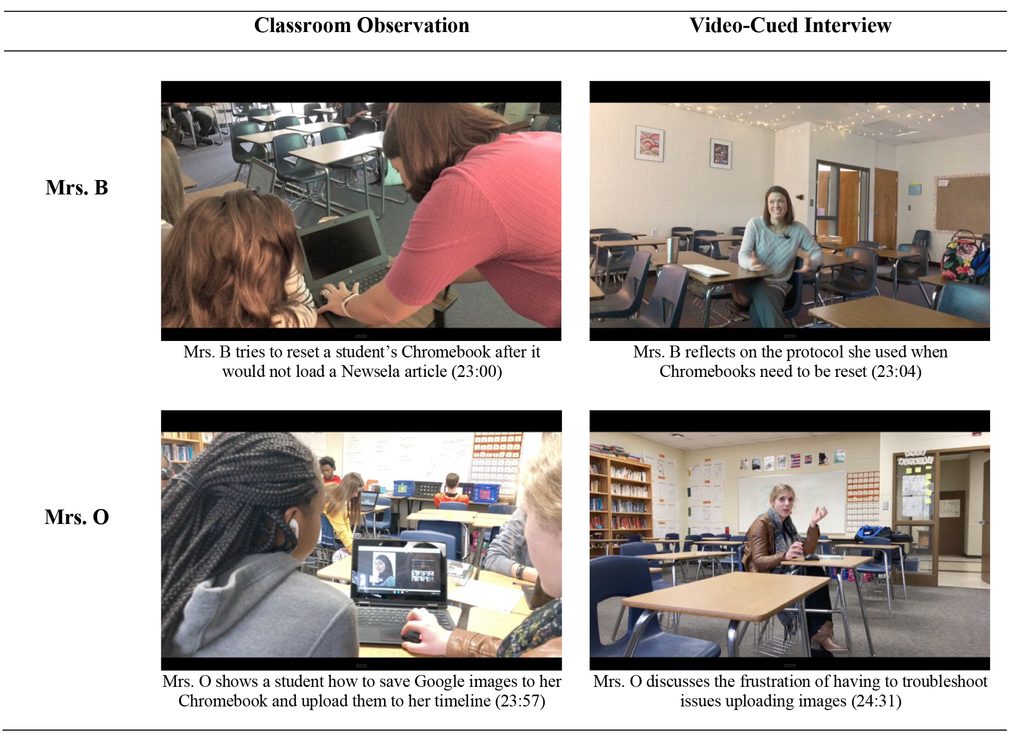
To better understand this method, I will discuss how one salient theme arose from “focal moments” that were identified during the data collection and analysis process. During both observation windows, teacher-participants experienced technical difficulties with students’ Chromebooks. Having conducted Mrs. B’s observation first, it was in her classroom where I experienced the first focal moment of technical difficulties when she was trying to help restart a student’s Chromebook after it refused to load a Newsela article (23:00). As I was recording, this instance seemed significant because it was a moment where a malfunctioning Chromebook became the focus for Mrs. B, requiring her singular attention to help troubleshoot a particular issue.
I observed a different type of technical difficulty in Mrs. O’s classroom, as a student struggled to download images onto her Chromebook so that she could add them to her book study timeline (23:57). I recognized this as a focal moment, where addressing Chromebook issues became the focus for Mrs. O. Both focal moments became part of each participant’s 30-minute video so that I could ask them about their experiences with technical difficulties during their video-cued interview.
During their respective video-cued interviews, Mrs. B (23:04) and Mrs. O (24:31) watched their clips with me and provided commentary related to their respective focal moments, offering insights about how they dealt with technical issues. Focal moments from both classrooms, along with the video-cued interview comments, were put side by side in the final documentary. The proximity of the observed events in the final documentary was intended to demonstrate that both teachers had similar experiences, while their interviews served as the commentary that provided nuanced descriptions of their unique approaches to dealing with technical difficulties in the classroom. Figure 1 illustrates the relationship between tech failure focal moments and its relationship to the video-cued interview data.
Figure 1
Screenshots From the Technical Difficulties Segment of Video Ethnography
Findings in this manuscript were drawn from the process just described and the resulting documentary. This written piece offers a more traditional companion to the documentary, providing additional scholarly context and methodological considerations that are not as easily accommodated through the visual narrative medium. The reader might find it useful to stop reading here and attend to Video 1 before finishing the remainder of this written piece.
Video 1
Teachers Who Tech
Findings
Both Mrs. O and Mrs. B had their own unique approaches in their integration of technology in their classrooms. However, pre-observation and video-cued interviews uncovered similarities in the experiences and philosophical approaches to using technology in their secondary English classrooms.
Mentors as Identity Builders
Mrs. O felt as if her positive orientation toward technology was developed when she was paired with a mentor teacher who used technology whenever possible during her student teaching experience. Pine Grove High School had not yet adopted a 1:1 technology policy, yet her mentor teacher kept the schoolwide laptop cart in his classroom, even though he was supposed to return it to the media center at the end of the day. She recalls them using laptops nearly every day, which served her well when she returned to Pine Grove years later when they were adopting a 1:1 policy.
Because she earned an alternative certification, Mrs. B never participated in a full-time TPP, nor did she have a student-teaching experience. However, during her first years in the classroom, she recalled having a mentor teacher whom she credited as being a divergent thinker who sparked her interest in becoming a “rebel teacher.” There were a few times Mrs. B mentioned the words “traditional,” “clunky,” and “unnatural,” to describe her view of the current American education system, conveying frustration over the lack of innovation in classrooms. Entering the classroom in 2005 after spending years as a cell phone retailer made her feel frustrated that more teachers did not see technology being used to its full potential. At the same time, she realized that technology could be her entry point to becoming the “divergent thinker” and rebel teacher she desired in trying to follow in the footsteps of her mentor.
Social Media and Teaching Identity
While mentors laid the foundation for technology use, social media served as the scaffolding for continued professional learning and refining teaching identities. Mrs. B explained that she was “professionally on Twitter,” (now X), believing it to be a valuable resource for curating an audience — a “hive mind” as she called it — where she could ask her network a knotty pedagogical question and they would provide her with “proven ways of doing things” in her classroom. She argued that Twitter had augmented her teaching, positioning it as both a community and space for professional development. Mrs. B started Twitter chats related to teaching with technology and often went to her online network first when she needed help finding new tools to use in her classroom.
Mrs. O did not use Twitter, finding the platform to be overwhelming. Instead, she chose Instagram. In talking about what drew her to Instagram, she stated, “I love following other teachers on Instagram. And then I have a ‘teachergram.’ So, my students can follow me on my teachergram.” Teachergrams provide educators with their own slice of the Instagram platform by allowing them to create profiles with the explicit purpose of sharing their teaching ideas and student work with other educators using hashtags and mentions. In addition, she followed bookstagrams: Instagram accounts devoted to book recommendations (similar to TikTok’s BookToks). Mrs. O’s Instagram account not only connected her to other teachers but also to readers, both inside and outside of education, so that she could stay current on texts she may want to include in her classroom.
While she talked a lot about following other teachers on their teachergram accounts, Mrs. O’s own identity on Instagram seemed tenuous. She explained that at first her teachergram account was “for the students. It was a place for me to share student work and stuff.” It had since shifted to a platform for her to reflect on her teaching practices through the sharing of student work. As a result, she admitted to feeling uncertain about the audience for her teachergram. Specifically, she wanted to use her platform to celebrate students without crossing any boundaries, stating, “I love my students, but I don’t really want to communicate via Instagram with them. … I have a lot of students that follow me, but it’s less for them and it’s more for me to reflect on what I’m doing.”
Both Mrs. B and Mrs. O had personal accounts that were separate from those they used for their classroom identities. Mrs. B said that she was “not an Instagram person,” instead choosing Facebook because “it’s a lot more about sharing memories or microblogging.” Mrs. O only used Instagram but created a separate handle for her personal account. When asked why she had two different Instagram accounts, Mrs. O said, “It’s not like I’m posting anything bad on there. It’s just mostly my kids and so I try to keep that just a little bit separate from my teachergram.” Whereas Mrs. O seemed to value her privacy by separating her teaching life from her personal life using different accounts on the same platform, Mrs. B appreciated how the functions of Twitter and Facebook offered unique affordances that allowed her to curate and sustain personal and professional relationships differently.
1:1 Initiatives
District- and schoolwide initiatives played a critical role in facilitating technology integration for Mrs. B and Mrs. O. One year prior to her 1st year of teaching, Mrs. O’s school district adopted a 1:1 Chromebook initiative. When I asked her what those first years of teaching were like, she said that technology use was not only encouraged, it was “an expectation.” Mrs. O discussed having observations from the district technology team, which inspired her to think about how to make every lesson digital. In addition, Mrs. O’s district would provide her with a substitute teacher so that she could attend half-day professional learning days with the technology team. She appreciated this because it was “time set aside where I was focusing on technology, what new tools are there, what can I use them for. It was a creating process for me.”
Five years later, shifts in district-level administration resulted in a change in the philosophical approach to technology. Digital tools became a casualty of the administrative transition. Mrs. O remembered how suddenly the district technology team was disbanded and there were no longer walkthroughs or professional development to support the use of technology. One of the side effects of the sudden loss of district support was the impact that it had on Mrs. O’s motivation to keep innovating with technology. She admitted that her application of digital tools became stagnant during the past few years, finding it difficult to use her discretionary time to prioritize searching for and tinkering with new platforms.
Mrs. B’s school was at a different point in their 1:1 initiative, as this was the 1st year her eighth-grade students were given Chromebooks. As a member of her school’s technology team, she was positioned as one of the more knowledgeable teachers with ed tech in her school. As a result, Mrs. B was in the process of brainstorming informal professional development opportunities to support her colleagues in using technology. Rather than more formalized professional development, she suggested offering a series of “y’all come sessions” that highlight how colleagues were reimagining analog projects and translating them into digital products. Mrs. B believed that these y’all come sessions could be “the spark” that helped other teachers in her school realize the potential for technology in their own classrooms.
Policies, Rules, and Approaches
The introduction of 1:1 technology brought new policies regarding the use of technology in both schools. Mrs. B’s interpretation of her school’s policy was that the Chromebooks alleviated students’ reliance on personal devices, which made it simple to enforce a zero-tolerance cell phone policy in class. However, while Mrs. B was able to clearly outline a policy and rationale regarding technology use, she was quick to explain that her classroom rules were less stringent because some students used their cell phones to set homework reminders or read fanfiction, recognizing that different devices serve different purposes for young people. Only on rare occasions, when cell phones became a distraction, she would have to tell a student to put their personal device away. Mrs. B’s looser cell phone policy was grounded in a belief that she was responsible for teaching students how to manage life with multiple digital devices, and if students learn how to use the technology in school they will be better prepared to use them responsibly in their personal lives.
When I brought up the school policy on personal devices with Mrs. O during our pre-observation interview, she chuckled, saying, “That’s a funny topic. … Of course, the cell phone policy is that students are supposed to keep them in their bookbags during class time. That does not happen.” As a result, Mrs. O had to create her own cell phone policy that was tailored to her classroom practices. She was vehemently against confiscating cell phones, because she saw it as a liability and argued, “I don’t have enough room for all the phones I would have to take up.”
Instead, Mrs. O decided to talk directly to students and tell them to put their phones away when she observed that it was a distraction — a strategy she learned from her mentor teacher. It became clear that Mrs. O’s policy was grounded in her own familiar struggles with cell phone use. She described not checking her phone as a “skill” that she had to practice, reflecting on times where she planned on posting something quickly to her teachergram, only to find herself tempted to then scroll through her feed.
“Put it away,” became a mantra that Mrs. O used often during independent work time. As she circulated about the classroom, she would tell students to “put it away. It’s not helping you,” positioning it more as a tip for getting classwork completed in a timely manner than a school-sanctioned reprimand. Mrs. O also recognized that cell phones served an academic purpose, specifically when students forgot their devices at home or their Chromebooks were not working. This further complicated any cell phone policy, as students need to have their phones with them in case of an issue related to the Chromebooks without the presence of the phones serving as a distraction in the classroom.
Tech Failure
I observed technical difficulties in both classrooms. In Mrs. O’s class, technology failure occurred when students struggled using the timeline websites. At one point, she sat with one student for 5 minutes, as she showed the student how to save an image in her Google Drive and upload it to her timeline. Most of Mrs. O’s students had Chromebooks for the past 5 years as part of the Griswold County 1:1 initiative, so saving images to their Drive should have been a skill they possessed. Upon reflecting on her students’ technical difficulties, Mrs. O determined that asking for technical support can be a veiled excuse for students who “don’t know how to start or don’t want to start” to get help from the teacher.
In Mrs. B’s classroom, technology failure manifested when one student’s Chromebook refused to load a specific website for the day’s assignment. She provided individualized attention to this student by going through a step-by-step protocol she developed to try to fix the technical issue — a process that took 10 minutes. When asked about this moment, Mrs. B explained,
There’s always some challenge, which I think is great because it teaches the kids things aren’t going to always work, and so, you have to be creative, and you have to find those ways to work around.
Mrs. O echoed similar sentiments, sharing that, when faced with tech failures, she “always [tried] to use it as a learning experience. ‘Okay, well let’s figure out a different way. This one’s not working, let’s, let’s try to figure out something else.’ There’s usually always another option.” Whereas technical failures can be frustrating, they also afforded these teachers who tech opportunities to teach students about creativity, resilience, and adaptability.
Seeking Balance
Despite their appreciation for technology, both teachers believed in the need for “balance” between high and low tech in their classrooms. Mrs. O discussed a renewed need for balance during our pre-observation interview, stating, “I felt like I was doing a lot of digital projects, but then I wasn’t really reflecting on what they were learning from that. … So, I went from ‘Everything’s digital’ to ‘We need to balance things out a little bit more.’” In a similar fashion, Mrs. B mentioned that she and the other language arts teachers were noticing that, in light of the novelty of the 1:1 devices, they were assigning too many digital activities and that they needed to consider doing “a third on paper and two thirds online.” Both teachers highlighted the awareness of using technology for specific purposes and that recognizing when not to use technology was just as important as considering the myriad ways to employ digital tools.
One idea that both Mrs. B and Mrs. O discussed was the idea of “switching gears.” During a day in Mrs. O’s class, she gave students sticky notes after a day of engaging in digital, social annotation. Students wrote down their ideas from the day’s reading on a sticky note as an exit ticket to be posted on the classroom door on their way out. When asked about this decision, she explained that she used to have students fill out exit tickets on Google Forms, but found that she rarely read them. Mrs. O explained, “I like the contrast of students doing something digital, but then now we’re switching gears,” arguing that “different mediums” could help “synthesize” ideas and knowledge.
Similarly, Mrs. B expressed the importance of switching gears with students in her classroom. Describing her students’ response to assignments on paper, Mrs. B stated, “It’s like, ‘Oh, we’re on paper.’They realize it’s a new format, a new medium, and now I’ve got to adjust my thinking.” For both teachers, switching gears was not only important for offering a disruption to possible digital monotony but also valuable in recognizing the learning affordances of different media.
Discussion
The findings, both the written portion and the video, illustrated that the classroom observations, as well as the video-cued interviews, helped build a theory of a unique orientation toward the integration of digital tools in the classroom: the teacher who techs. In response to the research questions, the findings from this study suggest that teachers who tech share certain pedagogical practices, informed by personal and professional experiences with technology, platforms, mentors, students, and school policies. Table 1 compares how other scholars have defined teaching identities with technology based on skills, dispositions, and pedagogies.
Table 1
Defining Teachers Who Tech
| Skills | Dispositions | Pedagogies | |
|---|---|---|---|
| Tech-Savvy Teacher | Use technology in personal life (Schrum et al., 2008), but may or may not possess technical skills to integrate tech and anticipate technical issues (Kajder, 2003) Self-taught when it comes to developing technological skills (lack of planning time and professional development around tech is a constraint but not a barrier) (Schrum et al., 2008) | Comfort with technology encourages them to take risks with digital tools with students (Kajder, 2003; Schrum et al., 2008) Technology use viewed as critical to student learning and necessary based on future careers (Schrum et al., 2008) Curious, life-long learner with regard to technology (Kajder, 2003) Effective integration of technology increases self-efficacy as a teacher (Schrum et al., 2008) | Support students in becoming “digitally literate within the context of the curriculum” (Kajder, 2003, p. 16) Technology does not replace more “traditional” literacies, but is leveraged in conjunction with ELA content when appropriate and necessary (Kajder, 2003) |
Techie Teacher (Hobbs & Coiro, 2019) | Experimenter when it comes to digital tools and apps | Passionate curiosity about new digital tools and platforms Pride related to being an early adopter of digital tools | Technology is used when it promotes learning and/or greater engagement |
| Teacher who Techs | Use social media for both personal and professional purposes Mentors model innovative practices Schools provide resources through technology infrastructure and professional development opportunities | Creates classroom technology policies responsive to academic affordances, social implications, and teaching appropriate use Comfortable taking risks because of experience and established protocols that anticipate technology failure | Technology used purposefully to support the creation of digital products toward specific student learning outcomes Analog tools used in tandem or in place of digital tools depending on appropriateness to seek instructional balance |
As Table 1 illustrates, there are some significant connections between techie teachers, tech-savvy teachers, and teachers who tech. First, teachers who tech are largely self-taught when it comes to technology and are attentive to the ways platforms help create personal and professional networks. These teachers had mentors who modeled innovative practices that encouraged them to use technology in their own classrooms. They also had the added benefit of teaching in technology-rich environments, which are often paired with professional development. While they may not be formally trained in how to troubleshoot all potential issues related to technology, teachers who tech are willing to take risks with digital tools — another similarity with tech-savvy teachers. Past experiences with tech failures also provided them with a set of protocols that they can leverage whenever something goes wrong.
Because of their personal experiences with technology, teachers who tech create classroom policies that not only recognize the potential academic need for personal devices, but they also understand how these technologies both connect youth to their peers and the distractions they can create in a learning environment. As a result, they see distraction as an opportunity to help students understand the effect that their mobile devices can have on their focus and, by extension, their learning.
This understanding of both the affordances and constraints of digital tools allows teachers who tech to take a measured approach to integrating technology. They are purposeful in thinking about when technology is most appropriate and when analog tools (i.e., paper and pencil) might lead to more meaningful engagement. Far from tech-evangelists, teachers who tech privilege instructional balance over a pure devotion to making all activities digital, realizing the importance of contrast that comes from balance and switching gears.
In grounding the definition of teachers who tech in a tradition of understanding the importance of teachers who read (Neno et al., 2022; Sroka, 2025; Wahab, 2023) and teachers who write (De Abreu Malpique et al., 2023; Hsiang et al., 2020; Wang & Troia, 2023), it is imperative to realize that, while skills are not insignificant, they are not the driving force that sets them apart from their less technological colleagues. In other words, teachers who read and teachers who write are not defined by their literacies skills. English teachers, of course, must be able to read and write themselves to teach others how to do so.
Similarly, this study was underwritten by the presumption that many teachers owned a smartphone and had a social media account. But, unlike using social media for the sporadic post or like, the teacher who techs consistently uses public-facing platforms with a purpose, whether that is to curate a digital identity, share and respond to interesting ideas, or reflect on one’s professional practice. Put differently, they recognize the power of platforms to do things that support their personal and professional interests, and they actively engage with online communities to achieve those ends.
Importantly, the teacher who techs is situated along a continuum of teaching identity markers that include techie and tech-savvy teachers as well as teachers who are indifferent to technology and neo-Luddites (Logan et al., 2025), who actively resist the use of technology in the classroom. The difference might be understood less in terms of skill and more as commitment — a commitment that mirrors the sustained personal practices of teachers who read and teachers who write. Unlike the teacher who reads and writes, the teacher who techs develops a discerning taste for digital tools rather than books and writing utensils to develop values which translate into pedagogical moves. Furthermore, restraint is not reluctance; the neo-Luddite refuses technology, whereas the teacher who techs knows it well enough to judge the specific use cases where it best serves students.
Taken together, a teacher who techs is defined as an educator whose sustained personal use of a range of hardware and platforms yields not only discerning tastes, but protocols for tech failure and pedagogical commitments that inform when to deploy, adapt, and set aside digital tools. This last characteristic — a willingness to seek balance between digital and analog tools —separates the teacher who techs from the techie and tech-savvy teacher. Rather than situating their pedagogical practice around seeking as many opportunities as possible to integrate technology, the teacher who techs is keenly aware of both the benefits and potential downsides of digital tools and exercises restraint, making technology use purposeful rather than presumptive.
Put simply, the teacher who techs is not the one who uses technology the most, but the teacher who knows when to best deploy it. Such an orientation is accrued through personal practice more so than professional development.
Implications for Classroom Practice
An important consideration of this study is that the data were collected in fall 2019, months before humanity would reckon with a worldwide pandemic and education would be forced online. It was also conducted before OpenAI released ChatGPT, and Twitter became X. This study investigated classrooms before Jonathan Haidt’s (2025) The Anxious Generation would use correlational data to draw a direct line between technology and teen mental health crises. More recently, media outlets like The Atlantic (Anderson, 2026) and the New York Times (Singer & Elliott, 2026) chronicled the prevailing resistance to the 1:1 computer movement, believing that perhaps schools had gone too far in using technology to mediate the entirety of American students’ educational experience.
Much has changed in the educational and technological landscape since this study was conducted. Yet, what is often missing in current debates around the effectiveness of ed tech is that perhaps the technology itself is not the problem, but the way it has been used in the classroom. This is not meant to vilify teachers for using technology ineffectively, nor is it intended to let ed tech companies off the hook. In fact, I assume that most ed tech purchased by districts over the past 2 decades has been implemented as intended — and perhaps that is the problem.
As noted in the NCTE policy brief on digital platforms, the tendency for teachers to “bend instruction toward the platform’s design features, rather than toward their desired teaching goals” (LeBlanc et al., 2023, p. 3) cedes teacher expertise to ed tech companies. When education is oriented toward the whims of platforms rather than the unique needs of students within a specific learning context, teachers — particularly those who do not tech — opt to outsource their pedagogical skills and content knowledge to ed tech companies in ways that are unlikely to lead to greater learning outcomes.
While hardware like Chromebooks is being removed in droves over concerns of the detrimental effects of screentime on teen focus and mental health, AI education (AIED) platforms are entering schools with the promise of making the teaching and learning process easier and more efficient for teachers and students. For example, the leading AIED platform, MagicSchool, has partnered with some of America’s largest school districts (e.g., Atlanta, Buffalo, Denver, Seattle; Gray, 2026) to provide teachers with complete access to their “full collection of 80+ teacher tools and 50+ student tools you can use in your classroom today” (MagicSchool, n.d.).
When ed tech is imposed on the teaching process at the district level like this, the role of the teacher who techs becomes increasingly important because their experience with technology — both personal and professional — can shape how new technologies are taken up and challenge technology mandates when necessary. For those who accept the premise that the problem is not ed tech but rather an issue of implementation of digital tools in school, then teachers who tech in the MagicSchool districts will not only play a critical role in tinkering with the suite of over 130 tools to discover ways to integrate the tools effectively but serve as outspoken advocates on behalf of their colleagues in determining the logical limits of AI in education.
If the past is prologue when it comes to ed tech, then educators would be wise to consider what a postmortem on 1:1 initiatives signals for the future of AIED tools like MagicSchool and how this era of educational technology could result in the regret and vitriol currently facing tools like Chromebooks. While greater advocacy from teachers who tech will be important, less techy colleagues can learn a lot from Mrs. B and Mrs. O about their own integration of AIED tools, particularly when thinking about the balance between digital and analog tools. Restraint might be thought of as a design principle for curriculum that teachers could consider as they tinker with AIED tools, determining the places where these platforms might be used to fill in curricular gaps rather than driving curriculum.
This might look like developing a heuristic like Mrs. B, who opted to move one third of her activities on paper with the other two thirds on the Chromebook. Or, perhaps teachers might adopt Mrs. O’s approach to switching gears by actively seeking pedagogical ways to shift from one medium to another — shifting back and forth between analog and AIED tools to support students with flexible meaning-making skills. Viewed this way, curricular restraint with AIED does not represent merely the minimal viable application of technology, but the intentional integration of digital tools driven by the intended learning outcomes.
Implications for Teacher Preparation
This study drew on Grossman (1990) and the making of a teacher by considering the formative experiences that teachers who tech had in developing their teaching identity. Discussions around the making of a teacher are challenging because professional identity is dynamic, ever-evolving, and constantly negotiated over time and across contexts (Groenewald & Arnold, 2025; Li, 2025). Given this “polymorphous” nature of teacher identity (Dockerty, 2025), one could assume that tech-related identities are likely to change over the span of a teaching career, since their identities are intrinsically tied to the whims of technological shifts. Yet, studies by O’Byrne and Hunter-Doniger (2021) and Ye et al. (2025) underscore the importance of helping PSTs establish teaching identities in their TPP.
School culture, leadership, and mentorship during the first years of teaching are also important factors that shape teacher identity (Uras Eren & Atay, 2025), which can either crystallize one’s identity as a teacher or lead to attrition (Admiraal, 2025). Not surprisingly, self-efficacy with instruction grows with more teaching experience (Feng et al., 2026). So, while identity-work is malleable and ongoing over the course of a teaching career, experiences during teacher preparation, practicums, and induction years inevitably play a significant role in the making of a teacher who techs.
At the same time, increased datafication and surveillance with educational platforms (Nichols & Garcia, 2022; Pangrazio et al., 2022) underscore the reality that platforms are not neutral (NCTE, 2018) and that TPPs must support PSTs in developing the necessary critical orientations toward technologies. Rather than teaching how to use the technology du jour, coursework should offer sustainable skills and philosophies that PSTs can mold as new technologies transform the digital landscape. In thinking specifically about teachers who tech, educators might consider how TPPs could help PSTs translate transformative experiences with mentors as well as their own engagements in online communities into commitments that recognize the potential learning opportunities alongside the dangers of technologies as it relates to their future English classrooms.
Teacher beliefs regarding technology have been cited as either barriers to technology implementation (Ertmer, 1999) or an enabling condition for technology integration (Heath, 2017). Beliefs, then, might not be understood as a polarizing concept, but rather as a fulcrum that teeters teachers in one direction or the other, offering a way beyond the good vs. bad debate regarding technology. As such, consider how belief statements like NCTE’s (2018) Beliefs for Integrating Technology into the English Language Arts Classroom and Digital Platforms and the ELA Classroom (LeBlanc et al., 2023) should not only outline the values and practices of English educators, but reflect the beliefs that animate the pedagogies of teachers who tech so that educators can learn from them to help current and future English teachers get beyond technology barriers in schools.
References
Admiraal, W. (2025). Attrition risk profiles of novice teachers based on their job demands, individual and school resources, and well-being. Teaching and Teacher Education, 162, 105070. https://doi.org/10.1016/j.tate.2025.105070
Alvermann, D. E., & Moore, D. W. (2011). Questioning the separation of in-school from out-of-school contexts for literacy learning: An interview with Donna E. Alvermann. Journal of Adolescent and Adult Literacy, 55(2), 156–158. https://doi.org/10.1002/JAAL.00019
Anderson, J. (2026, April 6). What happened after a teacher ditched screens. The Atlantic. https://www.theatlantic.com/ideas/2026/04/teachers-screens-edtech-students/686681/
Baker, R. S., & Gowda, S. M. (2018). The 2018 technology & learning insights report: Towards understanding app effectiveness and cost (S. Erlanger, Ed.). BrightBytes.
Bell, E., & Barr, D. (2024). Barriers to technology integration in the A-level history classroom in Northern Ireland. Irish Educational Studies, 43(4), 1227–1248. https://doi.org/10.1080/03323315.2023.2209853
Bice, H., & Tang, H. (2022). Teachers’ beliefs and practices of technology integration at a school for students with dyslexia: A mixed methods study. Education and Information Technologies, 27(7), 10179–10205. https://doi.org/10.1007/s10639-022-11044-1
Blundell, C. N., Mukherjee, M., & Nykvist, S. (2022). A scoping review of the application of the SAMR model in research. Computers and Education Open, 3, 100093. https://doi.org/10.1016/j.caeo.2022.100093
Cuban, L. (2001). Oversold and underused: Computers in the classroom. Harvard University Press.
Cuban, L., Kirkpatrick, H., & Peck, C. (2001). High access and low use of technologies in high school classrooms: Explaining an apparent paradox. American Educational Research Journal, 38(4), 813–834. https://doi.org/10.3102/00028312038004813
De Abreu Malpique, A., Valcan, D., Pino-Pasternak, D., & Ledger, S. (2023). Teaching writing in primary education (grades 1–6) in Australia: A national survey. Reading and Writing, 36(1), 119–145. https://doi.org/10.1007/s11145-022-10294-2
Dockerty, K. (2025). Early career teachers’ identities: Polymorphous identities that form, morph, and flex over time. Journal of Education for Teaching, 51(4), 797–813. https://doi.org/10.1080/02607476.2025.2530470
Ertmer, P. A. (1999). Addressing first- and second-order barriers to change: Strategies for technology integration. Educational Technology Research and Development, 47(4), 47–61.
Feng, X., Helms-Lorenz, M., & Maulana, R. (2026). Navigating the early-career landscape: Unpacking the role of induction in shaping beginning teachers’ intrinsic motivation, affection, and self-efficacy. Teachers and Teaching, 32(4), 696–729. https://doi.org/10.1080/13540602.2025.2482977
Francom, G. M. (2020). Barriers to technology integration: A time-series survey study. Journal of Research on Technology in Education, 52(1), 1–16. https://doi.org/10.1080/15391523.2019.1679055
Gray, K. (2026, June 10). MagicSchool’s districts leading the way: Class of 2026. MagicSchool. https://www.magicschool.ai/blog-posts/districts-leading-the-way-2026
Groenewald, E., & Arnold, L. (2025). Teacher professional identity: Agentic actions of a novice teacher in a challenging school context. Teachers and Teaching, 31(3), 453–470. https://doi.org/10.1080/13540602.2024.2308890
Grossman, P. L. (1990). The making of a teacher: Teacher knowledge and teacher education. Teachers College Press.
Haghi, S., Alpat, M. F., & Kamali, J. (2026). AI-mediated instruction and novice language teachers’ identity: Reinforcing and disrupting factors. Frontiers in Education, 10, 1722903. https://doi.org/10.3389/feduc.2025.1722903
Haidt, J. (2025). The anxious generation: How the great rewiring of childhood is causing an epidemic of mental illness. Penguin Books.
Heath, M. K. (2017). Teacher-initiated one-to-one technology initiatives: How teacher self-efficacy and beliefs help overcome barrier thresholds to implementation. Computers in the Schools, 34(1–2), 88–106. https://doi.org/10.1080/07380569.2017.1305879
Hobbs, R., & Coiro, J. (2019). Design features of a professional development program in digital literacy. Journal of Adolescent and Adult Literacy, 62(4), 401–409. https://doi.org/10.1002/jaal.907
Hsiang, T. P., Graham, S., & Yang, Y.-M. (2020). Teachers’ practices and beliefs about teaching writing: A comprehensive survey of grades 1 to 3 teachers. Reading and Writing, 33(10), 2511–2548. https://doi.org/10.1007/s11145-020-10050-4
Jerasa, S., & Boffone, T. (2021). BookTok 101: TikTok, digital literacies, and out‐of‐school reading practices. Journal of Adolescent & Adult Literacy, 65(3), 219–226. https://doi.org/10.1002/jaal.1199
Kajder, S. B. (2003). The tech-savvy English classroom. Stenhouse.
Kelly, D. P. (2015). Overcoming barriers to classroom technology integration. Educational Technology, 55(2), 40–43.
Lankshear, C., & Knobel, M. (2011). New literacies: Everyday practices and social learning. Open University Press.
LeBlanc, R. J., Aguilera, E., Burriss, S., de Roock, R., Fassbender, W. J., Monea, B., Nichols, T. P., Zacher Pandya, J., Robinson, B., Smith, A., & Stornaiuolo, A. (2023). Digital platforms and the ELA classroom [Policy Research Brief]. National Council of Teachers of English. https://ncte.org/wp-content/uploads/2023/05/2023-NCTE-Squire-Office_Digital-Platforms-and-the-ELA-Classroom.pdf
Li, J. (2025). A review of research on the mechanisms influencing pre-service teachers’ professional identity: An integrative perspective on educational internships, field interactions, and perceptions of efficacy. Proceedings of ICILLP 2025 Symposium: Psychological Perspectives on Teacher-Student Relationships in Educational Contexts, 113(1), 78–84. https://doi.org/10.54254/2753-7048/2025.NS26762
Logan, C., Nichols, T. P., & Garcia, A. (2025). Teach like a Luddite. Phi Delta Kappan, 107(3–4), 37–41.
MagicSchool. (n.d.). AI tools for teachers. https://www.magicschool.ai/magic-tools
Margolin, J., Pan, J., & Yang, R. (2019). Technology use in instruction and teacher perceptions of school support for technology use in Iowa high schools. Institute of Education Sciences.
Minicozzi, L. L. (2019). Seeking to create tech-savvy teachers. In C. Meidl & L. Ammentorp (Eds.), Impactful practices for early childhood teacher educators (pp. 125–135). Rowman & Littlefield Publishers.
National Council of Teachers of English. (2018). Beliefs for integrating technology into the English language arts classroom. https://ncte.org/statement/beliefs-technology-preparation-english-teachers/
Neno, H., Emanuel, U., & Yulita, D. (2022). Teachers’ reading habits and their effect on the students’ literacy. English Review: Journal of English Education, 10(3), 811–820. https://doi.org/10.25134/erjee.v10i3.5705
Nichols, T. P., & Garcia, A. (2022). Platform studies in education. Harvard Educational Review, 92(2), 209–230.
O’Byrne, W. I., & Hunter-Doniger, T. (2021). Pre-service educators developing a digital identity. TechTrends, 65(4), 444–453. https://doi.org/10.1007/s11528-021-00617-5
Pangrazio, L., Stornaiuolo, A., Nichols, T. P., Garcia, A., & Philip, T. M. (2022). Datafication meets platformization: Materializing data processes in teaching and learning. Harvard Educational Review, 92(2), 257–283.
Patton, M. Q. (2015). Qualitative research and evaluation methods. Sage Publications, Inc.
Puentedura, R. R. (2006). Transformation, technology, and education in the state of Maine. https://hippasus.com/resources/tte/puentedura_tte.pdf
Rahman, N., & Curwood, J. S. (2026). Teaching with TikTok: Leveraging social reading cultures through #BookTok. Teaching Education, 37(1), 1–20. https://doi.org/10.1080/10476210.2025.2559739
Reich, J., Buttimer, C., Coleman, D., Colwell, R., Faruqi, F., & Larke, L. (2020). What’s lost, what’s left, what’s next: Lessons learned from the lived experiences of teachers during the pandemic. Teaching Systems Lab. https://edarxiv.org/8exp9
Rodrigues, F., & Mogarro, M. J. (2019). Student teachers’ professional identity: A review of research contributions. Educational Research Review, 28, 100286. https://doi.org/10.1016/j.edurev.2019.100286
Schrum, L., Shelley, G., & Miller, R. (2008). Understanding tech-savvy teachers: Identifying their characteristics, motivation, and challenges. International Journal of Technology in Teaching and Learning, 4(1), 1–20.
Singer, N., & Elliott, D. R. (2026, March 29). Chromebook remorse: Tech backlash at schools extends beyond phones. The New York Times. https://www.nytimes.com/2026/03/29/technology/chromebook-remorse-kansas-school-laptops.html
Sroka, M. (2025). Teachers as readers: Examining the personal reading lives of English educators. Georgia Journal of Literacy, 47(1), 46–65. https://doi.org/10.56887/galiteracy.188
Street, B. V. (1984). Literacy in theory and practice. Cambridge University Press.
Tobin, J. (2019). The origins of the video-cued multivocal ethnographic method. Anthropology and Education Quarterly, 50(3), 255–269. https://doi.org/10.1111/aeq.12302
Twenge, J. M. (2026). International declines in academic performance and increases in loneliness are linked to electronic devices. Journal of Adolescence, 98(1), 250–261. https://doi.org/10.1002/jad.70058
Uras Eren, E., & Atay, D. (2025). Constructing professional identities: The role of school climate in early-career university teachers. Asian-Pacific Journal of Second and Foreign Language Education, 10(1), 22. https://doi.org/10.1186/s40862-025-00329-w
Wahab, K. (2023). Effect of teachers’ reading habits on their employed classroom methodologies: A study of secondary school teachers of district Lahore, Pakistan. Journal of Childhood Literacy and Societal Issues, 2(2), 1–12. https://doi.org/10.71085/joclsi.02.02.19
Wang, H., & Troia, G. A. (2023). How students’ writing motivation, teachers’ personal and professional attributes, and writing instruction impact student writing achievement: A two-level hierarchical linear modeling study. Frontiers in Psychology, 14, 1213929. https://doi.org/10.3389/fpsyg.2023.1213929
Winter, E., Costello, A., Brien, M. O., & Hickey, G. (2021). Teachers’ use of technology and the impact of Covid-19. Irish Educational Studies, 40(2), 235–246. https://doi.org/10.1080/03323315.2021.1916559
Ye, X., Cheng, T., & Yang, W. (2025). Learning engagement and professional identity among pre-service teachers: The sequential mediating role of adaptability and self-concept. Behavioral Sciences, 15(7), 881. https://doi.org/10.3390/bs15070881
