The emergence of generative artificial intelligence (GenAI) has reshaped educational game design by enabling new pathways for creativity, efficiency, and personalization across digital learning environments. Recent research highlights GenAI’s dual role as both a production tool and a creative collaborator, facilitating not only automation but also cocreation between human designers and intelligent systems (Alharthi, 2025; Moon et al., 2025). Through AI tools such as large language models (LLMs) and diffusion-based engines, GenAI can dynamically generate narrative scenarios, dialogue, and adaptive challenges. This enables content creators to transform traditional rule-based games into responsive learning environments that evolve alongside learners’ cognitive and affective states (Ngu et al., 2025). This capacity for real-time responsiveness and adaptive scaffolding allows for more personalized experiences that align educational content with individual learner profiles. As a result, both engagement and learning outcomes can be enhanced in a variety of specialty content fields.
Within this evolving landscape, the integration of generative platforms (i.e., Gemini Notebook and Perplexity AI) into educator preparation programs (EPPs) signals a strategic step toward AI-augmented instructional design in the field of teacher education. Gemini Notebook (formerly NotebookLM) functions as an interactive research and content generation assistant that synthesizes scholarly resources and produces multimodal learning supports. These supports include interactive study notes, structured assessments, spoken podcasts with naturalistic two-voice dialogue, and videos with naturalistic dialogue and corresponding presentation slides (Florell, 2025). These tools generate podcasts featuring realistic, conversational exchanges between two AI voices, along with dynamic audio and video presentations that directly align with state and professional standards when prompted. In doing so, they can significantly reduce the time EPP faculty and staff spend developing materials (Miranda, 2025; Yeo et al., 2025).
Complementing this approach, Perplexity AI has introduced advanced document-upload and web-link analysis capabilities. These capabilities enable educators to input certified sources (i.e., official test preparation manuals and website links) and automatically generate targeted question banks aligned with validated outcomes. Beyond raw material creation, automated systems can facilitate the scale of complex pedagogical supports. For instance, GenAI models can mimic or complement expert human mentors when delivering real-time performance feedback in teacher-education environments (Nygren et al., 2025). Together, these systems allow educators to leverage GenAI to extend the pedagogical reach of human educators by automating content development while maintaining contextual and curricular fidelity (Kohnke, Zou, Ou et al., 2025, Kohnke, Zou, & Xie, 2025; Miranda, 2025; Nygren et al., 2025; Yeo et al., 2025).
The central aim of this article is to report the ways Gemini Notebook and Perplexity AI can be integrated simultaneously to support game-based learning in educator preparation contexts. Emerging evidence shows that GenAI can enhance creative ideation, productivity, and instructional adaptability (Amarilli & Timakova, 2024; Ngu et al., 2025). Building on this evidence, the article introduces the Standards‑to‑Simulation (S2S) framework, which integrates the GenAI platforms Gemini Notebook and Perplexity AI into EPPs to illustrate ways faculty can design interactive games and simulations that effectively scaffold preservice teachers’ preparation for certification exams.
By automating the generation of aligned question banks and producing multimodal learning media, these AI tools have the potential to streamline faculty workload, reduce design barriers, and enrich learner experiences through dynamic study guides and interactive digital assets (Florell, 2025; Kohnke, Foung, Zou, & Jiang, 2024; Miranda, 2025). In doing so, they support a model of instructional codesign, where human expertise shapes, supervises, and contextualizes the generative capabilities of AI.
Ultimately, the integration of GenAI into educational game design signifies a paradigm shift that redefines the relationship between human instructors and digital tools. Rather than serving as mere accelerators of production, systems like Gemini Notebook and Perplexity AI enable the creation of adaptive, ethically aware, and pedagogically coherent game experiences. This synergy reflects recent findings that call for multiscaffolding frameworks, where GenAI functions as a responsive partner in learning design by providing instantaneous feedback, adaptive difficulty, and reflective interaction (Ngu et al., 2025). As such, the framework outlined in this article is designed to contribute to the growing literature on AI-augmented pedagogy. The S2S framework is designed to illustrate how cross-platform generative systems can advance evidence-based, scalable, and human-centered innovation in teacher education and assessment-driven learning.
Literature Review
State teacher certification exams in the United States, such as the Texas Examinations of Educator Standards (TExES), serve as essential gateways into the teaching profession by ensuring that preservice teachers demonstrate both adequate pedagogical understanding and content mastery and expertise (Darling-Hammond et al., 2017; Goldhaber et al., 2017; National Research Council, 2001). These exams are considered high stakes because they are closely tied to state accountability systems and educator licensure requirements (see also Cochran-Smith et al., 2018). Similar state certification systems exist nationwide, each with standards-aligned expectations developed by state education agencies to ensure fidelity to subject-specific competencies (National Association of State Directors of Teacher Education and Certification, 2025).
Such exams play a critical role in shaping the curriculum and instructional design of EPPs, which are tasked with systematically preparing teacher candidates to meet these benchmarks (Celik, 2023; Kohnke & Zou, 2025; Kohnke, Zou, & Xie, 2025; Luckin et al., 2022). Navigating these high-stakes pathways successfully requires teacher preparation programs to explicitly build candidates’ professional digital competence (Starkey, 2020) and technical integration skills (Ngao et al., 2022). Scaffolding these digital teaching experiences prepares candidates for modern technology‑enhanced classrooms and directly boosts preservice teacher self‑efficacy (Clark & Newberry, 2019).
Increased self‑efficacy, in turn, helps mitigate the psychological pressures associated with mandatory licensure assessments (Kohnke, Zou, & Xie, 2025). However, preparing candidates for high-stakes certification assessments poses a persistent structural challenge for EPPs. Faculty members are continuously tasked with translating complex, dense test frameworks into localized study materials that align strictly with evolving state or national mandates (McKee et al., 2024; Peck et al., 2010).
Compounding this challenge, these materials must simultaneously be adapted into multimodal digital units capable of supporting diverse learning needs. This educational optimization process is heavily driven by emerging personalized adaptive learning frameworks (Essa et al., 2023) and scaffolded digital media environments (Kohnke, Zou, Ou et al., 2025; Kohnke, Zou, & Xie, 2025). Once these digital units are deployed, candidate success heavily relies on the student’s ability to utilize independent self-regulation to navigate the learning environment and manage these diverse materials effectively (Alserhan et al., 2023). However, successfully scaling and implementing these adaptive learning frameworks introduces critical pedagogical and data-management bottlenecks that educators and software developers continue to navigate (Li et al., 2021).
Generative AI in EPPs
One longstanding challenge within EPPs is finding effective ways to help preservice teachers consolidate and retain knowledge while simultaneously developing the analytical and reflective skills essential for classroom practice (Korthagen, 2016; Loughran, 2019; Zeichner, 2010). Kohnke, Zou, and Xie (2025) posited that preservice teachers need both technological pedagogical content knowledge (or technology, pedagogy, and content knowledge [TPACK]) and self-regulated learning (SRL) strategies to navigate GenAI-enhanced classrooms and to engage in reflection and regulation of their learning as educators. This idea is supported by a wealth of existing research in the field (Backers et al., 2024; Chai et al., 2013; Karlen et al., 2023; Koh et al., 2014; Lachner et al., 2021; Mishra & Koehler, 2006; Mouza et al., 2014; Ortube et al., 2024; Panadero, 2017).
Yet despite this evidence, EPPs often follow a one-size-fits-all approach utilizing traditional study materials (i.e., practice questions, static manuals, and review sessions) that can fail to reflect the dynamic and applied nature of educational instruction and pedagogy in the modern classroom (Celik, 2023; Cullen & Greene, 2011; Kohnke, Zou, & Xie, 2025; Starkey, 2020). These traditional approaches fail to incorporate structured, hands-on experiences with emerging technologies like GenAI, which require mastery of distinctly different competencies and pedagogical strategies than traditional digital tools (Chiu, 2024; Ding et al., 2024; Moorhouse & Kohnke, 2024).
Emerging research highlights the need for “Intelligent-TPACK” that goes beyond conventional technological skills. Intelligent-TPACK develops new AI-focused competencies and urges EPPs to consider the critical need for preservice teacher AI literacy as they prepare to enter today’s AI-integrated classrooms (Celik, 2023; Kohnke & Zou, 2025; Luckin et al., 2022; Moorhouse, 2024; Moorhouse et al., 2024).
Moreover, as EPP faculty workloads increase, instructors face limited time and capacity for the continuous development of updated, standards-aligned materials that meet the requirements for state and national accreditation while simultaneously keeping pace with the rapid advancements in educational technologies (Ngao et al., 2022; Park & Son, 2022; Starkey, 2020). These obstacles reinforce the need for adaptive, data-driven systems capable of personalizing learning paths and tailoring content delivery to meet diverse student behaviors (Alserhan et al., 2023; Essa et al., 2023; Li et al., 2021). Current research on GenAI tools indicates their potential to fill this structural gap by automatically analyzing complex certification frameworks to produce adaptive, multimodal study resources that maintain strict alignment with accrediting mandates (Amarilli & Timakova, 2024; Miranda, 2025; Moon et al., 2025).
The integration of GenAI into educator preparation aligns with broader shifts across higher education toward AI-augmented instructional design. A growing body of research addresses AI’s expanding role in teacher education, specifically in the areas of AI readiness, structural literacy, and new instructional design models (Chiu, 2024; Luckin et al., 2022). GenAI tools like Gemini Notebook and Perplexity AI address these emerging shifts within EPPs by automating time-intensive administrative processes, allowing instructors to focus more intentionally on student-centered engagement (Florell, 2025). These tools can analyze dense textual sources, such as exam preparation manuals, to dynamically generate tailored study materials, assessments, and multimodal resources (see also Yeo et al., 2025). Once generated, educators can seamlessly disseminate these assets across university LMS environments to scaffold student self-regulation (Alserhan et al., 2023; Essa et al., 2023) or embed them directly into immersive contexts like mixed-reality classroom simulations (Nygren et al., 2025).
Unlike static resource development, this process leverages adaptive learning models to ensure fluid structural tailoring as instructional requirements change over time (Essa et al., 2023; Li et al., 2021). When implemented within educator preparation, these data-driven platforms allow instructors to customize training assets around the specific, shifting profiles of preservice candidates (Moorhouse et al., 2024; Ulla et al., 2023).
Such responsive approaches to curriculum design are particularly valuable for building candidate professional competence (Starkey, 2020), maximizing technical integration skills (Ngao et al., 2022), and reinforcing teacher self-efficacy across complex instructional environments (Clark & Newberry, 2019). Ultimately, a growing body of research within teacher education emphasizes that this purposeful integration must focus on cultivating critical AI literacy and operational frameworks among both EPP faculty and preservice teachers (Celik, 2023; Kohnke & Zou, 2025; Kohnke, Zou, & Xie, 2025; Luckin et al., 2022).
Furthermore, the evolving landscape of teacher preparation increasingly emphasizes the need for instructional materials that are both interactive and heavily data driven (Moorhouse, 2024). Game-based learning (GBL) and simulation-based training (SBT) have emerged as powerful methods for reinforcing professional competencies, allowing preservice teachers to apply complex theoretical knowledge in authentic, low-stakes digital environments (Ngu et al., 2025; Reinhardt & Elwood, 2019). When scaffolded within modern educator preparation, these immersive environments provide distinct opportunities for self-regulated learning (SRL) by tracking candidate interactions and optimizing feedback loops through digital platforms (Alserhan et al., 2023; Essa et al., 2023; Li et al., 2021). Emerging applications of GenAI further enhance these simulation spaces by driving real-time responsive feedback, adaptive content generation, and customized learning pathways. This tool ultimately combines the motivational affordances of gamification with the precision of automated educational analytics (Moorhouse, 2024).
Finally, the increasing sophistication of GenAI applications points toward an educational ecosystem where instructors, algorithms, and learners work together to coconstruct knowledge (Celik, 2023; Luckin et al., 2022; Popenici & Kerr, 2017). These systems represent more than content creation tools; they embody a nuanced collaboration in which human expertise guides, refines, and evaluates machine-generated outputs (Kohnke & Zou, 2025; Pack & Maloney, 2023). When embedded into educator preparation, this synergy holds the promise of providing highly personalized preparation experiences that help candidates optimize their learning workflows beyond traditional resource limitations (Kohnke, Foung, & Zou, 2024; Kohnke, Foung, Zou, & Jiang, 2024). Ultimately, scaffolding these advanced instructional environments allows programs to harvest real‑time user metrics (Alserhan et al., 2023; Essa et al., 2023; Li et al., 2021; Xie et al., 2019). These metrics align the fluid output of generative engines with the precise behavioral tracking required by adaptive learning architectures.
By leveraging GenAI to generate evidence-based review questions, multimodal media, and interactive learning tools, EPPs can successfully transition away from static study manuals toward an adaptive and inclusive model for teacher readiness (Kohnke et al., 2023; Kohnke, Foung, & Zou, 2024; Kohnke, Foung, Zou, & Jiang, 2024). When intentionally mapped to standardized state exam frameworks (i.e., Texas’ TExES exams or national PRAXIS benchmarks), these automated tools drastically optimize the localized test-preparation pipeline (National Research Council, 2001). The potential for this structural innovation situates GenAI as a transformative force in teacher education (Chiu, 2024; Kohnke, Zou, & Xie, 2025; Moorhouse, 2024; Moorhouse & Kohnke, 2024; Moorhouse et al., 2024). GenAI could support faculty agency, enhance candidate performance, and foster a new paradigm of AI‑augmented instructional design that continues to evolve as AI technologies improve.
Game-Based Learning for Exam Preparation
Game‑based learning, including virtual gaming simulations and mixed‑reality environments, has emerged as an effective strategy for supporting preservice teachers in preparing for certification and licensure exams by strengthening the pedagogical skills and content knowledge assessed in these evaluations (Cumming et al., 2025; Herrmann & Drechsel, 2024; Moon et al., 2025; Rodríguez-Ferrer et al., 2023). Commercial mixed‑reality simulation platforms such as TLE TeachLivE, Mursion, and SchoolSims operationalize these principles by placing preservice teachers in avatar‑mediated classrooms where they can rehearse core pedagogical moves with virtual students before working with children in a real classroom. Studies of these environments show that mixed‑reality simulations provide structured opportunities to practice classroom management, deliver specific praise and error correction, differentiate instruction, and implement high‑leverage practices for inclusive teaching in low‑risk settings while improving the candidates’ confidence and perceived readiness for clinical work (Dalinger et al., 2020; Kinsey et al., 2024; Whitney et al., 2025).
Additionally, educational games, unlike traditional review sessions or static flashcards, integrate cognitive challenge, repetition, and instant feedback in an engaging, low-stakes format (Herrmann & Drechsel, 2024; Rodríguez-Ferrer et al., 2023). This approach leverages core motivational principles such as competition, achievement, and curiosity to drive participation and knowledge retention. In the context of exam preparation, games can be used to simulate real-world classroom dilemmas, provide opportunities for collaborative problem-solving, and create environments where risks are minimized and learning from mistakes is encouraged (Cumming et al., 2025; Herrmann & Drechsel, 2024; Kaplan-Rakowski & Gruber, 2024).
Building on these affordances of game‑based learning, current research highlights how integrating GenAI into these platforms can further individualize and scale exam preparation for preservice teachers. GenAI‑enhanced games dynamically generate practice questions, branching scenarios, and adaptive task pathways that respond to learners’ performance data, keeping challenge levels appropriately calibrated while maintaining engagement (Li et al., 2021; Moon et al., 2025). As a result, preparation for certification and licensure exams can mirror adaptive classroom assessment practice, with content and difficulty continuously aligned to each candidate’s emerging strengths and weaknesses.
For preservice teachers, navigating these AI‑driven simulations not only supports improved test outcomes but also provides an empirical framework that mirrors the human-AI collaborative workflows expected in modern educational ecosystems (Moon et al., 2025). Furthermore, the deployment of multimodal game elements (i.e., AI‑generated dialogue, audio prompts, and interactive problem‑solving sequences) allows candidates to safely rehearse both content knowledge and highly complex pedagogical interactions in practice‑rich, responsive environments (Jeong et al., 2024).
Gemini Notebook vs Perplexity AI in Educational Content Creation
Gemini Notebook and Perplexity AI function as complementary GenAI engines that supply the adaptive games and simulations described earlier with rich, standards‑aligned content for teacher preparation. Gemini Notebook operates as an AI‑powered research assistant that ingests multimodal source sets (i.e., curriculum standards, licensure exam blueprints, and scholarly articles) and produces synthesized outputs including study guides, briefing documents, and assessment items that are optimized for instructional use (Florell, 2025; Miranda, 2025; Yeo et al., 2025). The audio overview capability generates dialogic, podcast‑style discussions between two AI hosts, enabling complex source collections to be transformed into scripted audio segments or video voice‑overs that support both auditory and visual learners in educator‑preparation contexts (Yeo et al., 2025).
Current research on GenAI in instructional design suggests that such tools can substantially reduce development time for cases, scenarios, and assessments while still allowing designers to iteratively edit outputs and align them with explicit learning objectives. When coupled with GenAI‑driven game engines, Gemini Notebook can, therefore, supply narrative scripts, question pools, and other multimedia artifacts that feed directly into interactive simulations and exam‑preparation games for pre‑service teachers (Florell, 2025; Moon et al., 2025; Yeo et al., 2025).
Perplexity AI, by contrast, is optimized for rapid evidence‑seeking and question‑generation workflows that require tight coupling to cited sources (Rinko, 2024; Sui & Hess, 2024). Perplexity is noted in current research as a preferred conversational answer engine due to its accuracy (see also Kohnke, Zou, & Xie, 2025; Nygren et al., 2025). Perplexity’s file‑upload and web‑analysis features allow EPPs to process large collections of certification manuals, standards documents, and exemplar items. These items can then be distilled into concise concept maps and citation‑backed explanations that instructional designers can trust for high‑stakes exam alignment.
With output responses including interactive links to supporting documents, Perplexity’s citation‑forward interface facilitates rigorous fact‑checking and helps reduce the risk of content drift or misalignment when building high‑volume item banks and formative quizzes for game‑based environments (Nygren et al., 2025; Shute & Moore, 2017). Used alongside Gemini Notebook, Perplexity can serve as the standards‑verification layer and item‑generation engine that supplies calibrated, source‑linked prompts to GenAI‑enhanced games and mixed‑reality simulations. This dual-AI model approach empowers EPP faculty to design exam‑preparation experiences that are engaging, adaptive, and demonstrably anchored in the policy and knowledge domains targeted by licensure assessments (International Test Commission & Association of Test Publishers, 2025).
To operationalize this dual-AI model approach within educator preparation, programs must systematically map each engine’s distinct affordances onto the sequential phases of instructional development. While Perplexity AI serves as the foundational validation layer, Gemini Notebook drives the subsequent multimodal production cycle. To clarify these operational distinctions and highlight how each platform targets specific competencies, Table 1 provides a structured comparative analysis of their respective roles, functions, and outputs within the S2S framework.
Table 1
Comparative Analysis of AI Platform Roles Within the S2S Framework
| Feature / Role | Perplexity AI | Gemini Notebook |
|---|---|---|
| Primary Model Role | AI-Assisted Analyst | Synthesis & Design Space |
| Primary Framework Stage | Stage 2: Analytic Extraction | Stage 3: Multimodal Design |
| Key Function | Surfacing key concepts and generating draft question banks. | Building integrated "study ecosystems" and media assets. |
| Metadata & Tagging | Tags items with explicit competency and Depth-of-Knowledge (DOK) references. | Organizes assets around UbD "Desired Results" and TPACK decisions. |
| Primary Outputs | Standards-aligned questions and outcome mapping data. | Explanatory notes, podcasts, video scripts, and scaffolded tasks. |
| Educational Alignment | Supports backward planning and standards ingestion. | Supports pedagogical moves and content representations. |
| Iterative Function | Used for item refinement based on performance analytics. | Used for content redesign and asset adjustment. |
| Note. UbD = Understanding by Design, TPACK = Technological, Pedagogical, and Content Knowledge | ||
Conceptual Framework
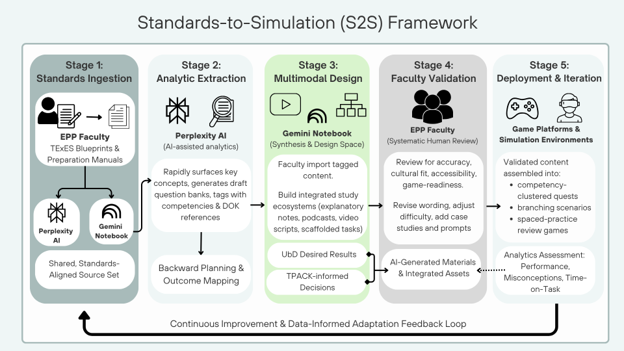
The conceptual framework outlined in this article, the S2S model, presents an approach to integrating GenAI into educator preparation that is grounded in research-based educational theories and emerging best practices for AI-augmented digital content development. Central to this approach are the principles of constructivism, which emphasizes active, learner-centered engagement (Dewey, 1910), as well as game-based learning models that leverage motivation and challenge to add depth to content knowledge acquisition (Herrmann & Drechsel, 2024; Moon et al., 2025). By combining these pedagogical foundations with the TPACK framework and standards alignment methodologies, the S2S framework shown in Figure 1 ensures both educational rigor and adaptability (Celik, 2023; Kohnke & Zou, 2025; Luckin et al., 2022; Moorhouse, 2024; Moorhouse et al., 2024).
Figure 1
S2S Framework
Understanding by Design (UbD) fits naturally into the standards‑driven S2S framework because it begins with clarifying the outcomes and evidence that matter most before selecting content or activities. A critical guiding assumption of the S2S framework is that any GenAI‑mediated tool must align directly with state and professional standards, such as those utilized in the TExES certification exams, and that these standards must be translated into clearly articulated program and course‑level outcomes (Forte, 2017; International Test Commission & Association of Test Publishers, 2025; Newell et al., 2024). In alignment with UbD, EPP faculty members first identify the big ideas and transferable understandings that underlie licensure competencies and then prioritize which of these understandings will anchor assessment and instruction, rather than allowing GenAI tools to drive coverage of decontextualized facts.
This means that AI‑generated items, simulations, and learning activities are initially mapped to desired results and acceptable evidence (i.e., specific outcomes, depth‑of‑knowledge expectations, and performance tasks) before being iteratively reviewed against licensure blueprints to ensure both content and pedagogical alignment (Forte, 2017; Newell et al., 2024). Within this backward‑planning process, GenAI platforms support efficiency by proposing draft questions, scenarios, and rubrics keyed to those outcomes, while human EPP faculty refine these outputs to preserve disciplinary accuracy and contextual relevance (see also International Test Commission & Association of Test Publishers, 2025). Framing GenAI as a standards‑aligned codesigner working within a UbD backward‑design cycle, rather than as an autonomous assessor, allows exam‑preparation games and mixed‑reality experiences to remain constructivist, learner‑centered, and explicitly focused on transferable professional competencies.
Structurally, the integrated dual‑platform model operationalizes this UbD‑informed, TPACK‑aligned approach by providing a stepwise pathway for leveraging Gemini Notebook and Perplexity AI in tandem. The process begins with EPP faculty identifying key licensure competencies and big ideas that transfer across teaching contexts. Faculty members then upload the reference documents such as Texas’ TExES exam guides, preparation manuals, and state frameworks into both platforms (Newell et al., 2024).
Perplexity AI first functions as an AI‑enhanced analyst, extracting validated information and generating competency‑tagged question banks mapped to specific standards and depth‑of‑knowledge expectations. Gemini Notebook is then used to synthesize and contextualize this content into multimodal assets (i.e., interactive study notes, explanations, assessments, podcasts, and video scripts) that can be embedded within game‑based learning environments (Moon et al., 2025). At each stage, faculty members draw on their TPACK to decide which AI outputs to retain, revise, or discard. This process ensures that materials support constructivist engagement with the content rather than rote recall (Kohnke & Zou, 2025; Luckin et al., 2022).
Within this dual‑platform S2S framework, EPP faculty members serve simultaneously as instructional designers, content validators, and K-12 practitioners who translate licensure standards into authentic classroom scenarios. AI‑generated questions, scenarios, and rubrics are iteratively reviewed through a backward‑design lens to verify that each item provides acceptable evidence of the targeted outcome as well as aligning with local curriculum expectations (Newell et al., 2024). This human‑in‑the‑loop process is consistent with guidelines for technology‑based assessment and AI‑enabled assessment design, which emphasize transparent alignment, defensible inferences, and ongoing expert oversight (International Test Commission & Association of Test Publishers, 2025).
Moving from design to practice, the S2S framework proposes concrete implementation pathways that EPPs can adapt to local structures and game‑based ecosystems. A typical workflow might involve a faculty team uploading a revised exam preparation manual to Perplexity AI to generate a competency‑tagged question bank, importing that bank into Gemini Notebook to layer in explanatory notes and multimodal reinforcements, and then deploying the validated items into digital games or simulations. Game-based platforms such as Genially and Kahoot, together with mixed-reality simulation platforms such as TeachLivE, SchoolSims, and Mursion, serve as vehicles that deliver the content created within the framework for use with students (Dalinger et al., 2020; Kinsey et al., 2024; Moon et al., 2025; Rodríguez‑Ferrer et al., 2023; Whitney et al., 2025).
Unlike current commercial systems that rely on preauthored scenarios and trained human interactors, GenAI-driven item banks and narratives can help generate or refresh scenarios more rapidly while remaining tied to licensure standards. Different cohorts can receive differentiated question sets, narrative scenarios, or mixed‑reality practice tasks based on diagnostic data from earlier game sessions. This aligns with constructivist and game‑based models that emphasize challenge, feedback, and adaptive scaffolding (Ke et al., 2016; Li et al., 2021).
Finally, documenting these implementation pathways provides institutions with a practical blueprint for scaling GenAI integration while safeguarding pedagogical integrity. Clear protocols for document ingestion, AI prompting, UbD‑style evidence checks, and TPACK‑informed validation help ensure that digital innovation enhances, rather than replaces, the irreplaceable expertise of educator‑preparation faculty (Kohnke, Zou, Ou et al., 2025; Newell et al., 2024).
Guiding Principles and Assumptions
Guiding principles and assumptions for the S2S framework blend constructivism, game‑based learning, UbD, and TPACK. Constructivist theory holds that learners build understanding by actively engaging with content, testing ideas, and making sense of new information in authentic contexts rather than passively receiving information (Dewey, 1910; Korthagen, 2016). In this model, AI‑supported game‑based resources provide those contexts by allowing preservice teachers to interact directly with exam‑aligned material, attempt problem‑solving strategies, and receive immediate feedback while working with standards‑tagged question banks and scenarios (Moon et al., 2025; Rodríguez‑Ferrer et al., 2023). As candidates replay challenges, compare explanations, and experiment with alternative responses, they construct internal models of licensure competencies through iterative cycles of exploration, reflection, and refinement. This is consistent with TPACK’s emphasis on integrating pedagogical and content knowledge within technology‑rich environments (Kohnke & Zou, 2025; Luckin et al., 2022).
Rather than emphasizing memorization, the S2S framework assumes that well-designed games and simulations cultivate higher order thinking, adaptive test-taking strategies, and professional judgment. Frequent review, varied mechanics, and competitive or collaborative elements sustain engagement and encourage learners to revisit difficult concepts from multiple angles. This approach mirrors the iterative reasoning processes of classroom practice and clinical decision-making (Cumming et al., 2025; Ke et al., 2016). Empirical work on game‑based learning and virtual simulations indicates that these interactive study experiences can increase self‑efficacy, reduce exam anxiety, and improve knowledge retention and assessment performance. These are outcomes that are especially important for high‑stakes teacher licensure exams (Herrmann & Drechsel, 2024).
A second guiding principle is that all GenAI‑supported resources must be designed through backward planning and rigorous standards alignment. Drawing on UbD principles, the S2S framework begins with clarification of desired results (e.g., licensure level big ideas and transferable understandings) before specifying acceptable evidence and planning learning experiences (Newell et al., 2024). In operational terms, this means that all AI‑generated questions, activities, and game scenarios are first mapped to explicit competencies and depth‑of‑knowledge (DOK) expectations using current preparation manuals, blueprints, and state frameworks and only then developed into multimodal assets (Forte, 2017; Newell et al., 2024).
Underpinning this backward‑design cycle is the dual‑platform model in which Perplexity AI functions as a standards‑verification and item‑generation engine, while Gemini Notebook serves as a multimodal synthesis and contextualization tool. This cycle begins with certified standards and reference documents being uploaded into both platforms. Perplexity AI produces competency‑tagged question banks and summaries, while Gemini Notebook organizes this content into integrated study guides, explanatory media, and game‑ready scripts that remain traceable back to their original standards (Moon et al., 2025).
EPP faculty members then apply their TPACK‑informed professional judgment to validate and adapt these AI drafts, ensuring disciplinary accuracy, local curricular fit, accessibility, and fairness (International Test Commission & Association of Test Publishers, 2025; Kohnke, Zou, Ou et al., 2025). This set of assumptions preserves academic integrity while ensuring that the constructivist benefits of game‑based review are consistently anchored in licensure expectations and in the expert oversight of educator‑preparation faculty.
S2S: Dual-Platform Model
The dual‑platform model translates the framework’s constructivist, UbD, and TPACK assumptions into a repeatable workflow that links licensure standards to game‑based learning experiences. In Stage 1 (standards ingestion), EPP faculty members identify priority competencies and big ideas from certification exam blueprints and preparation manuals (or comparable manuals based on state requirements. These documents are then uploaded into both Perplexity AI and Gemini Notebook, establishing a shared, standards‑aligned source set for all subsequent AI outputs. In Stage 2 (analytic extraction), Perplexity AI functions as an AI‑assisted analyst, rapidly surfacing key concepts, generating draft question banks, and tagging each item with explicit competency and DOK references that support backward planning and outcome mapping (Forte, 2017; Newell et al., 2024).
Stage 3 (multimodal design) centers on Gemini Notebook as a synthesis and design space. Here, EPP faculty members import the tagged items generated by Perplexity and use Gemini Notebook to build integrated study ecosystems. Gemini Notebook then links questions with explanatory notes, podcasts, video scripts, and scaffolded tasks that can be embedded in games and mixed‑reality simulations (Moon et al., 2025). For example, question banks and scenarios derived from state exam blueprints could be instantiated as scripted practice episodes in TeachLivE or SchoolSims, thus providing candidates with live, avatar‑mediated rehearsals of exam‑relevant dilemmas (Dalinger et al., 2020; Kinsey et al., 2024; Whitney et al., 2025).
While mixed‑reality platforms such as TeachLivE and SchoolSims typically rely on preauthored scenarios and manually curated case materials, the S2S framework differs by using a S2S pipeline and dual‑platform AI workflow. This framework, explicitly grounded in UbD and TPACK, generates and updates the simulation content directly from licensure blueprints. These assets are organized around UbD “desired results” and TPACK‑informed decisions about which technologies and representations best support particular pedagogical moves and content explanations (Kohnke & Zou, 2025).
Stage 4 (faculty validation) involves systematic human review of all AI‑generated materials for accuracy, cultural and contextual fit, accessibility, and game‑readiness. In the context of mixed‑reality platforms, this human‑in‑the‑loop process ensures that the dilemmas, student avatars, and feedback prompts candidates encounter reflect realistic classroom dynamics, community norms, and the linguistic and cultural diversity of the PK–12 learners they will serve. By refining language, calibrating difficulty, and embedding classroom case studies or guided reflection prompts, EPP faculty members transform AI‑generated items into rehearsal opportunities. In these rehearsals, preservice teachers can safely practice high‑leverage practices, receive targeted feedback, and build professional confidence before entering clinical placements. EPP faculty also revise wording, adjust difficulty, and add classroom case studies or reflection prompts so that items function as both assessment and learning opportunities. These enhanced items allow candidates to surface misconceptions, rehearse alternative responses, and connect simulation experiences back to their own values and instructional goals.
In Stage 5 (deployment and iteration), validated question sets and media packages are exported into game platforms and mixed-reality simulation environments. Here they can be assembled into competency‑clustered quests, branching scenarios, or spaced‑practice review games. Analytics from these environments (i.e., item performance, patterns of misconception, or time‑on‑task) feed back into the dual‑platform cycle, informing new rounds of Perplexity‑assisted item refinement and Gemini Notebook-based redesign. This iterative cycle operationalizes the framework’s commitment to continuous improvement and data‑informed adaptation (Cumming et al., 2025; Shute & Moore, 2017). Figure 1 depicts these five stages and the bidirectional flows between Perplexity AI, Gemini Notebook, faculty expertise, and game‑based/mixed reality simulation delivery systems. Thus, highlighting how the model keeps GenAI firmly nested within standards‑aligned, human‑guided instructional design.
Proposed Implementation Pathways
The proposed implementation pathways for the S2S framework move beyond outlining dual‑platform stages to show how GenAI can be embedded into specific UbD‑oriented, TPACK‑informed exam‑preparation sequences within EPPs. Rather than treating AI as a stand‑alone automation tool, these pathways position Perplexity AI and Gemini Notebook as a coordinated, standards‑based support system that helps faculty enact backward design at scale across actual courses and cohorts (Newell et al., 2024). EPP teams begin by setting local protocols for ingesting licensure blueprints, preparation manuals, and program outcomes into both platforms so that every AI‑generated question, scenario, and media asset is traceable to validated reference materials and program priorities.
This explicit alignment enables faculty members to revise or expand competency‑tagged item banks whenever exam specifications change, while maintaining the UbD cycle of clarifying desired results, determining acceptable evidence, and planning learning experiences visible at each step. At the program level, teams formalize a small set of checkpoints (i.e., document ingestion, AI‑assisted synthesis and mapping, faculty validation, and integration into game‑based platforms) so that TPACK decisions remain intertwined in line with the TPACK framework (Kohnke & Zou, 2025). By specifying who leads each checkpoint and when it occurs within the semester calendar, these pathways extend the conceptual dual‑platform model into a repeatable governance structure that can be adapted to different exams, courses, and cohorts.
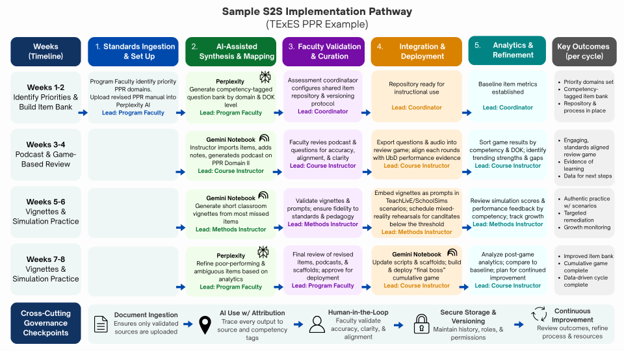
University EPPs can then adapt these pathways to local curricular calendars and instructional priorities while preserving their constructivist intent. Consider a cohort of preservice teachers enrolled in a Texas TExES Pedagogy and Professional Responsibilities (PPR) review seminar during the eight weeks leading up to TExES licensure testing. In Weeks 1-2, program faculty members identify priority PPR domains and upload the revised PPR manual into Perplexity AI. Faculty members then utilize Perplexity to generate a competency‑tagged question bank organized by domain and DOK level while an assessment coordinator configures a shared item repository and versioning protocol.
During Weeks 3-4, the course instructor pulls a subset of these items into Gemini Notebook, adds explanatory notes, and generates a 10‑minute podcast episode focused on “Domain II- Creating a Positive, Productive Classroom Environment.” Faculty members then export the questions and audio into a Genially or Kahoot review game, aligning each game round with specific UbD performance evidence (e.g., requiring candidates to justify why a particular option best reflects inclusive practice). In Weeks 5-6, a methods instructor selects the most frequently missed items and uses Gemini Notebook to draft short classroom vignettes that are embedded as prompts in TeachLivE or SchoolSims scenarios. Additional mixed‑reality rehearsals can be scheduled for candidates whose game scores fall below the threshold in targeted domains.
Finally, in Weeks 7-8, Perplexity AI is reused to refine poorly performing items (such as ambiguous questions) based on analytics from the game and simulation environments. Simultaneously, Gemini Notebook updates scripts and scaffolds for a culminating “final boss” cumulative game, ensuring that the evolving item bank remains standards‑aligned and responsive to cohort needs. Because this vignette traces roles, tools, and decisions across a concrete course timeline, it illustrates how the S2S pathways operate in practice and distinguishes the section from the more abstract description of the dual‑platform model stages.
This iterative cycle provides preservice teachers opportunities to test ideas, receive feedback, and revisit challenging concepts through repeated, game‑based practice (Cumming et al., 2025; Herrmann & Drechsel, 2024). Cohorts can receive differentiated item sets, game formats, or remediation quests based on performance data emerging from these environments, with Perplexity AI reused to refine ambiguous items and Gemini Notebook updated to adjust scaffolds for subsequent sessions. In this way, AI‑supported resources scaffold individual learning trajectories in ways that static review manuals cannot, while keeping human instructors firmly in control of instructional intent, assessment quality, and the constructivist goals of the S2S framework.
Figure 2 translates these implementation pathways into a sample implementation pathway that visualizes how standards ingestion, dual‑platform content design, faculty validation, and game‑based deployment unfold across an exam‑preparation cycle within an EPP. Whereas Figure 1 depicts the conceptual five‑stage S2S model and the bidirectional flows between GenAI, faculty expertise, and delivery systems, Figure 2 focuses on the concrete sequencing of tasks, roles, and decision points for a typical cohort. Together, the two figures highlight the distinction between the frameworks underlying design logic and the pragmatic pathways through which EPPs can adapt the model to local calendars, licensure exams, and game or simulation platforms.
Figure 2
Sample S2S Implementation Pathway: TExES PPR Example
Anticipated Outcomes and Implications
For EPP faculty members, the adoption of the S2S framework reframes exam‑preparation work as a TPACK‑driven design challenge rather than a purely production task. By delegating much of the initial question generation, standards tagging, and media drafting to Gemini Notebook and Perplexity AI, EPP teams can devote more time to interpreting data, curating exemplars, and designing UbD‑aligned performance evidence that reflects authentic teaching practice (Kohnke & Zou, 2025; Newell et al., 2024). Studies of GenAI use in higher education indicate that instructors who integrate AI into their planning workflows report greater efficiency and capacity for iterative refinement of assessment banks and learning activities (Kohnke & Zou, 2025; McNeill et al., 2024). This was found to be particularly true when standards and outcomes are explicitly modeled within the tools. Within the S2S framework, faculty expertise is redirected toward high‑leverage decisions (i.e., selecting which competencies to foreground in games, determining appropriate levels of cognitive demand, and crafting debrief prompts that help candidates connect gameplay to real classroom scenarios), thereby supporting scalability without diluting pedagogical intentionality.
For preservice teachers, the primary benefit lies in how the dual‑platform model operationalizes constructivist and UbD principles through game‑based interactions. Instead of encountering exam content as static lists of facts, candidates engage with clusters of questions, multimodal explanations, and simulations that are all explicitly tied to clearly articulated big ideas and transferable understandings (Korthagen, 2016; Newell et al., 2024). As they navigate AI-generated, faculty-validated games, learners test hypotheses, receive rapid feedback, and revisit misconceptions across multiple contexts, which supports deeper conceptual change and adaptive test‑taking strategies (Cumming et al., 2025; Moon et al., 2025). Performance data from these environments can be used to personalize follow‑up tasks (e.g., assigning targeted quests, reflection prompts, or microlessons aligned to specific competencies), thereby extending gameplay into structured self‑assessment and metacognitive practice consistent with constructivist views of learner agency.
At the same time, the S2S framework acknowledges limitations and risks that must be addressed through intentional design. Because GenAI systems can misinterpret standards language or generate superficially plausible but inaccurate items, all outputs require systematic human checking for factual accuracy, alignment to local curricula, and sensitivity to candidate diversity (International Test Commission & Association of Test Publishers, 2025). There is also a danger that richly scaffolded AI‑supported environments could encourage overreliance if candidates are not asked to critique AI‑generated explanations, compare multiple solution paths, or design their own items and scenarios. To mitigate these risks, the framework treats AI outputs as provisional drafts and embeds opportunities for candidates to interrogate, revise, and extend materials, turning GenAI into an object of critical inquiry that supports, rather than replaces, professional judgment (Kohnke, Zou, Ou et al., 2025).
When these safeguards are in place, the S2S framework offers EPPs a way to couple the efficiency of scalable AI production with the depth of UbD‑guided curriculum design and the rich engagement of constructivist, game‑based learning. Programs can modernize their exam‑preparation ecosystems, redirect faculty time toward coaching and conceptual clarification, and provide candidates with repeated, meaningful practice that mirrors the decision‑making demands of real classrooms (Herrmann & Drechsel, 2024; Moon et al., 2025). Ultimately, the model aims not only to improve pass rates on licensure exams, but to cultivate reflective, adaptable early career teachers whose assessment literacy and AI fluency prepare them to design similarly rigorous, engaging learning experiences for their own students.
Best Practices and Recommendations
Drawing on the preceding framework and platform analyses, several practices can guide responsible adoption of the S2S framework in educator preparation programs (EPPs). First, programs should formalize UbD‑aligned standards protocols: faculty collaboratively identify priority competencies and big ideas, then upload the associated blueprints, preparation manuals, and outcome statements into both Gemini Notebook and Perplexity AI to establish a shared source of truth for all AI‑generated materials (Newell et al., 2024). Clear tagging conventions and routine cross‑checks against these documents help ensure that game items, simulations, and study artifacts remain tightly linked to intended outcomes and DOK expectations, rather than drifting toward convenience‑driven content (Forte, 2017).
A second recommendation is to institutionalize robust human‑in‑the‑loop validation structures that leverage faculty TPACK. AI‑generated question banks, podcasts, and interactive notes should pass through systematic review cycles in which content experts, methods instructors, and educational technologists jointly vet accuracy, cognitive demand, accessibility, and cultural responsiveness (Kohnke & Zou, 2025). Programs can operationalize this by designating review committees, developing rubrics for construct alignment and item quality, and scheduling periodic spot audits of game assets. Feedback from preservice teachers’ gameplay and performance data should feed directly into these cycles to support continuous improvement and responsive remediation (International Test Commission & Association of Test Publishers, 2025).
Logistical and ethical safeguards form a foundational element of best practice. Because the model relies on large volumes of standards documents and learner interaction data, EPPs must ensure copyright compliance for uploaded materials, implement secure data‑handling procedures for gameplay analytics, and maintain audit trails that allow every game item to be traced back to its originating standard or source passage. Explicit policies on bias monitoring, explainability of AI‑generated recommendations, and accommodations for candidates with diverse needs help prevent inequitable or opaque uses of GenAI in assessment (McNeill et al., 2024). At the same time, institutions should invest in sustained faculty development that treats AI tools as objects of inquiry, supporting instructors to design prompts, critique outputs, and model critical AI literacy for candidates, rather than adopting a purely technical training approach (Kohnke, Zou, Ou et al., 2025).
Finally, future research and implementation efforts should mirror the framework’s emphasis on iterative, evidence‑based refinement. Multisite and longitudinal studies can examine how different configurations of the S2S framework influence exam outcomes, self‑efficacy, and transfer of learning to clinical and classroom practica with particular attention to diverse candidate groups (Cumming et al., 2025; Moon et al., 2025). Explorations of tighter integration between the dual‑platform workflow, learning analytics dashboards, and adaptive feedback engines could further enhance personalization, provided they remain anchored in equity‑focused design and transparent standards alignment. Collectively, these recommendations position GenAI not as a shortcut to exam success, but as a carefully governed partner in cultivating reflective, assessment‑literate beginning teachers.
Conclusion
The S2S conceptual framework positions GenAI not as a shortcut to licensure success, but as an engine for UbD‑aligned, TPACK‑informed, constructivist learning within a game-based learning environment. By orchestrating standards ingestion, dual‑platform content design, human‑in‑the‑loop validation, and game‑based delivery, the S2S framework illustrates how faculty can shift from primarily producing static materials to curating dynamic learning ecosystems, using their expertise to coach, interpret data, and design rich opportunities for transfer rather than simply deliver information. The integrated use of Gemini Notebook and Perplexity AI makes it feasible to refresh question banks, scenarios, and multimodal resources in step with changing licensure expectations while maintaining clear audit trails to the underlying competencies and source documents (Forte, 2017).
Anticipated benefits span both faculty and candidates. For instructors, the framework offers scalable workflows that free time for high‑value tasks such as diagnostic analysis, targeted remediation, and mentoring around assessment literacy and AI ethics (Kohnke & Zou, 2025). For preservice teachers, AI‑supported games and simulations operationalize the guiding principles by providing repeated, feedback‑rich encounters with standards‑aligned problems that demand reasoning, reflection, and application across contexts. Thereby supporting confidence, reducing anxiety, and strengthening exam performance (Cumming et al., 2025; Moon et al., 2025). When combined with careful attention to equity and accessibility, these design choices can help broaden access to high‑quality preparation pathways, particularly for nontraditional or geographically dispersed candidates.
At the same time, the framework underscores that meaningful AI integration depends on disciplined governance: explicit standards protocols, ongoing faculty review, safeguards for privacy and bias, and a commitment to treating AI outputs as drafts that require professional judgment rather than as authoritative answers (International Test Commission & Association of Test Publishers, 2025; Kasneci et al., 2023). Future investigations should examine how different configurations of the S2S framework influence long‑term teacher learning, classroom practice, and equity outcomes, ensuring that technological innovation remains accountable to the core purposes of educator preparation. If enacted with this spirit of critical iterative inquiry, the S2S framework can help cultivate a new generation of teachers who are not only better prepared for licensure exams, but also equipped to harness and question AI in ways that advance engaging learning for their own students.
References
Alharthi, S. A. (2025). Generative AI in game design: Enhancing creativity or constraining innovation? Journal of Intelligence, 13(60). https://doi.org/10.3390/jintelligence13060060
Alserhan, S., Alqahtani, T. M., Yahaya, N., Al-Rahmi, W. M., & Abuhassna, H. (2023). Personal learning environments: Modeling students’ self-regulation enhancement through a learning management system platform. IEEE Access, 11, 5464–5482. https://doi.org/10.1109/ACCESS.2023.3236504
Amarilli, F., & Timakova, O. (2024). An exploratory study on the role of generative AI in designing educational board games. Proceedings of the 4th International Conference on AI Research. https://doi.org/10.34190/icair.4.1.3081
Backers, L., De Smedt, F., & Van Keer, H. (2024). Teachers as agents of self-regulated learning (SRL): Studying the relations between teachers’ knowledge, beliefs, and SRL implementation across educational levels. UNTERRICHTSWISSENSCHAFT, 52, 15–38. https://doi.org/10.1007/s42010-023-00190-1
Celik, I. (2023). Towards intelligent-TPACK: An empirical study on teachers’ professional knowledge to ethically integrate artificial intelligence (AI)-based tools into education. Computers in Human Behavior, 138, Article 107468. https://doi.org/10.1016/j.chb.2022.107468
Chai, C. S., Koh, J. K. L., & Tsai, C. C. (2013). A review of technological pedagogical content knowledge. Educational Technology & Society, 16(2), 31–51. http://www.jstor.org/stable/jeductechsoci.16.2.31
Chiu, T. K. F. (2024). A classification tool to foster self-regulated learning with generative artificial intelligence by applying self-determination theory: A case of ChatGPT. Educational Technology Research and Development, 72, 2401–2416. https://doi.org/10.1007/s11423-024-10366-w
Clark, S., & Newberry, M. (2019). Are we building preservice teacher self-efficacy? A large-scale study examining teacher education experiences. Asia-Pacific Journal of Teacher Education, 47, 32–47. https://doi.org/10.1080/1359866X.2018.1497772
Cochran-Smith, M., Carney, M. C., Keefe, E. S., Burton, S., Chang, W.-C., Fernández, M. B., Miller, A. F., Sánchez, J. G., & Baker, M. (2018). Reclaiming accountability in teacher education. Teachers College Press.
Cullen, T. A., & Greene, B. A. (2011). Preservice teachers’ beliefs, attitudes, and motivation about technology integration. Journal of Educational Computing Research, 45(1), 29–47. https://doi.org/10.2190/EC.45.1.B
Cumming, T. M., Lee, H. M., & Hoenig, J. (2025). Using mixed reality simulations to prepare preservice teachers for inclusive classroom management. Australasian Journal of Special and Inclusive Education, 49(2), 126–137. https://doi.org/10.1017/jsi.2025.10005
Dalinger, T., Thomas, K. B., Stansberry, S., & Xiu, Y. (2020). A mixed reality simulation offers strategic practice for pre-service teachers. Computers and Education, 144, 103696. https://doi.org/10.1016/j.compedu.2019.103696
Darling-Hammond, L., Hyler, M. E., & Gardner, M. (2017). Effective teacher professional development. Learning Policy Institute. https://learningpolicyinstitute.org/sites/default/files/product-files/Effective_Teacher_Professional_Development_REPORT.pdf
Dewey, J. (1910). How we think. D.C. Health & Co.
Ding, A-C. E., Shi, L., Yang, H., & Choi, I. (2024). Enhancing teacher AI literacy and integration through different types of cases in teacher professional development. Computers and Education Open, 6, Article 100178. https://doi.org/10.1016/j.caeo.2024.100178
Essa, S. G., Celik, T., & Human-Hendricks, N. E. (2023). Personalized adaptive learning technologies based on machine learning techniques to identify learning styles: A systematic literature review. IEEE Access, 11, 48392–48409. https://doi.org/10.1109/ACCESS.2023.3276439
Florell, D. (2025). Supercharging productivity with Google’s NotebookLM: Google’s NotebookLM is an AI-powered assistant with a variety of features that can help you tackle your caseload this school year. Communique, 54(1), 7. https://link.gale.com/apps/doc/A854117955/AONE?u=anon~9510a1d2&sid=googleScholar&xid=2ab4e1eb
Forte, E. (2017). Evaluating alignment in large-scale standards-based assessment systems [White paper]. Council of Chief State School Officers. https://edcount.com/wp-content/uploads/2019/05/ccsso_tilsa_forte_evaluating_alignment_2017.pdf
Goldhaber, D. (2025). Teacher licensure. In D. Harris (Ed.), Live handbook of education policy research. Association for Education Finance and Policy. https://livehandbook.org/k-12-education/workforce-teachers/teacher-licensure/
Goldhaber et al., 2017;
Herrmann, C., & Drechsel, B. (2024). Virtual gaming simulation (VGS) in teacher education: Fostering counseling competencies in preservice teachers. Psychology Learning & Teaching, 23(3), 405–415. https://doi.org/10.1177/14757257241270636
International Test Commission & Association of Test Publishers. (2025). Guidelines for technology-based assessment. Association of Test Publishers. https://www.intestcom.org/upload/media-library/tba-guidelines-ver-11-july-2025-1754044782Z3vV9.pdf
Jeong, Y., Lee, Y., Byun, G., & Moon, J. (2024). Navigating the creation of immersive learning environments in Roblox: Integrating generative AI for enhanced simulation-based learning. Immersive Learning Research – Practitioner, 1(1), 16–19. https://doi.org/10.56198/5M1RHT9ZJ
Kaplan‐Rakowski, R., & Gruber, A. (2024). An experimental study on reading in high‐immersion virtual reality. British Journal of Educational Technology, 55(2), 541–559. https://doi.org/10.1111/bjet.13392
Karlen, Y., Hirt, C. N., Jud, J., Rosenthal, A., & Eberli, T. D. (2023). Teachers as learners and agents of self-regulated learning: The importance of different teachers’ competence aspects for promoting metacognition. Teaching and Teacher Education, 125, Article 104055. https://doi.org/10.1016/j.tate.2023.104055
Kasneci, E., Sessler, K., Küchemann, S., Bannert, M., Dementieva, D., Fischer, F., Gasser, U., Groh, G., Günnemann, S., Hüllermeier, E., Krusche, S., Kutyniok, G., Michaeli, T., Nerdel, C., Pfeffer, J., Poquet, O., Sailer, M., Schmidt, A., Seidel, T., … Kasneci, G. (2023). ChatGPT for good? On opportunities and challenges of large language models for education. Learning and Individual Differences, 103, 102274. https://doi.org/10.1016/j.lindif.2023.102274
Ke, F., Xie, K., & Xie, Y. (2016). Game-based learning engagement: A theory‐and data‐driven exploration. British Journal of Educational Technology, 47(6), 1183–1201. https://doi.org/10.1111/bjet.12314
Kinsey, D., Mikeska, J. N., Howell, H., & Bharaj, P. K. (2024). Examining the connection between preservice teachers’ discussion performance in a mixed reality teaching simulation with their self-reported goals and success in facilitating discussions. Computers & Education X Reality, 5, 100071. https://doi.org/10.1016/j.cexr.2024.100071
Koh, J. H. L., Chai, C. S., & Tay, L. Y. (2014). TPACK-in-Action: Unpacking the contextual influences of teachers’ construction of technological pedagogical content knowledge (TPACK). Computers & Education, 78, 20–29. https://doi.org/10.1016/j.compedu.2014.04.022
Kohnke, L., Foung, D., & Zou, D. (2024). Microlearning: A new normal for flexible teacher professional development in online and blended learning. Educational and Information Technologies, 29, 4457–4480. https://doi.org/10.1007/s10639-023-11964-6
Kohnke, L., Foung, D., Zou, D., & Jiang, M. (2024). Creating the conditions for professional digital competence through microlearning. Educational Technology & Society, 27(1), 183–197. https://doi.org/10.30191/ETS.202401_27(1).SP05
Kohnke, L., Moorhouse, B. L., & Zou, D. (2023). ChatGPT for language teaching and learning. RELC Journal, 54(2), 537–550. https://doi.org/10.1177/00336882231162868
Kohnke, L., & Zou, D. (2025). Artificial intelligence integration in TESOL teacher education: Promoting a critical lens guided by TPACK and SAMR. TESOL Quarterly, 59(3). https://doi.org/10.1002/tesq.3396
Kohnke, L., Zou, D., Ou, A. W., & Gu, M. M. (2025). Preparing future educators for AI-enhanced classrooms: Insights into AI literacy and integration. Computers and Education: Artificial Intelligence, 8, 100398. https://doi.org/10.1016/j.caeai.2025.100398
Kohnke, L., Zou, D., & Xie, H. (2025). Microlearning and generative AI for pre-service teacher education: a qualitative case study. Education and Information Technologies, 30(15), 21221–21248. https://doi.org/10.1007/s10639-025-13606-5
Korthagen, F. A. J. (2016). Pedagogy of teacher education. In J. Loughran & M. L. Hamilton (Eds.), International handbook of teacher education (Vol. 1, pp. 311–346). Springer. https://doi.org/10.1007/978-981-10-0366-0_8
Lachner, A., Armin Fabian, A., Franke, U., Preiß, J., Jacob, L., Führer, C., Küchler, U., Paravicini, W., Randler, C., & Thomas, P. (2021). Fostering pre-service teachers’ technological pedagogical content knowledge (TPACK): A quasi-experimental field study. Computers & Education, 174, 104304. https://doi.org/10.1016/j.compedu.2021.104304
Li, F., He, Y., & Xue, Q. (2021). Progress, challenges and countermeasures of adaptive learning: A systematic review. Educational Technology & Society, 24(3), 238–255. https://www.jstor.org/stable/27032868
Loughran, J. (2019). Deconstructing teacher education: Challenges and opportunities for professional knowledge. Asia-Pacific Journal of Teacher Education, 47(5), 494–508. https://doi.org/10.1080/1359866X.2019.1670409
Luckin, R., Cukurova, M., Kent, C., & du Boulay, B. (2022). Empowering educators to be AI-ready. Computers and Education: Artificial Intelligence, 3, Article 100076. https://doi.org/10.1016/j.caeai.2022.100076
McKee, L., Read, S., & Rickey, D. (Eds.). (2024). Using data for continuous improvement in educator preparation. Myers Education Press.
McNeill, L., Uddin, M. M., Pei, M., & Regalado, L. (2024). Generative AI in instructional design: Adoption, benefits, and best practices. Journal of Applied Instructional Design, 14(3), 108–135. https://doi.org/10.59668/2223.22720
Miranda, S. (2025). Artificial intelligence from Google environment for effective learning assessment. Information, 16(6), 462. https://doi.org/10.3390/info16060462
Mishra, P., & Koehler, M. J. (2006). Technological pedagogical content knowledge: A framework for teacher knowledge. Teachers College Record, 108(6), 1017–1054. https://doi.org/10.1111/j.14679620.2006.00684.x
Moon, J., Lee, U., Koh, J., Jeong, Y., Lee, Y., Byun, G., & Lim, J. (2025). Generative artificial intelligence in educational game design: Nuanced challenges, design implications, and future research. Technology, Knowledge and Learning, 30(1), 447–459. https://doi.org/10.1007/s10758-024-09756-z
Moorhouse, B. L. (2024). Generative artificial intelligence in ELT. ELT Journal, 78(4), 378–392. https://doi.org/10.1093/elt/ccae032
Moorhouse, B. L., & Kohnke, L. (2024). The effects of generative AI on initial language teacher education: The perceptions of teacher educators. System, 122, 103290. https://doi.org/10.1016/j.system.2024.103290
Moorhouse, B. L., Wan, Y., Wu, C., Kohnke, L., Ho, T. Y., & Kwong, T. (2024). Developing language teachers’ professional generative AI competence: An intervention study in an initial language teacher education course. System, 125, 103399. https://doi.org/10.1016/j.system.2024.103399
Mouza, C., Karchmer-Klein, R., Nandakumar, R., Ozden, S. Y., & Hu, L. (2014). Investigating the impact of integrated approach to the development of preservice teachers’ technological pedagogical content knowledge (TPACK). Computers & Education, 71, 206–221. https://doi.org/10.1016/j.compedu.2013.09.020
National Association of State Directors of Teacher Education and Certification. (2025). The NASDTEC interstate agreement for educator licensure. https://www.nasdtec.net/page/Interstate
National Research Council. (2001). Testing teacher candidates: The role of licensure tests in improving teacher quality. The National Academies Press. https://doi.org/10.17226/10090
Newell, A. D., Foldes, C. A., Haddock, A. J., Ismail, N., & Moreno, N. P. (2024). Twelve tips for using the understanding by design curriculum planning framework. Medical Teacher, 46(1), 34–39. https://doi.org/10.1080/0142159X.2023.2224498
Ngao, A. I., Sang, G., & Kihwele, J. E. (2022). Understanding teacher educators’ perceptions and practices about ICT integration in teacher education program. Education Sciences, 12(8), Article 549. https://doi.org/10.3390/educsci12080549
Ngu, P.-C., Chien, C.-C., Ho, Y.-T., & Hou, H.-T. (2025). A generative AI educational game framework with multi-scaffolding supports workplace competency development. Computers & Education, 239, Article 105421. https://doi.org/10.1016/j.compedu.2025.105421
Nygren, T., Samuelsson, M., Hansson, P.-O., Efimova, E., & Bachelder, S. (2025). AI versus human feedback in mixed reality simulations: Comparing LLM and expert mentoring in preservice teacher education on controversial issues. International Journal of Artificial Intelligence in Education, 35(5), 2856–2888. https://doi.org/10.1007/s40593-025-00484-8
Ortube, A. F., Panadero, E., & Dignath, C. (2024). Self-regulated learning interventions for pre-service teachers: A systematic review. Educational Psychology Review, 36(113). https://doi.org/10.1007/s10648-024-09919-5
Pack, A., & Maloney, J. (2023). Using artificial intelligence in TESOL: Some ethical and pedagogical considerations. TESOL Quarterly, 58(2), 1007–1018. https://doi.org/10.1002/tesq.3320
Panadero, E. (2017). A review of self-regulated learning: Six models and four directions for research. Frontiers in Psychology, 8, Article 422. https://doi.org/10.3389/fpsyg.2017.00422
Park, M., & Son, J.-B. (2022). Pre-service EFL teachers’ readiness in computer-assisted language learning and teaching. Asia Pacific Journal of Education, 42(2), 320–334. https://doi.org/10.1080/02188791.2020.1815649
Peck, C. A., Gallucci, C., & Sloan, T. (2010). Negotiating implementation of high-stakes performance assessment policies in teacher education: From compliance to inquiry. Journal of Teacher Education, 61(5), 451–463. https://doi.org/10.1177/0022487109354520
Popenici, S. A. D., & Kerr, S. (2017). Exploring the impact of artificial intelligence on teaching and learning in higher education. Research and Practice in Technology Enhanced Learning, 12, Article 22, https://doi.org/10.1186/s41039-017-0062-8
Reinhardt, K. S., & Elwood, S. (2019). Promising practices in online training and support: Microlearning and personal learning environments to promote a growth mindset in learners. In J. Keengwe (Ed.), Handbook of research on virtual training and mentoring of online instructors (pp. 298–310). IGI Global. https://doi.org/10.4018/978-1-5225-6322-8.ch013
Rinko, S. (2024). Perplexity AI vs ChatGPT (2024): AI app comparison. eWeek. https://www.eweek.com/artificial-intelligence/perplexity-ai-vs-chat-gpt/
Rodríguez-Ferrer, J. M., Manzano-León, A., & Aguilar-Parra, J. M. (2023). Game-based learning and service-learning to teach inclusive education in higher education. International Journal of Environmental Research and Public Health, 20(4), 3285. https://doi.org/10.3390/ijerph20043285
Shute, V. J., & Moore, G. R. (2017). Consistency and validity in game-based stealth assessment. In D. Ifenthaler & Y.-K. Baek (Eds.), Technology enhanced innovative assessment: Development, modeling, and scoring from an interdisciplinary perspective (pp. 31–51). Information Age Publishing. https://doi.org/10.1108/978-1-68123-931-620251003
Starkey, L. (2020). A review of research exploring teacher preparation for the digital age. Cambridge Journal of Education, 50(1), 37–56. https://doi.org/10.1080/0305764X.2019.1625867
Sui, N., & Hess, G. (2024). Comparing perplexity AI and ChatGPT: A faculty perspective. Office for Faculty Excellence. https://provost.ncsu.edu/ofe/2024/09/11/comparing-perplexity-ai-and-chatg pt-a-faculty-perspective/
Ulla, M. B., Perales, W. F., & Busbus, S. O. (2023). ‘To generate or stop generating response’: Exploring EFL teachers’ perspectives on ChatGPT in English language teaching in Thailand. Learning: Research and Practice, 9(2), 168–182. https://doi.org/10.1080/23735082.2023.2257252
Whitney, T., Cooper, J. T., & Snider, K. (2025). A comparison of role-play vs. mixed-reality simulation on pre-service teachers’ behavior management practices. Journal of Special Education Technology, 40(1), 28–38. https://doi.org/10.1177/01626434241257225
Xie, H., Chu, H. C., Hwang, G. J., & Wang, C. C. (2019). Trends and development in technology-enhanced adaptive/personalized learning: A systematic review of journal publications from 2007 to 2017. Computers & Education, 140, Article 103599. https://doi.org/10.1016/j.compedu.2019.103599
Yeo, M. A., Moorhouse, B. L., & Wan, Y. (2025). From academic text to talk-show: Deepening engagement and understanding with Google NotebookLM. Teaching English as a Second Language Electronic Journal, 28(4). https://doi.org/10.55593/ej.28112int1
Zeichner, K. (2010). Rethinking the connections between campus courses and field experiences in college- and university-based teacher education. Journal of Teacher Education, 61(1–2), 89–99. https://doi.org/10.1177/0022487109347671
